Using this time of self-isolation at home I thought I would spend some time writing up some of the inspirational and interesting stories told to me by fascinating characters I have met over my decades in Asia. Some of these stories are covered in my three life story books on South East Asia and India and some have been told to me by elderly Myanmar citizens for my Myanmar Oral History Podcast.
About 20 years ago I thought it would be a good idea to do a book on the life stories of the then Presidents and Prime Ministers of South East Asia. Combining such an endeavour with my “day job” meant I moved much slower than professional writers. This proved to be a big downside as several of the people I interviewed lost their role as leader before I completed the book and I decided to abandon the project as I figured not many people would be interested in reading a book on immediate past Presidents and Prime Ministers. There is only one leader who was a leader in 2000 and is still a leader now and that is Prime Minister Hun Sen of Cambodia. However there is, of course, Tun Mahathir bin Mohamad of Malaysia who lost his Prime Ministership in 2003 but surprisingly came back to lead the country again from 2018 until a few months ago.
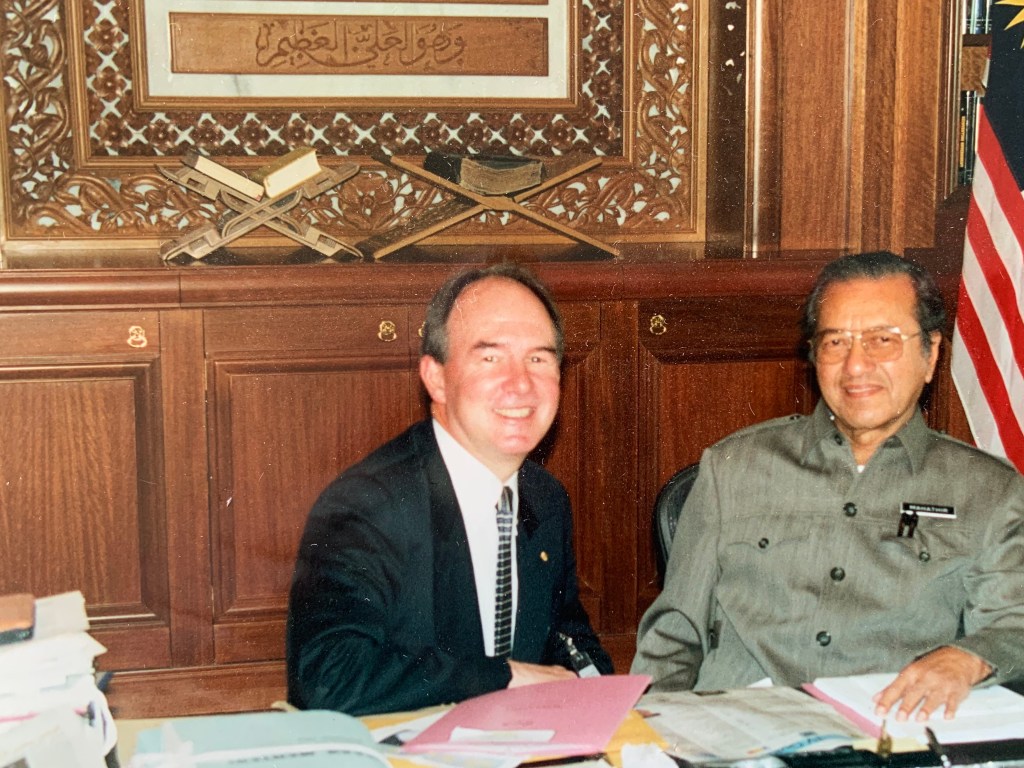
Most of my story today will be about Prime Minister Hun Sen but I thought you might find one part of my meeting with Mahathir of interest. Anyone who can come back as Prime Minister at the age of 93 – he was born in 1925 – has to be exceptional. Through media coverage, many of you would have heard him speak in the last couple of years and would not only have been impressed with his mind, but also his physical well-being. When I interviewed him for my aborted book project, he would have been a mere 75. Much of my interview was taken up in going through his many achievements over those years and I knew well that he is someone who makes every minute of every day count. He is the sort of person who on a short 30-minute flight within Malaysia can write articles or sections of the many books he has written. He is also a gifted orator. I have been present in an auditorium full of young students and, within minutes, he has them all “eating out of his hand” and prepared to do whatever he asks of them. My meeting took place in the Prime Minister’s office in Putrajaya, the administrative capital of Malaysia just outside Kuala Lumpur. It is an enormous office (bigger than any other I have seen) and I would say the width of his desk is at least 2 1/2 meters so I could not see anything on his side of the desk. At the end of my meeting I asked the Prime Minister if he would mind if I had a photo with him to which he kindly agreed. I went around to his side of the desk and, for some reason, the Prime Minister decided to stay seated so I decided to kneel on the floor so I would be about the same height as him which you can see in the attached photo. After the photo was taken, I could not help but look down at the papers he had in front of him and noted to my surprise he had the newspaper or some other guide open as to what was on TV that evening. I burst out laughing and said, “Mr Prime Minister, I am pleased to see that you are not all work and no play.” I am pleased to say he too laughed.
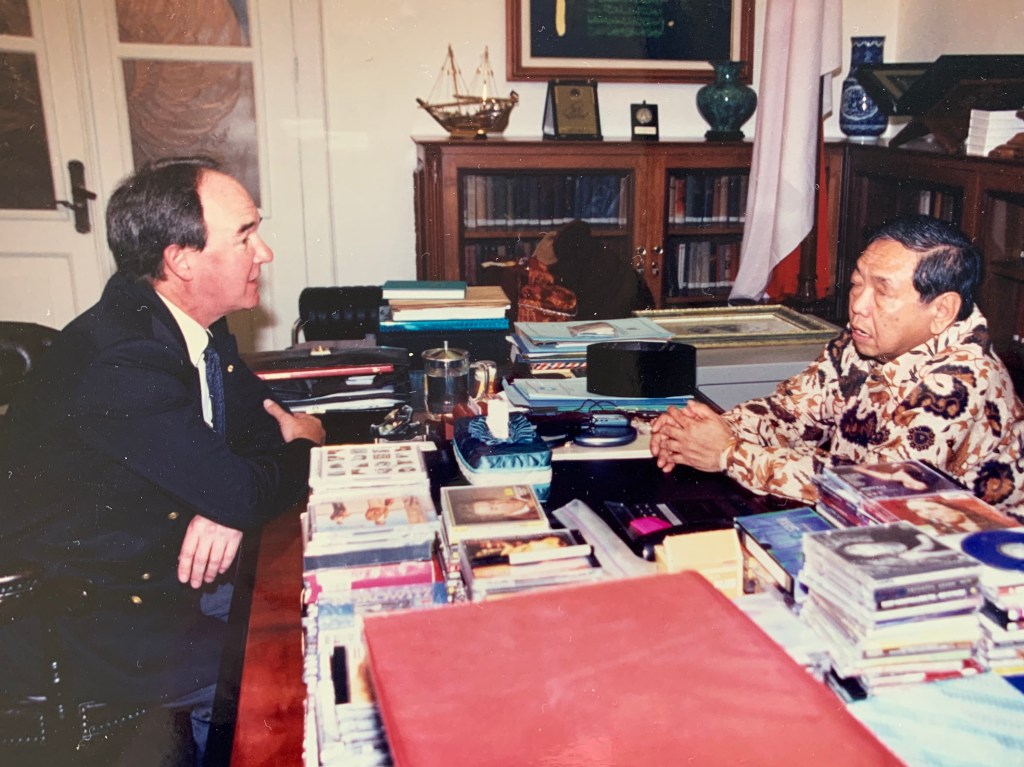
I also had the pleasure of interviewing President Abdurrahman Wahid of Indonesia. As some of you would know he was almost blind and was known to the world by his nick name “Gus Dur” which derives from “bagus” meaning “good” and an abbreviation of his family name. I met him several times before he became President and I always found him to be a humble and kind man. I have attached a photo of my meeting with him and, if you look closely, you will see many music CD covers as he used to listen to music a lot between meetings and rely more on oral briefings as his eyesight was so poor.
This leads me to my story of my meeting with Prime Minister Hun Sen. There are many stories which flow from the meeting but there is only space in this short note for one. Often, but not always, there will be a pre meeting with the Prime Minister’s or President’s staff at which they will cover things they feel you should know. This one was different to any other I have had. The first thing they told me was to be aware the Prime Minister had quite a temper and there could be no telling whether I would be with him for 5 minutes or 2 hours so to be prepared for anything. The second thing they told me was under no circumstances to ask him about his glass eye.
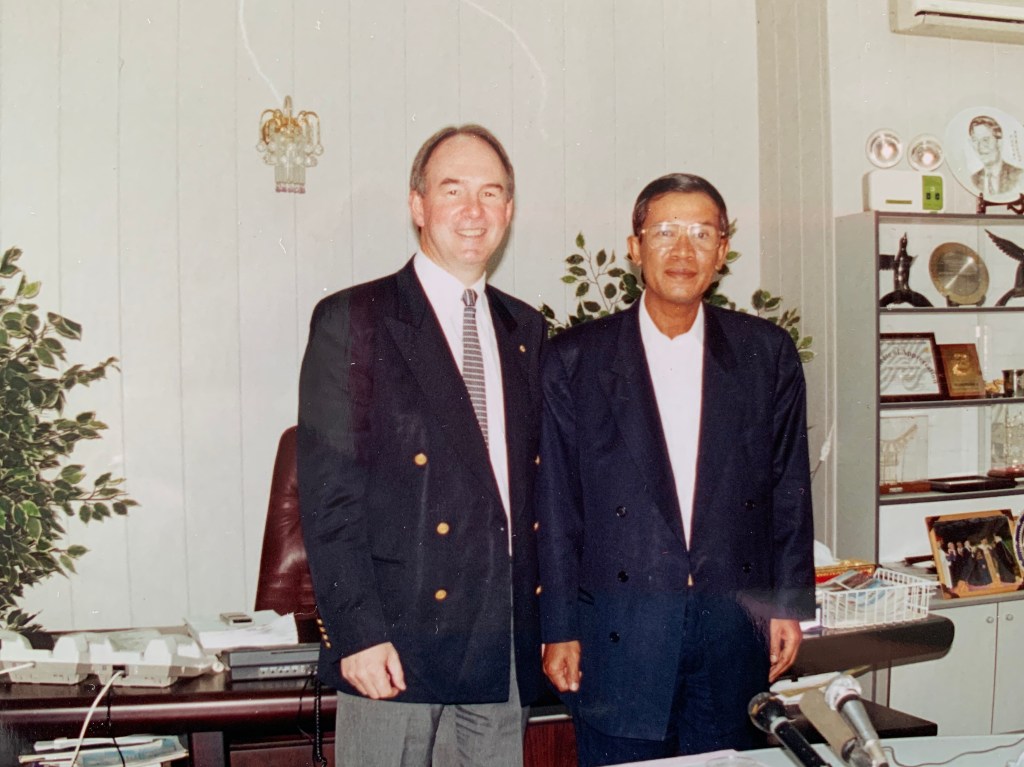
And so, into the meeting I went – see photo. It started off being in Khmer, the national language. This meant we had a translator translating my questions and his answers. Understandably this really slows things down and makes the whole conversation quite stilted. I knew a few things about Hun Sen, including that he loved playing golf and that he spoke quite reasonable English. I turned the conversation to golf, and he became quite animated and pulled out his membership cards of a golf club in Paris and one in Phnom Penh. Not surprisingly the local club gave him an extremely high handicap (meaning he would be difficult to beat in Phnom Penh – and who wants to beat a Prime Minister anyway) whereas the Paris one gave him a much lower handicap. He thought the French were most unfair.
As the conversation was going well, I asked him if we could switch to English to which he agreed. We chatted on happily for another half an hour or so and I had pretty much everything I needed and decided to take a big risk and asked him “What is the story about your glass eye?” I could feel his Khmer advisers literally tense up and I prepared for the meeting to come to a very abrupt end. However, he must have been in an extremely good mood for he responded immediately “Let me tell you what happened.”
Hun Sen was part of the murderous Khmer Rouge army but fled to Vietnam along with some of his men in 1977 when he could see how the Khmer Rouge leaders were starting to turn on each other and he knew he was at risk of being killed himself. He realised that only the Vietnamese had the strategic interest and power to defeat the Khmer Rouge which they ultimately did on 7 January 1979. That same day Hun Sen was appointed Foreign Minister by the Kampuchean People’s Revolutionary Council which took control. The rest, as they say is history, and he has been de facto head of the Cambodia since 1985.
But back to 16 April 1975, the night before the Khmer Rouge captured Phnom Penh and forced all of its inhabitants to leave their homes and possessions and walk into the countryside where they would spend the next four years working and dying as peasants. Hun Sen was, at this time, a Corporal in charge of a section of some seven men. His battalion was based less than ten kilometres outside Phnom Penh and his orders that evening were to take his men and attack a Nationalist Army camp just outside Phnom Penh. This involved them swimming across a river and then attacking the camp which he was told was two kilometres away. However, when they got to the river, they could see the army camp was less than a kilometre on the other side. He said “We were using very old French maps and clearly the river had changed its course since the map was made. I radioed back to headquarters and asked what we should do as I said if we swam across the river we would surely be spotted by the enemy’s scouts. HQ’s response was clear that we should continue as planned. This was the army and we had no choice. As I guessed would happen, when we were mid-way across the river we were indeed spotted and the enemy open fired. Some of my men were injured by the gun fire but we all made it across. As I was climbing up the river bank a shell hit a coconut tree near me and some shrapnel ricocheted into my eye. I can remember grabbing the field radio and telling HQ we had injuries and to send urgent assistance. The next thing I knew was that I woke up in an army field hospital where they were taking out my injured eye without anaesthetic and putting in a marble as its replacement.” At this point I looked him in the eye and said “Well, whoever did the operation that night, Prime Minister, has done an excellent job on your eye as I can’t tell which is the artificial one.” He laughed and pointed to his artificial eye and said, “Oh no, that was long ago and this is a Japanese eye!” It was the perfect point to end the meeting.
 Peter Church blog