U Nay Oke and the Myanmar Censorship Board

Using this time of self-isolation at home I thought I would spend some time writing up some of the inspirational and interesting stories told to me by fascinating characters I have met over my decades in Asia. Some of these stories are covered in my three life story books on South East Asia and India and some have been told to me by elderly Myanmar citizens for my Myanmar Oral History Podcast.

As a slight deviation from a life story I thought you might be interested in an experience I had last year that links the ruthless Joseph Stalin, the former Premier of the Soviet Union and the slightly less, but still ruthless, General Ne Win who led the military junta in Myanmar from 1962 to 1974.

Some of you probably saw the recent movie, The Death of Stalin in which the Soviet leader forces his inner circle (Beria, Khrushchev, Malenkov, and Molotov) to sit through a screening of John Ford’s 1939 movie, “Stagecoach”. Whilst that was a very strange scene, it is historically accurate.  John Wayne who stars in that movie was Stalin’s favourite movie star.  This was at a time when foreign movies were absolutely banned in the Soviet Union. Foreign movies weren’t dubbed for Stalin – this would have made the dictator’s tastes in cinema known to more people than Stalin wanted to. So, he had Ivan Bolshakov, who was called “Stalin’s projectionist”, learn the dialogue of each movie by heart.

General Ne Win also loved western movies and his particular favourites were all the James Bond movies.  Movies weren’t banned in Myanmar but there was strict censorship.  Whilst Stalin could only risk having his closest political colleagues watch the western movies in his home, this was not so for General Ne Win who was known to invite friends to join him for dinner and a movie on a Saturday night.

You may be by now wondering how this links to my life.  Well, back in 1995 a senior Myanmar Government official (who remains a friend to this day and shall remain nameless) arranged for me as a life experience to be ordained as a Buddhist monk in a Yangon monastery and for our teenage son, Nick to join me – see photo.  Last year I caught up with my friend and we yarned about “the old days” and I asked him how he managed to persuade the rather unpleasant Lieutenant General who was the Minister of his Department to arrange this for him.  At that time the junta discouraged contact between locals with foreigners who were often looked at with suspicion.  He then told me the story of what happened and which he had kept to himself for over 20 years. My friend told me that when he asked the General to arrange for me to go into the monastery he replied “So now you want to bow down in front of foreigners” which all Buddhists would do when they met a monk who, in this case, would be me. Nevertheless, the Lieutenant General arranged the visit for me.  My friend told me that he knew his request had earned him a big black mark.  Not long after this, my friend reviewed a project in the normal course of his work and rejected it.  My friend did so, not realising the project had come from a friend of the General.  This led, not just to a second black mark, but my friend being transferred to a remote place in the country at a date to be nominated by the Lieutenant General. The date never came.  “Why?” I asked my friend.  “Well” he told me “that is a very interesting story.  To make ends meet, my wife started a small retail business and one day General Ne Win’s wife came in to buy something and, over time, they became friends.  This led to us being regularly invited to General and Mrs Ne Win’s home on Saturday nights for the screening of movies.  The Lieutenant General knew my wife was friends with General Ne Win’s wife and, so if my wife turned up one Saturday night for a screening without me, it is quite likely General Ne Win would ask my wife where I was.”  General Ne Win had an extremely short and violent temper (worse I understand as he got older) and thus there was a big risk for the Lieutenant General that if General Ne Win saw my friend’s transfer for what it was, the next day or even that night, the Lieutenant General could be relieved of his ministerial position and transferred himself to some unimportant military post.

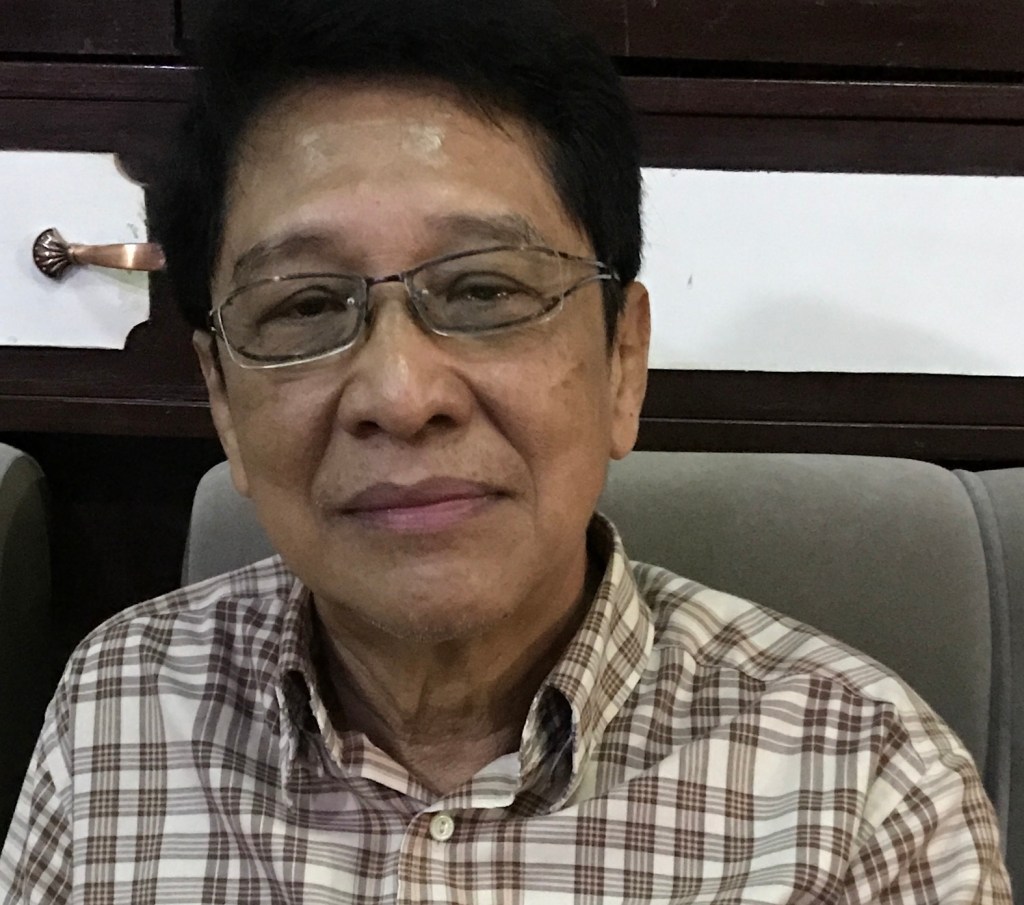
A month or so after this encounter, I met up with U Nay Oke (see photo), a Burmese friend I have known for almost 30 years.  He comes from a truly fascinating family and he himself has led a remarkable life which I have covered in one of my books and also in my oral history podcast.  I asked Nay Oke about General Ne Win’s love of western movies and to which he replied, “Didn’t you know that I used to review movies for the Censorship Board?” Of course, I had no idea and so he explained what happened.  While Nay Oke was at school he started writing for magazines and doing reviews of movies.  “Apparently General Ne Win read one of my reviews and enjoyed it tremendously, no doubt because it echoed his own view of the movie.  He told his adjutant to go and find the reviewer and appoint him to the Censorship Board.  So, a number of military officers turned up at my parent’s home and asked to see me.  My father was extremely worried as he, needless to say, thought I had done something wrong and would be carted off to jail.  I was still a teenager and when I came to the door the soldiers were shocked at my age and asked, ‘Are you the U Nay Oke who writes movie reviews?’  I responded that indeed I was.  They looked at each other and you can see they quickly decided there was no way they were going back to General Ne Win and explain I was only a teenager.  Ne Win’s orders were orders and so I was appointed to the Censorship Board.  In 1962, ‘Dr No’, the first James Bond movie was released and, of course, I wrote a glowing review with which General Ne Win wholeheartedly agreed.  A year or so later the second Bond movie was released.  As you may remember it was called ‘From Russia with Love’.  The Censorship Board wanted to ban it as they thought it was a political movie criticising the Soviet Union with which Burma at that time was close.  I insisted that General Ne Win would love the movie.  They would not budge until I came up with the suggestion that we would change the name of the movie in Burmese to something like ‘From Europe with Love’ and that I would take full responsibility.  They knew if it all went horribly wrong with Ne Win, I would get the blame.  Of course, Ne Win loved it and from that day on my colleagues on the Board never opposed any of my recommendations.

And that is my story of the link between Joseph Stalin and General Ne Win.
Captain Krishnan Nair

Using this time of self-isolation at home I thought I would spend some time writing up some of the inspirational and interesting stories told to me by fascinating characters I have met over my decades in Asia.  Some of these stories are covered in my three life story books on South East Asia and India and some have been told to me by elderly Myanmar citizens for my Myanmar Oral History Podcast.

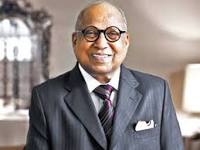
I met Captain CP Krishnan Nair 20 or so years ago at his office in the Leela Hotel in Mumbai, the flagship of his hotel group.  I expected to meet someone in his 60s but there before me was a man in his early 80s, whose whole body exuded the energy and interest in life of a man decades younger.  He was born into a poor family of 10 children in a small village in Kerala. He recalled the casteism which he first became aware of walking to and from his elementary school.  The casteism “etiquette” was that he should stand aside and let higher caste boys past first when walking across the borders between rice paddies.  He got into many fights as he refused to comply.

When he was in first year of high school an event changed his life.  One day, not long after he started, the local Maharaja who owned the school came to visit and speak to the students.  Captain Nair remembers all 700 boys were crowded into the playground sitting on the ground.  He told me he had never seen a man dressed in such beautiful clothes and who spoke such beautifully accented Hindi.  While he was sitting listening to the Maharaja, he made a poem up about him comparing him to the brilliance of the sun and the cool radiance of the moon.  When the Maharaja finished speaking, without any request from anyone to do so, he leapt to his feet and recited the poem out loud the Maharaja.  He then told the Maharaja words to the effect that “you who give us the gift of education are more important than a king or rich businessman”.  You can imagine the whole school was shocked into silence and Captain Nair remembers the headmaster looking “daggers” at him.  The Maharaja too was shocked but, after gathering his composure called Captain Nair to the stage and pulled him to his breast and whispered in his ear “What is your name, boy?” He whispered back “Krishnan Nair, Sir.”  With that the Maharaja said publicly to the Headmaster “Give this boy a scholarship” and whispered into his ear again “If you ever need help with your education you come and see me.”

Years later when Captain Nair finished high school, he had no money to study further but remembered the words of the Maharaja.  So off he went to see him.  After the normal pleasantries the Maharaja said, “I suppose you have come to see me because you need help with your ongoing education?”  Captain Nair confirmed that was the case.  The Maharaja responded “Look, I am having a rather difficult time financially at the moment” and then pointing to an enormous ring on one of his fingers continued “ if you take this ring to my jeweller in Madras, its value will be enough to pay for all your education.”  And that is how Captain Nair started his way in the world and eventually became one of India’s leading hoteliers.  Captain Nair died in 2014 at the age of 92.

Cambodian Pirates

Using this time of self-isolation at home I thought I would spend some time writing up some of the inspirational and interesting stories told to me by fascinating characters I have met over my decades in Asia. Some of these stories are covered in my three life story books on South East Asia and India and some have been told to me by elderly Myanmar citizens for my Myanmar Oral History Podcast.

Today’s story involves Cambodia.  I first visited Cambodia in the early 1990s, not long after Vietnam withdrew its troops from the country.  My older friends will remember that Vietnam invaded Cambodia in 1979 to bring to an end the murderous four-year reign of the Khmer Rouge during which nearly a quarter of the population – that’s around 1.5 million people – died from execution, disease, starvation and overwork.  With Vietnam’s withdrawal the country was in a political vacuum and, to bring stability, the United Nations established UNTAC (UN Transitional Authority in Cambodia) in late 1991.  Its key tasks were to disarm the warring factions, repatriate refugees and prepare for elections which were held in 1993 and following which UNTAC was dismantled.

Thus, at the time I interviewed businessmen and women for my book on South East Asia in the early to mid 1990s, all were at the early stages of building their businesses. If I look at where they are now, most have had extraordinary financial success but, for some, this success has been tinged with scandal and disputes. For this short vignette I want to focus on their early lives and a very unusual experience I had with one of them.

Even now it is not possible to meet Cambodians who were not affected by the Khmer Rouge in some horrible way.  All of the people I interviewed were directly affected and miraculously lived through the four years of slaughter.  One, for example, told me how he was forced to work in the fields from 3AM until midnight and that they were always so hungry that they resorted to eating grass roots and bark.  On one occasion, this person told me that he caught and ate one of what had been his family’s chickens before the takeover.  But, so far as the Khmer Rouge were concerned, everything was owned by the State and he was put in jail for a week.  “Every day the guards would start beating prisoners at 5pm and many did not make it through the night.  I was lucky as I was not put in jail until later in the evening when they had finished their beatings.  And fortunately, the head of the local farmers’ association, knew I was a hard worker and protected me until I was released.”  Another of those I interviewed also worked long hours in the fields and told me how he nearly lost his life in 1979 just after the Vietnamese invaded and were starting to push the Khmer Rouge into the jungle.  “I was so hungry that I tried to steal a cow for milking.  A Khmer Rouge soldier saw what I was trying to do and started shooting above my head to scare me away.  But I was so hungry I did not care if I lived or died.  The soldier came up to me and put a gun to my head and was about to pull the trigger.  I yelled out to him ‘kill me and you waste a bullet’.  The soldier hesitated for a second and asked me could I see any Vietnamese soldiers behind him.  I told him that there were. He then said quietly to me that if I had some rice, he would let me live. Fortunately, I did and survived.”

Both these two men made their initial fortunes by smuggling goods from Singapore, Malaysia and Thailand into Vietnam. Vietnam was under a trade embargo from the US and many other nations for 20 years from the time of the fall of Saigon to the North Vietnamese in 1975 until President Clinton lifted the embargo in 1995.  Cambodia with his long border with Vietnam was the perfect intermediary.  The Cambodian smugglers would usually meet Thai traders out at sea and swap goods like cigarettes (particularly the brand ‘555’ which became a de facto currency in that era), electronics and even larger items like motorbike; essentially, they smuggled whatever was in demand in Vietnam.  Some of the Thai traders were not much better than pirates; they would do a few trades with the Cambodian smugglers until the value became sizeable at which point, they would kill the Cambodians, take their money and keep the goods.  One day my subject was due to lead a smuggling party on his small boat but, one of his colleagues told him that he had had an argument with his wife and wanted to take his place.  All on that trip were killed.  On another occasion his wife was on the boat and they ran aground in Thai waters where she was arrested as a refugee and sent to a camp.  It took him four months to find her.  He arranged for some men to bring his boat back to Cambodia.  It was attacked by pirates and everyone on board was killed, except one man who managed to jump off the boat and swim to shore.  Apparently, the pirates could not find anything on the boat and just left it floating out at sea.  In fact, there was a large amount of cash and gold bars well-hidden on the boat and my subject was able to find the boat and recover the cash.

My story now turns to the strange experience my then teenage son, Nick and I had with the husband and wife smugglers mentioned above.  Nick had sat in on the interview I had conducted on their life story.  When we finished, they invited us to join them for lunch.  We went out of their office and were approaching their large armour-plated Mercedes which they had purchased from the UTAC officials after they exited the country.  They suggested Nick sit in the front beside their driver and I sit in the back seat with them.  After we all got in the car, Nick turned around to me and gave me the strangest look which I could not decipher.  He then turned around and off we went to lunch.  After lunch when we returned to the car, I guess because they realised it would be less squashed in the back seat with Nick rather than me, I was directed to the front seat.  As I went to put my feet down on the floor, I suddenly realised why Nick had given me that look.  Lying across the floor was an AK-47 machine gun and I then looked at the driver and realised he was no ordinary driver but a soldier they had hired from the army to protect them.  This was at a time when kidnappings of the wealthy were rife.  Nick no doubt thought we were about to be taken to the “killing fields” and executed.  I am happy to say Nick has never given me that look again.