
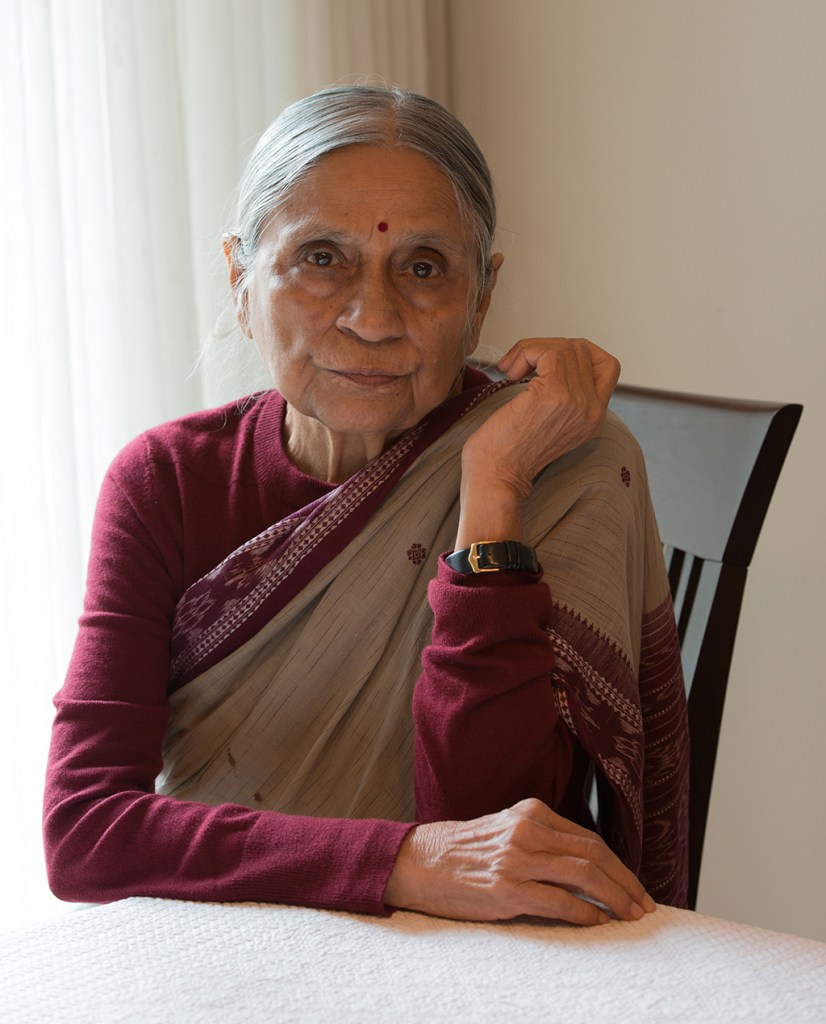
Ela Bhat is indeed a remarkable woman. She was born in Ahmedabad, Gujarat into a life of wealth and social standing in Ahmedabad in 1933. Her parents were Nagar Brahmins. As most of you may know the highest caste in the Hindu religion is that of Brahmin and it is from this caste that Hindu priests are drawn. All Brahmins believe in the importance of education over wealth and it was into this world Elara was brought up.
Her father was a successful lawyer who, in due course, was appointed “to the bench” as a judge whereas her mother’s father was a doctor. Her mother’s side of the family were staunch nationalists and many of whom spent time in jail as a result of their fight for independence from Britain.
Her mother had to stop her education in 6th class of primary school but was determined, once she had had her three children, to complete her education. At night Ela’s father coached her mother and over a decade she completed, not only her secondary education, but graduated from university and became active in the women’s movement in India.
Ela graduated from school at the young age of 15 and went to university to study law. It was here her world got turned “upside down”. She fell deeply in love with Ramesh who was two years ahead of her at law school. He too was a Brahmin but came from difficult family circumstances, as he lost his mother when he was five and his father was very poor and it fell to Ramesh to support the family. To Ela he was, as she told me, “brilliant and handsome.”
Ela was desperate to marry Ramesh but her father told her “we did not educate you for this…. Have you seen poverty? How are you going to spend your life in poverty? You know getting married is not an ordinary thing: it is not just romance.” To prove her parents wrong she left home and spent a year living in a village of landless labourers and cut off contact with Ramesh. As Ela recounted to me “Of course I could survive for this short period because of my caste and my education as I was not actually poor.” I was surprised to learn that, because she was a Brahmin, these poor landless labourers who largely accepted their ‘lot’ in life would often give her extra food with the excuse or belief that, if they did, they would receive good luck.
On her return from the village her parents finally accepted Ramesh and they were married in 1956. But her life style was changed; from living in a large house she moved to a rented room.
Not long before she got married she started working for the Textile Labour Association (TLA) which was one of the most powerful unions in India with close links to the ruling Congress Party. She worked there until 1981 when, as Ela puts it, “they threw me out”. Ela became a skilled labour lawyer protecting the rights of textile employees. But change was happening and during the late 1960’s mills all over India started to close down. Ela was asked to go to the homes of these now unemployed workers and find out how they were surviving. The answer was “women”. It was the women who were managing the home, earning money and feeding the family. They sold fruit and vegetables in the streets, stitched in their homes at piece-rates for middlemen, worked as labourers and many other roles, including collecting refuse. Ela realised these women were not protected by labour legislation and, in fact, accounted for a huge workforce nationwide.
Ela set about organising a union for these women and, after a long battle with bureaucracy, achieved the registration of the Self-Employed Women’s Association (SEWA) in 1971. She cleverly called these women “self employed” rather than “unemployed”. The next challenge was how to help these women financially. Many middlemen preyed on their situations charging huge rents for their use of equipment like sewing machines and carts. Indira Gandhi, the Prime Minister at that time, was pushing the banks to lend to small borrowers but, firstly the banks did not know how to reach these people, and secondly they did not see them as reliable borrowers. Chandaben, one of Ela’s close colleagues asked why they could not establish their own bank. Ela, as a good Brahmin, had avoided being involved with money and responded to her “But we are so poor” to which Chandaben replied “But we are so many”. Years later this became the title to Ela’s biography.
It took three years of hard work for the SEWA bank to be registered. One of the issues was that almost all of the women were illiterate and the banking regulator would not accept thumb print impressions. However, Ela came up with the alternative of using a photograph of the woman with her name underneath and which was accepted by the banking regulator and is now widespread in its use by other banks. From the bank’s second year of operation it has always paid a dividend.
Ela continued as a fierce advocate for the rights of her women members until she retired as Chairwoman at SEWA’s Annual General Meeting at the age of 65 in 1998. Her last day was not as she or anyone would have predicted. The elections of the new committee proceeded smoothly and at the end of the meeting Ela had no role. “To be honest, I had hoped someone would stand up and say a few good things about me; but there was nothing. After the meeting I came downstairs to my office and sat in the chair for the last time, but everything inside of me felt empty. I picked up my bag and left the office and got into my rickshaw. But there was a lump in my heart. I knew perfectly well that my SEWA colleagues were stunned and did not believe I would really retire and that they did not have the words to say anything at this time. I knew all of this but still I felt bad.”
But as we all know sometimes ‘one door closes and another opens’ and in many cases most unexpectedly. This was to be the case with Ela. As she told me “I could not cry. Then I came near my house where there is a music school on the left in the road. So I saw that and asked my driver to stop the rickshaw. I went in and upstairs into the school….There was a lesson in progress and I just sat there and waited for it to finish. The teacher came over and asked if I wanted to join a class. I told him I would and so he asked me to sing a few things to find out my level. The following week I joined the music school.”
The point of this story, she says, is that she always told her husband that she wanted to learn music and that he always gave her the standard boring answer of “Ela, there is a time for everything, there is a time for everything.” She suddenly realised that the time for music had come. She had not prepared for music to play a role in her post SEWA life but it has. “Music has become my passion; if I had not spent all those years at SEWA, I am sure they would have been spent on music.”
There is surely a message in Ela’s life for all of us. Just because your “day job” ends, it does not mean that beyond that there is not something else just as satisfying to take its place. Ela found hers at 65 and, as I turn 70 this year, I wonder if something new lies ahead for me?


Have you ever thought about adding a
little bit more than just your articles? I mean, what
you say is fundamental and everything.
But think of if you added some great pictures or videos to give your posts more, ?pop?!
Your content is excellent but with
images and video clips, this website could definitely be one of
the most beneficial in its niche.
Superb blog!
LikeLike