I think it was part fate and part passion that I ended up in Indonesia. It is quite a long story which I started writing for my grandchildren to read one day, but thought some of you who read these blogs might also be interested.
As a child I loved reading adventure stories like Treasure Island and Gulliver’s travels (although of course I did not appreciate the latter was a satire on the pettiness of human nature and an attack on the conservative UK Whig party of that era). In my teens I moved to novels set in the East and consumed books by Rudyard Kipling, like Plain Tales from the Hills, Rikki Tiki Tavi, The Jungle Book, Kim and his poem Gunga Din, Somerset Maugham (the Casuarina Tree and Borneo stories) and Joseph Conrad’s Lord Jim and The Malay Archipelago.
I can’t remember exactly how it happened but, at the time I left Sydney Church of England Grammar school (known as “Shore”) in 1967, one of my school friends, Vaughan Lehman and I decided to hitch hike to Darwin and fly to then Portuguese Timor and travel through the Indonesian islands ending up in Bali and Java. Hitchhiking was then a safe way of getting around in Sydney and certainly in the Australian outback as this was way before the 2001 murder of backpacker, Peter Falconio in the Northern Territory (his girlfriend Joanne Lees luckily escaped). What I remember most about the hitchhiking in the Northern Territory was being dropped in the middle of the night in the middle of nowhere as the person dropping us had turned off to go to the homestead of a cattle station which could have been 50km from the highway. At that time one could wait many hours before a car or truck would pass and, of course, not every vehicle would stop for two young men in the middle of the night. I think the longest we waited was around 6 hours but some talk of days of waiting.
We flew from Darwin to Bali. Kuta in Bali was a very different place in those days with only small losmen (small B&B houses) providing a place to sleep with fruit for breakfast. I can remember it cost around 35-50 cents per night and we could afford to have a small lunch and sometimes dinner for around 50 cents thereby living on around $1 per day. We travelled through to the ancient city of Djokjakarta (Yogyakarta) in Central Java which has a unique status in Indonesia of being the sole Sultanate in the country and was once the capital of Java. Djokja, as it is often called, is famous for its many ancient cultural traditions such as dance and music as well as for its batik painting. I can remember Vaughan and I purchased some cloth batik paintings by a well known artist, Bambang Oetoro. I believe he has passed away but found that he moved to Australia in 1972 to teach and paint before returning to Indonesia some years later. The paintings I purchased hung in our home in Sydney until around 2000 when we downsized and am not sure where the paintings are now.
By now I was smitten with Indonesia and so, at the end of my first year of university in 1968, I worked as a bricklayer’s labourer for 1 1/2 months and then used the money to again head to Indonesia by myself and decided this time to go via Portuguese Timor and then on to Indonesia, Singapore and Malaysia before heading back to Sydney. I again hitchhiked both ways from Sydney to Darwin. There were a couple of memorable moments on that trip.
Somewhere out in the Northern Territory on my way to Darwin, I was waiting for my next lift when I noticed a large road train start to slow down and stop by me. As most of you would know these road trains are prime movers pulling two or more full sized trailers so are double or more the length of a typical semi trailer. The driver leant over and wound down the window on the passenger’s side and said “Mate, can you drive?” I responded that I could drive a car but not something like a road train. He was not discouraged and asked me to hop in and he would explain how to drive the road train. I need to explain a few things. Firstly, his road train was empty having dropped his load of cattle off somewhere and he was returning to Darwin to get another load. Drivers in those days were paid per trip and so the faster you could turnaround the more money you could make. Secondly, the road is dead straight for hours on end. I don’t know how many gears his prime mover had but I am sure it was more than 10. Anyway he worked his way through the gears until we were traveling at a decent speed. He then asked me to crawl over and sit between his legs, put my right foot on the accelerator beside his and to hold onto the steering wheel. He then slowly pulled himself up behind me until I was the only one with my foot on the accelerator and with hands on the steering wheel. He moved into the passenger’s seat, told me to take over and promptly feel asleep. I don’t know how long I drove for but it was certainly a few hours. I figure his thinking was that I could not do much damage as the area beside the road was almost as flat as the road and if I had headed off onto that he would have immediately woken up and taken back control. There was also little traffic but I can tell you I kept the speed down and concentrated very hard on keeping the road train heading straight.
Another memorable experience from that trip was that the flight in those years from Darwin to Bacau in Portuguese Timor was by a small Indonesian airline called Zamrud which flew old DC3s. On the short flight from Darwin I can remember looking out of the window and seeing smoke and flames coming out of the port engine. I called the cabin attendant who looked as worried as me and he disappeared for a moment coming back with the pilot. The pilot looked out the window at the smoke and flames and then looked at me, shrugged his shoulders and returned to the cockpit.
In those years the route I was taking was very much on the “hippy trail” to Europe. We landed in Bacau, Timor’s second largest town, before catching a bus to the capital of Dili which was some 140km away on winding and poor roads. On arrival in Dili the authorities encouraged we backpackers to sleep in a large open air shed on the beach. The idea I am sure was so that we hippies did not contaminate the locals. The shed was essentially a large concrete slab with a roof and no sides, except where the toilets and showers were located. There would have been about 40 of us travelling to and from Australia and we all slept on that slab. I learnt that the Portuguese authorities were very short of blood supplies as apparently the Timorese were superstitious about giving blood; so much so that we backpackers were offered $30 for a pint of blood. This was an enormous sum to me and I immediately took up the offer as it provided me for funds for about 30 days as explained above.
In Bali I had one memorable but very lucky experience. A Dutch backpacker who was staying in the same losmen decided to climb Mt Batur with me. This is an active volcano which erupts with minor to moderate intensity every few years. I would have been climbing it around February, 1969 unaware, as I am now from research for this blog, that there had been minor eruptions in 1968 and again in 1970. The climb starts near Kintamani and takes a couple of hours of moderate intensity to reach the summit of 1717 meters. As we entered the lava fields my Dutch colleague and I separated as we choose separate paths. I choose the wrong one and ended up in box canyon which meant I either retraced my footsteps some 15 minutes back to the path the Dutchman had taken or I climbed the wall at the end of the canyon. I decided on the latter as I could see that the wall was only around 20 meters high and I could see a flat area at the top. I guess I had climbed about 10 meters, being careful to keep at least 3 of my arms and legs secure, when both my footholds collapsed and I was left dangling by my arms. There was no point in calling out for help and I knew I needed to keep calm. The strangest memory I have of that moment is that a fly landed on my face and I knew I could not swat it away as my two arms were the only thing stopping me from falling. I managed to kick some new footholds and knew I could not descend without a significant risk of falling or risk going higher, so I slowly manoeuvred myself across the face of the cliff to the left hand side of the canyon which was only 5 meters or so away. Needless to say when I rejoined my Dutch colleague at the top I did not admit I had taken the wrong path! This taught me a valuable lesson as to how one’s life can very easily be lost and the need to carefully calculate risk.
I stayed a week or two in Bali before moving on to Java as my next destination was Jakarta where Dr Ken Houston, a friend of my father, was the resident doctor for the Australian Embassy staff and Australians living in Jakarta. I cannot believe that I did it, but I decided to try my hand at hitchhiking across Java to Jakarta and found it extremely easy to get lifts as young foreign travellers at that time were most unusual in Java as compared to Bali. I got picked up by a wide range of trucks and cars. Usually I was dropped off in towns but I vividly remember I was dropped off late one night between villages. It was raining and not knowing where I was and how far it was to the next village I wandered along the road until I came to a small very basic house. Everyone was asleep but I knocked on the door and woke up the family. My Indonesian was not very good in those days and I made the sign of sleep by tilting my head onto my two hands. They kindly provided me with a corner of a shed to sleep and at first light I was out on the road seeking another lift. The generosity of Indonesians who have little in the way of material possessions is something that is a common theme I have experienced time and time again.
My time in Jakarta was a complete contrast with air conditioning, clean food and a comfy bed to sleep in. I decided to take a boat from Jakarta to Singapore as this was the cheapest way to travel and particularly if one took a deck ticket which I did. The deck ticket meant we had to stay on the deck for the couple of days it took to reach Singapore as we stopped at a number of places en route such as Tanjung Pinang, the capital of Indonesia’s Riau islands. It was pretty crowded on deck and there were no facilities for washing meaning that by the time we arrived in Singapore we must all have been quite smelly. There were, of course, a number of backpackers on the boat, and our main concern was whether we would be allowed into Singapore as we had all heard its then Prime Minister, Lee Kuan Yew, was very opposed to “hippies” who could be identified in men if they had long hair. At that time in Australia almost every young man had longish hair. When I got off the boat and was queuing for the immigration official to stamp our passports and allow us in, I noticed that the immigration had given a pair of scissors to one young man with long hair who was not far ahead of me in the queue. He asked the young man to get one of his colleagues to cut his hair. This involved back and forth for a few minutes as the official kept asking for more to be chopped off. Although my hair was far shorter than the young man ahead of me, I too suffered the indignity of having someone in the queue chop a few centimetres off.
After Singapore I headed north to Pinang and then took a ferry across to Medan in Sumatra where I started heading South on my long way back to Australia. I had two scary experiences in Sumatra. Both were on the bus trip back to Jakarta. At that time the roads in Sumatra were very bad and a normal bus would not be able to get through. This was solved by modifying trucks so that the back where normally they would be carrying rocks or sand or some such thing would be converted with several rows of hard wooden benches with an awning over the top to protect passengers from the elements. The idea was the bus never stopped, other than to pick up fuel and for comfort stops, and drivers would be changed about once every 12 to 18 hours at one of those stops. Late one night we were traveling through the jungle and came to a bridge. Most of the bridges were very basic wooden structures and the drivers took it very carefully as they crossed. This bridge consisted of long parallel wooden planks running the length of the bridge and on which our wheels were intended to stay. Under these long planks there were multiple horizontal cross planks. We were part way over the bridge when our front wheels went off one of the parallel planks and the truck crashed through the horizontal planks and the front of the truck started dropping down. Everyone was brought wide awake by the cracking sound and it was then I heard voices screaming two words which I did not then understand but have been etched for ever in my mind ” cepat turun” meaning “get out fast”. There was, of course, chaos as it was every man or woman for him or herself. Our exit was hampered due to the multiple rows of bench seats and only one exit. But we all did get out safely. The driver and his assistant instructed everyone to start walking to the next village as they had no idea if they could get the truck up from its wedged position. As we straggled to the next village I could hear the sounds of the jungle and imagined I heard the roar of tigers which then existed in that part of Sumatra. I don’t know how long it took them but after several hours the truck reappeared and we all got back in. Indonesians are ingenious at solving problems like this with very limited tools and I learnt what they did to get the truck back up. I believe they put their wheel jack on a horizontal plank near where the truck had fallen through and jacked that up so that they could then put more planks in to hold the truck at that level and then moved the jack closer to where the front wheels had fallen through. Over time they managed to get the front wheels up to being level with the surface of the bridge and somehow managed to then get the truck onto the parallel planks so they could drive off the bridge.
The route criss-crossed Sumatra, starting in Medan, Sumatra’s largest city on the East Coast and meandered across to Padang, another large city before heading South East to Palembang, the second largest city. By the time we arrived in Palembang after a couple of days of non stop travel all the passengers who had started in Medan were exhausted. We were told we had a hour or two to stretch our legs before the final push to the ferry taking us across the Sunda Straights and on to Jakarta. An English backpacker and I decided to walk down the main street and were about a kilometre from the truck. At that time, as mentioned, there were few westerners travelling in Sumatra and swarms of children followed us down the street and the braver ones occasionally ran up to touch the fair skin on our arms. This got pretty annoying. We were wearing our back packs and if you have had the experience of sitting in an aisle seat on a plane when a passenger wearing a back pack turns to talk to the person behind them, you will know how you get wacked in the head by the backpack. At some point my fellow English companion swung around to chase away a couple of annoying children and, in the process knocked over, a couple who started crying. We helped them up but did not see the impact this had had on adults nearby. They were furious and started throwing small stones at us. We tried to get away as quickly as we could but the stones kept coming and, although we were at this stage not hurt, a head shot might have done us serious damage. We saw a horse and cart “taxi” some 25 meters away and started running as fast as we could for it. But the stones kept coming. We jumped onto the back of the cart and the horse, which must have been hit by some of the stones, just took off with the driver and us hanging on for dear life. The driver made a circuitous route back to our truck where not long later we continued our trip to Jakarta. Other than that my return trip back to Sydney was uneventful.
While I was studying law at the University of Sydney in the early 1970s I made a decision that, once I finished, I wanted to combine my law degree with a post graduate specialisation in customary (adat) Indonesian law. In my final year I wrote to a number of Indonesian universities enquiring about a Master’s degree focused on adat law. As I wrote in English at a time when relatively few spoke the language let alone wrote it, I should not have been surprised that I did not receive any replies. I then found out that there was an English academic, Professor Mervyn Jaspan at the University of Hull who was the world’s leading anthropologist on customary law in South East Asia and particularly Indonesia. I wrote to him in late 1974 to enquire about doing a doctorate under his supervision into adat law in Indonesia. To my delight he accepted me, and Ginny and I were all set to move to Hull in the English summer of 1975 when I received the sad news that Professor Jaspan had committed suicide. I do not know what happened, but he left to the university all of his substantial research in what is known as the “Professor M A Jaspan Collections”.
This obviously led to a change of plans and I looked at doing a doctorate in Asian history at the University of Kent but finally decided on doing a Masters of Law at the University of London. As you will see this proved to be a very lucky decision. One great strength of this degree is that it is inter collegiate, meaning that I could study different areas of law at the different colleges that make up the University of London. I had the pleasure of studying company law at the London School of Economics (LSE) under Bill Wedderburn who was the most brilliant law lecturer I ever experienced. He made the dry cases of company law come to life. Not long after I finished my degree he became a life peer in the House of Lords. I also studied Trade Practices and Intellectual Law under excellent lecturers at University College and LSE. But it was the fourth course of Traditional Chinese Law at the School of Oriental and African Studies (SOAS) under a new young lecturer Dr Chen which changed my life.
SOAS would have to be the most eccentric academic institution in England, if not the world. I found the specialisations of its academics eccentric and often bizarre. There was, for example, one lecturer who specialised in something like the music of the central Sahara. This was a time way before documentaries appeared on TV and, before or after my Chinese law lectures, I was able to enjoy many of the anthropology documentaries which were shown in the main lecture hall. In my Chinese law class there were about 15 people hailing from a range of countries, including Malaysia, Canada, Hong Kong, Australia and the United States. We were all studying for our Master of Law degree but had different majors. Mine was corporate law, but others specialised in public international law, intellectual property and in admiralty (or maritime) law for which University College was world famous. Just as Professor Wedderburn was a giant in company law so Professor Francis Cadwallader (known as “Cad”) was the same for admiralty law. I became friendly with Neil Naliboff, an American who was a couple of years older than me and who had a good law degree from Boalt Hall at Berkeley. He was majoring in admiralty law. Like me, he was married but, unlike me, he had two young children; a son named Tenlay and a daughter named Samantha. Neil was Jewish but, like me, had become fascinated with Buddhism and a Tibetan yogi had given them the name for their son.
We chatted often about Asia and I told him many stories about Indonesia. At the end of our time at the University of London, Neil told me that Sharon and he were heading to China to work on their admiralty law and I told Neil that Ginny and I were heading back to Sydney where I would resume my corporate law practice at Clayton Utz, one of Sydney’s leading law firms. We agreed to keep in touch.
During my time in London I was entitled to a research pass at the British Library which is, not just the largest library in terms of number of items catalogued in London, but the world. I was able to find out one of my Scottish forbears had established a trading company in Jakarta (then called Batavia) in the early 1800s, post the British taking control from the Dutch. This reinforced my sense that my destiny lay in some way in Indonesia or at least South East Asia.
I returned to Sydney and, in my spare time, I participated in LawAsia, an organisation that had been established for lawyers in Asia Pacific interested in the practice of law in the region. At that time there were few Australian lawyers who were members. In June 1978 I noticed that a famous Indonesian lawyer would be speaking at a function to be held one evening at the NSW Law Society’s rooms. It was a cold and wet winter evening and I think only half a dozen lawyers turned up to hear the Indonesian lawyer’s presentation. As so few of us were there, each of us were able to chat for some time with the Indonesian lawyer.
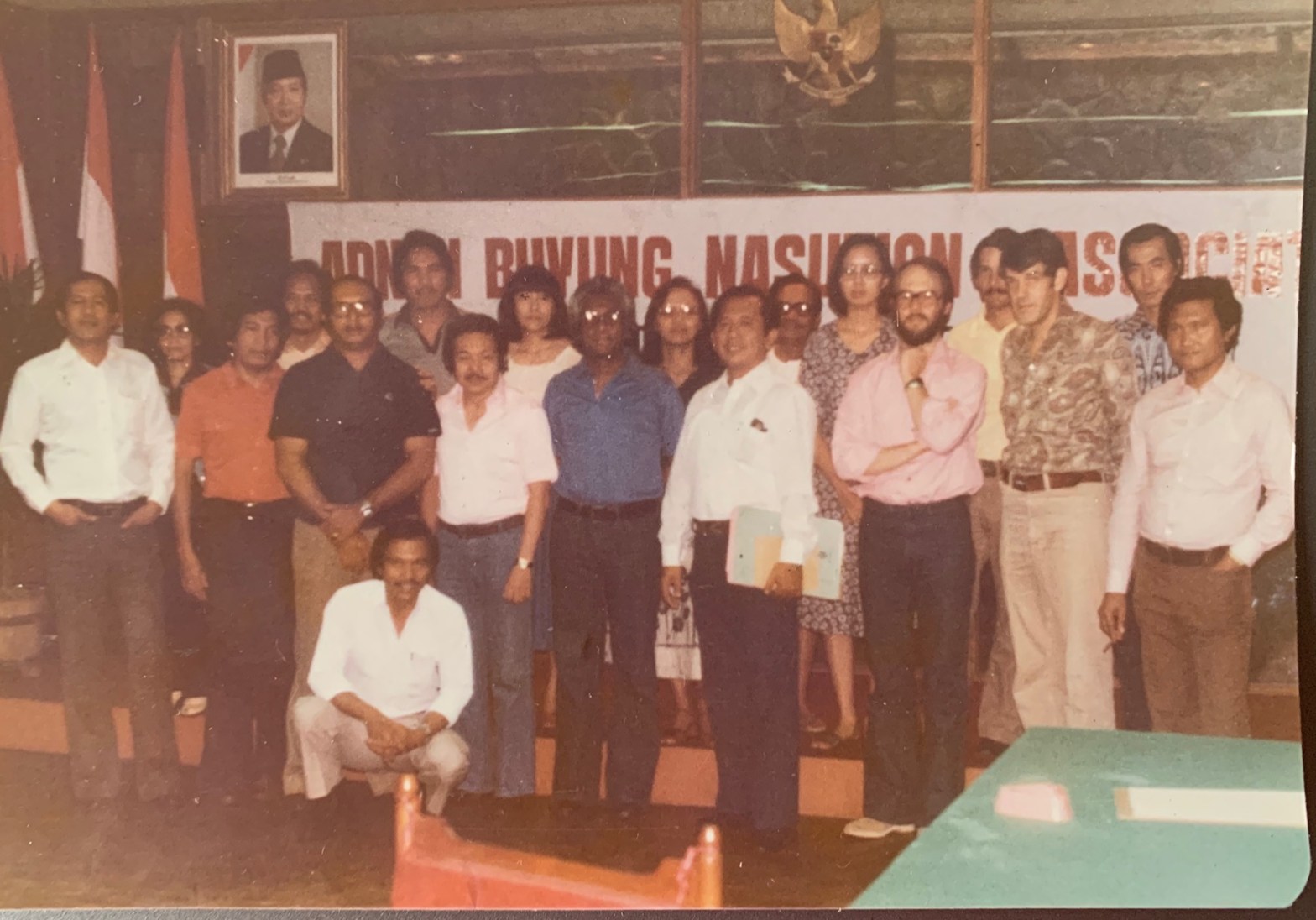
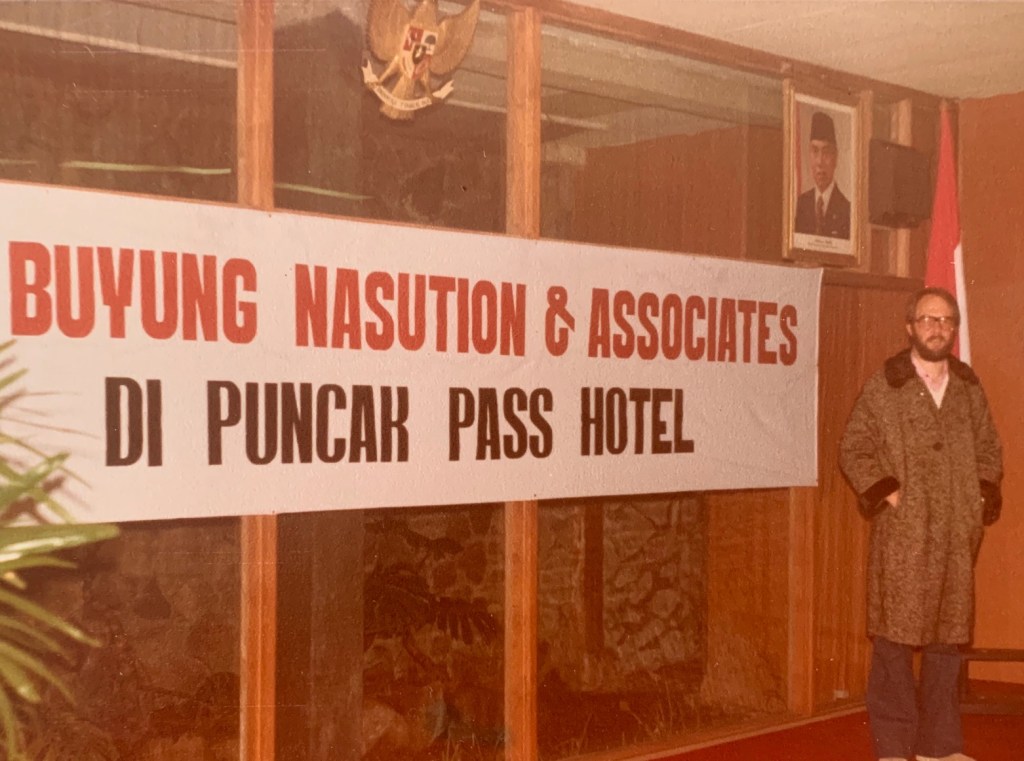
On returning home that evening Ginny handed me my mail for the day and I noticed, in amongst the window envelopes with bills, was an envelope hand addressed to me. I opened the envelope and found a letter from Neil. He told me what they had been doing since we last met and that he was working as a lawyer in Indonesia, the country I had always talked about to him about, and that he was working with a famous Indonesian lawyer, Adnan Buyung Nasution. This was the very Indonesian lawyer who I had met earlier that evening! His letter ended by saying that if I ever wanted to come and work in Indonesia to let him know. At this time I had just been offered a partnership at Clayton Utz and, as attractive as this was, I knew in my heart that I should take up Neil’s offer if Ginny was happy to do so. Fortunately she was, and the rest as they say is history as within a few months were were on our way to Jakarta. Many of my lawyer friends thought I was insane to turn down the partnership offer, but I knew if Indonesia turned out to be a disaster I would certainly be able to find another job as a lawyer in Sydney. And I also knew, if I turned down the Indonesian opportunity, I may have regretted it for the rest of my life.
I had an absolutely wonderful time in Jakarta and a number of my other blogs cover some of my experiences. I was the first Australian lawyer to practise law in Indonesia; my friend Zeke Solomon from Allens had earlier than me worked on a number of World Bank or internationally funded projects in Indonesia but had not lived there and Alan Cameron (currently Chair of the NSW Law Reform Commission) had also spent time in Indonesia before me working for an international not for profit organisation. At the time I arrived there were only 5 foreign lawyers in Indonesia – Frank Morgan, Tony Granucci and Daryl Johnson who worked for Mochtar, Karuwin and Komar (known as MKK) and Neil Naliboff and me who worked for Adan Buyung Nasution and Associates (known as ABNA). At that time MKK and ABNA were the only two firms with foreign lawyers. The reason behind there only being these two firms with foreign lawyers is very interesting. Although he had retired from practice by the time I arrived in Indonesia, the “Mochtar” in the MKK firm name comes from Mochtar Kusumaatmadja who was a prominent lawyer; not just in Indonesia but globally in his efforts to have the archipelagic theory accepted into the generally recognised public international law of the sea. From 1974 to 1978 he was Minister of Justice and used his influence to get work permits for foreign lawyers to work in MKK but, as a sign of fairness, allowed ABNA to also have permits. Buyung Nasution was a famous human rights lawyer and to an extent was seen as an opponent of the President Suharto regime. If one had a commercial argument with the Government there was little point in going to MKK so we picked up a lot of that work. In addition, MKK had such a large client base that they often were too busy or had conflicts and passed on some fantastic clients to Neil and me.
There is a very sad end to this story of my friendship with Neil. After about 4 years in Jakarta, Ginny and I returned to Sydney leaving Sharon and Neil in Jakarta. I think it must have been in 1982 that Neil contracted a severe case of pancreatitis. Doctors were unable to treat him in Jakarta and he was moved to a hospital in Singapore where I saw him for the last time. He was so weak that his watch, which depended on him moving his arm to charge the spring, had stopped. Again the doctors in Singapore were unable to restore Neil to full health so his parents arranged for him to be medevaced to their home in California. After several months in hospital Neil was well enough to return to his parent’s home and Sharon and he went out to celebrate. On their way home, a drunk driver crossed centre of road crashing into Neil and Sharon’s car and killing them both. It was so needless and unfair after all he and his family had been through. Their children were adopted by Neil’s brother and brought up with their children. I am pleased to say in the last couple of years I managed to track down Tenlay – how many Tenlay Naliboff’s could there be in the world – and have shared with him photos of his family’s time in Jakarta.

In returning to Sydney I was not returning without a job as Freehill, Hollingdale and Page (Freehills), one of Sydney’s most progressive law firms, saw the future that Asia offered to Australia and was keen to bring on board lawyers with practical Asian experience. The timing of my return was perfect in creating an opportunity for me to work with Freehill’s large Australian corporates which were beginning their first forays into South East Asia.
So that is the long and winding road of how I ended up in Jakarta in 1978.


Dear Peter,
Many thanks for your story. I enjoyed reading it very much. It is interesting and your good way of writing is excellent. Still in Sydney? I am still stuck with “ stay at home” guidelines for nine months in Yangon and getting frustrated. It is not the way to I like spend whatever little time left in life. The Lady did again and I am hopeful that we may have a separate ministry.
Looking forward to meet you again,
Merry Xmas, Yours, MT.
Sent from my iPhone
>
LikeLike
Hello Peter – I have just read your ‘blog’ on your early days in Indonesia. Fascinating and a great reminder for me of those days. Unfortunately, I was never able to work in Indonesia although I did spend 2 years in Dili for the Minister of Finance [2007-09]. I will put my details on the list of followers. All the very best for 2021. Best regards, Rod Lewis
LikeLike