Life Story Podcast of South East Asian and Indian business leaders

U Maung Nyi – a decision he made in March 1989 changed his life
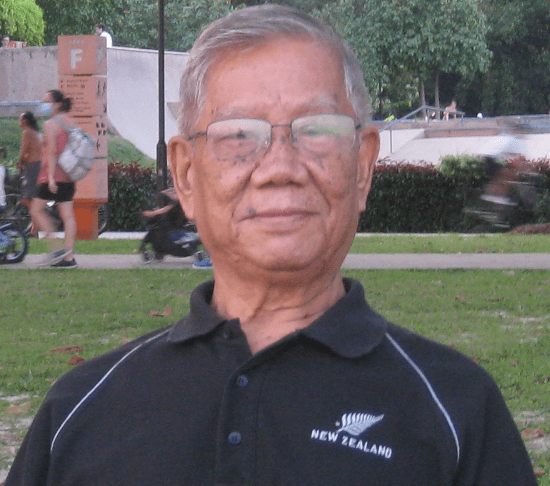
U Maung Nyi was born in Kyaukse on 15 April, 1936 and, at the time of my interview, had just turned 85. Most people now know him as David which was the name he took when he studied Mining Engineering in Otago, New Zealand in the late 1950s on a Colombo Plan scholarship.
Wikitravel advises the first Myanmar probably settled in the area of Kyaukse about 800AD and local 12th and 13th century inscriptions refer to Kyaukse as “the first home.” Remains of Pagodas and old cities are found throughout the area. The Shwe Thar Lyaung Pagoda, built by King Anawrahta, is located in Kyaukse. The surrounding area consists of a level strip running south from Mandalay along the foothills of the Shan Plateau. The area is located in the heart of Myanmar’s dry zone but is drained by the Panlaung and Zawgyi rivers, which were used for an ancient irrigation-canal system that predates Myanmar settlement in the area. The main lines of the canal system were supposedly dug by order of King Anawrahta in the 11th century. They are the largest of the historic irrigation works in Myanmar. The canalized area, traditionally the main Myanmar granary, was repaired and expanded under the British; it produces high yields of rice. Kyaukse has been an important area in Myanmar history. It is well irrigated and lush and has been ever since the bagan era when it was known as the granary of the kingdom. King Anawrahta built numerous fortresses along his kingdom’s borders, as well as along the rivers flowing within his lands. Tamote was one of nine fortresses along the rivers of Kyaukse region, erected because he needed protection against invasion by water. The Kyaukse area is known for its turmeric, mango and onions and has quite a large market and is where David’s mother had a stall.

As a mining engineer he spent many years working at Bawdwin, Myanmar’s famous lead, silver and zinc mine which during colonial times was the largest such mine in the world. Herbert Hoover, the 31st US President, made his fortune investing in Bawdwin. David eventually became its Mine Superintendent from 1983 to 1986 and was then promoted to become General Manager of a new copper mine at Monya (known as No. 1 Copper Mine). As you will hear from his life story, his resignation from this role after the 1988 riots and coup had far reaching consequences on the lives of all his family.
David told me that he was literarily inclined since his school days when he wrote short stories and poems which were published in magazines during his time studying in Mandalay. He carried this interest to Otago and to his time working at Bawdwin and No 1 Copper mine. But during the “dark days” following his resignation from the Government in 1989 the urge to write abandoned him and only returned post 2000. He wrote his first book in English on insight meditation in 2005 and has continued writing up to today. His most recent book in English is “What is Buddhism, a religion or a philosophy?” If you are interested in a copy please let me know.
U Myint Thein – his life story, including his time as Deputy Minister of Mines from 1992 to 2006
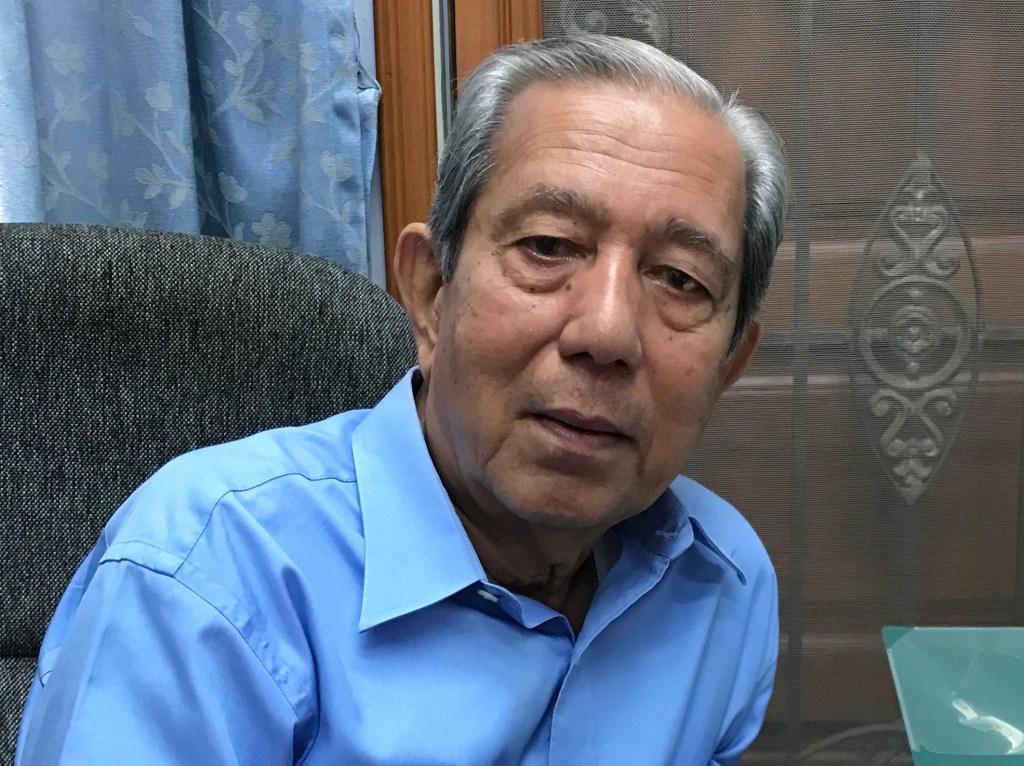
U Myint Thein was born in 1937 and was a highly respected Deputy Minister of Mines from 1992 to 2006. At that time almost all Ministers were active or retired military personnel
Daily life under the Myanmar military coups of 1962, 1988 and 2021
Last night I received the following email from a good friend in Myanmar:
“I have experienced three military coups in my life in Myanmar, in 1962, 1988 and 2021. When the first one occurred on March 2, 1962 I was not in the country. I arrived back only after 10 months. According to the news reports, there was only one fatality during the coup. By the time I arrived all the government departments were headed by military personnel. All were carrying on the usual business, including trading and factories. I got married in 1963 and our wedding was normal. The troubles only started in the early part of 1964. It started with the nationalizing of businesses, including small shops and followed by the first demonetization. There were no demonstrations or resistance from the masses. They just took it as it came, even though they were not satisfied. The result was not much killing and looting.
The second coup occurred on September 18, 1988. However, it was preceded by demonstrations started by students and office workers. It lasted only one month and 10 days before that coup. At that time everything was getting scarce, such as petrol, rice and edible oil. To make matters worse, they declared the third demonetization. I was on a tour when I heard the news and I had to borrow some cash from friends to return home. Even though there were some fatalities and looting and also killing in public by drugged people, most of the population, especially in the rural areas were safe. The military declared they had to take the responsibilities to restore “law and order”. They even named their Government the “State Law and Order Restoration Council”. They promised to change to a multiparty democracy and that General Elections would be held within a short time. At least life was bearable for ordinary public and soon after the coup, offices and the government apparatus were operating normally. All the cabinet members were from the military, but they did not even call themselves “Ministers”. The top man at the time, Senior General Saw Maung declared that they would return back to the “barracks” after the election.
The present coup is entirely different. The military destroyed peace, law and order in the county. Demonstrations started because of the coup. The Civil Disobedience Movement (CDM) only gathered steam after two weeks when, in the middle of February 2021, the military killed a young girl with a live bullet. The military compounded the anger by telling more lies. It is now almost three months and people are terrified and there is no longer law and order anywhere in the country. There have been many instances of looting, robbing and killing in public. At the present time the military is unable to cover up the real situation. It is not safe anymore; even to live in your own home. The phobia of losing all your life savings in your own home, without any authorities to report to, is becoming a common disease while the UN, EU, QUAD and ASEAN are still discussing.
MAY GOD HELP US!!!!!“
U K Ba Thaung
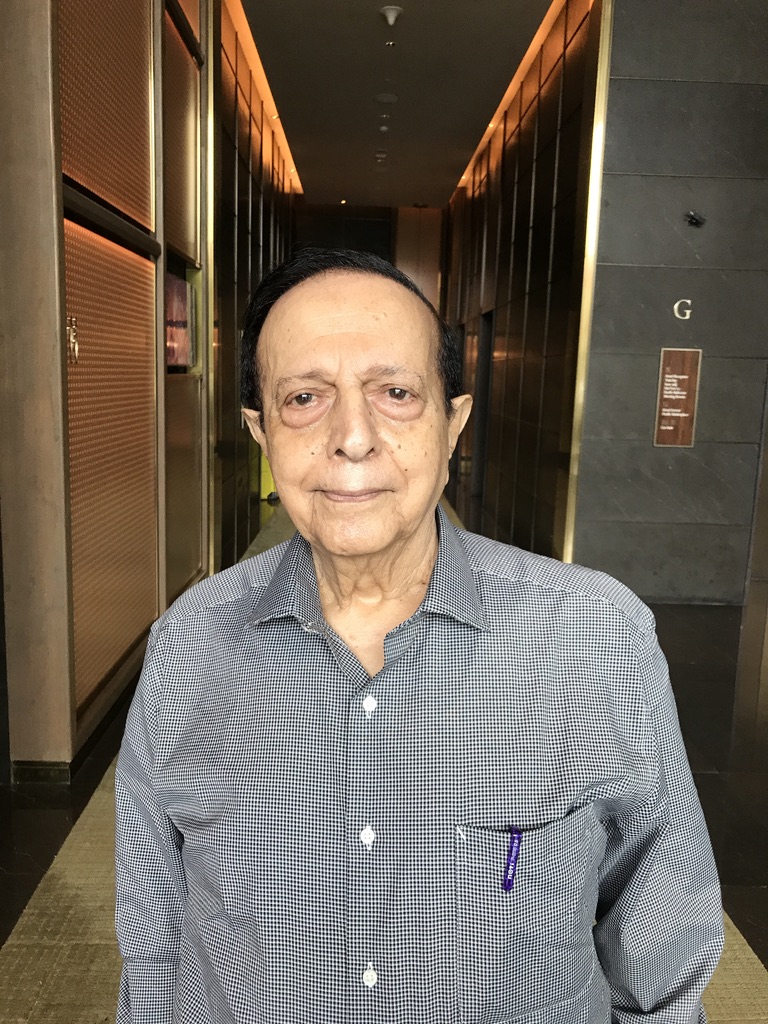
I have known U K Ba Thaung or Kenneth to his friends for more than 20 years. He was born in 1931 and has led an extraordinary life. When I interviewed him for my Myanmar Oral History podcast series ( https://podcasts.apple.com/au/podcast/myanmar-oral-history-project-life-stories/id1319152310) he was already in his late 80s and, as you can read from his birth year, he turns 90 this year. And, as you will hear, his voice is still strong and full of life.
I interviewed Kenneth twice to ensure I captured at least many of the key events in his long life. The first deals more with those events including Kenneth’s time in prison, whereas the second deals more with his relationship with General Ne Win, the first dictator of Burma (now called Myanmar) who ruled the country from 1962 to 1988. Ne Win was an extremely superstitious man and Kenneth recounts a number of stories detailing that superstition; from having a whale bone or sinew inserted into his penis to ensure he was always able to “perform”, to introducing 45- and 90-kyat notes to the currency because he believed nine was a lucky number and the numerals in each added up to nine, to overnight changing the country from one where people drove on the left to one where one drove on the right.

Why one should listen to travel advice – a lucky escape from a mugging in Buenos Aires
A little over 7 years ago, on 28 February, 2014 Ginny and I arrived in Buenos Aires with our close friends, Anne and Don Wood. We had just disembarked from a cruise around South America and had a couple of days before Ginny and I headed back to Singapore and the Woods to the Bahamas where their elder son and his family lived.
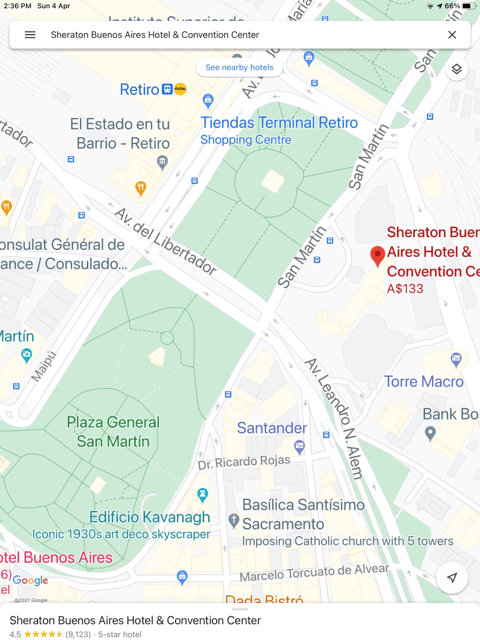
We stayed at the Sheraton Hotel on the corner of Avenue Leandro N Alem and Avenue San Martin – see map below
The morning after we arrived we decided to go shopping as the girls wanted to buy steak knives for which apparently Argentina is famous. At this point I have to admit I was extremely foolish as we were strongly advised by the hotel not to wear watches or any jewellery when we went out, as mugging is (or was at that time) common in Buenos Aires. However, having spent a lot of my life in somewhat risky parts of Asia, I figured that advice was not for experienced travellers like me. I also thought, as I was wearing a long sleeve shirt with my watch covered most of the time, I would be safe. How wrong could I have been?
We crossed the road in front of the hotel and walked up Avenue San Martin with the Plaza General San Martin on our right. After a couple hundred meters we headed off the the left into a shopping area with some pedestrian areas. At one point Don and I thought we would support a local shoe shine man and chatted to him as he cleaned our shoes. Anne and Ginny eventually found a shop with the steak knives they wanted and Don and I left them to do the negotiation. Don and I walked back to Avenue San Martin and walked down through the Plaza Gen San Martin park back to the corner of Avenue del Libertador and Avenue San Martin. Here we waited for the pedestrian lights so we could walk across to the South Eastern side of Avenue Leanardro N. Alem directly opposite the hotel.
As I stepped up onto the pavement I felt myself falling slowly to the ground. My first thought was that I must have had a heart attack and then I thought Don must be playing a trick on me by tackling me to the ground. But I realised Don would never do that. And then I felt a body slide over the top of me and heard people starting to scream. I realised I was being mugged. The mugger jumped up and put his fingers under the metal band of my watch and starting pulling me along the ground hoping that my watch band would snap. It didn’t. As more and more female bystanders started screaming and, as the band had not snapped, the mugger ran away.
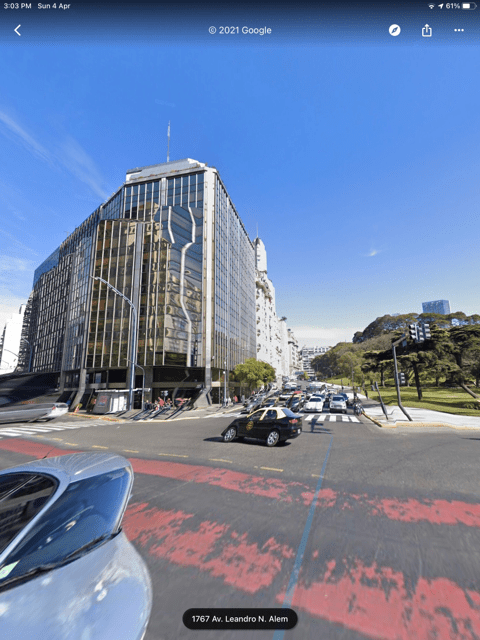
Whilst I was a little shaken I was fine. Don and I decided we should find the girls and warn them to be very careful. We found them a couple of hundred meters up Avenue San Martin. We all proceeded down the side of the street opposite the park and then crossed over the pedestrian crossing on the left in the above photo to be just outside the hotel – see photo (the entrance has changed a little since we were there).
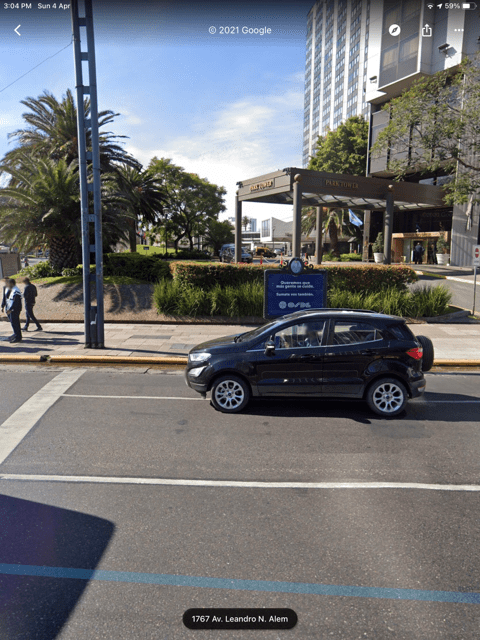
Don and I were walking a few steps in front of Anne and Ginny and were meters from the hotel entrance when I heard Ginny scream “Peteeeeeeee”. I turned and saw the same mugger sprinting towards me. As he went to crash tackle me to the ground, I bent over at that instant resulting in him going over my head and falling to the ground. He jumped up, looked at me and then at the hotel entrance, possibly worried about hotel security, and then ran down to Avenue Leanardro N. Alem where he had a motor bike waiting on the wrong side of the road. He jumped onto the back and they took off. I realised I had had a very lucky escape. I took my watch off that day and have virtually not worn it since.
Reflecting over what happened, as my watch was not visible when I was walking, I am convinced that the person cleaning my shoes must have seen my watch from under my cuff and passed on the information to the mugger. When I returned to Singapore I had the watch serviced to check the band and they told me that the mugger would have known everything about my watch from his first failed mugging which is why he returned for a second attempt. I was surprised to learn that in watch terms my watch was an antique as I had purchased it over 30 years ago.
I realised how lucky I was when Ginny and I heard on the news a week later that an Australian had been shot to death for his camera in Buenos Aires. It was a stupid mistake on my part to wear my watch and for which I might well have paid with my life.
U Ko Ko Than
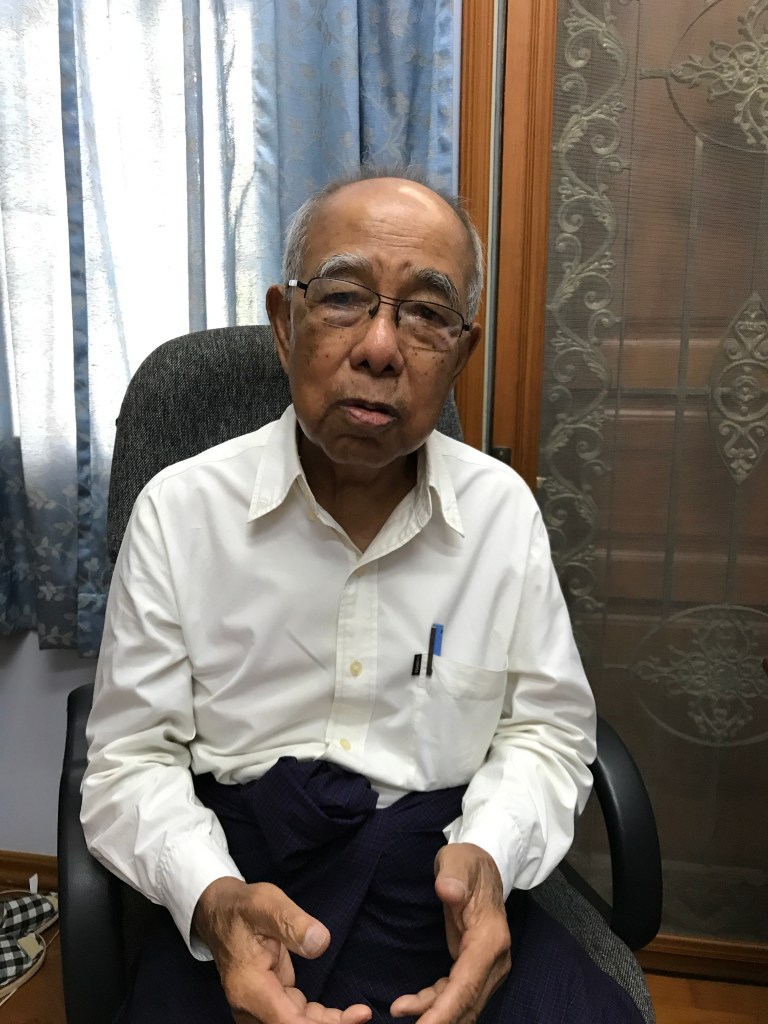
U Ko Ko Than -born 1930. Former Myanmar Deputy Minister of Mines – his life story
U Ko Ko Than spent his career in the Myanmar mining sector from which he retired as Deputy Minister of Mines. Deputy Minister was the most senior position in most ministries during the military rule of that era. Ministers during that period were almost all military officers.
After a long and productive life U Ko Ko Than passed away in recent days. I thought it an appropriate time to publish my interview with him back in November 2017. For me he was a professional to the end and gentleman in every sense of the word.
My “road less traveled”- how I ended up as a lawyer in Indonesia in 1978
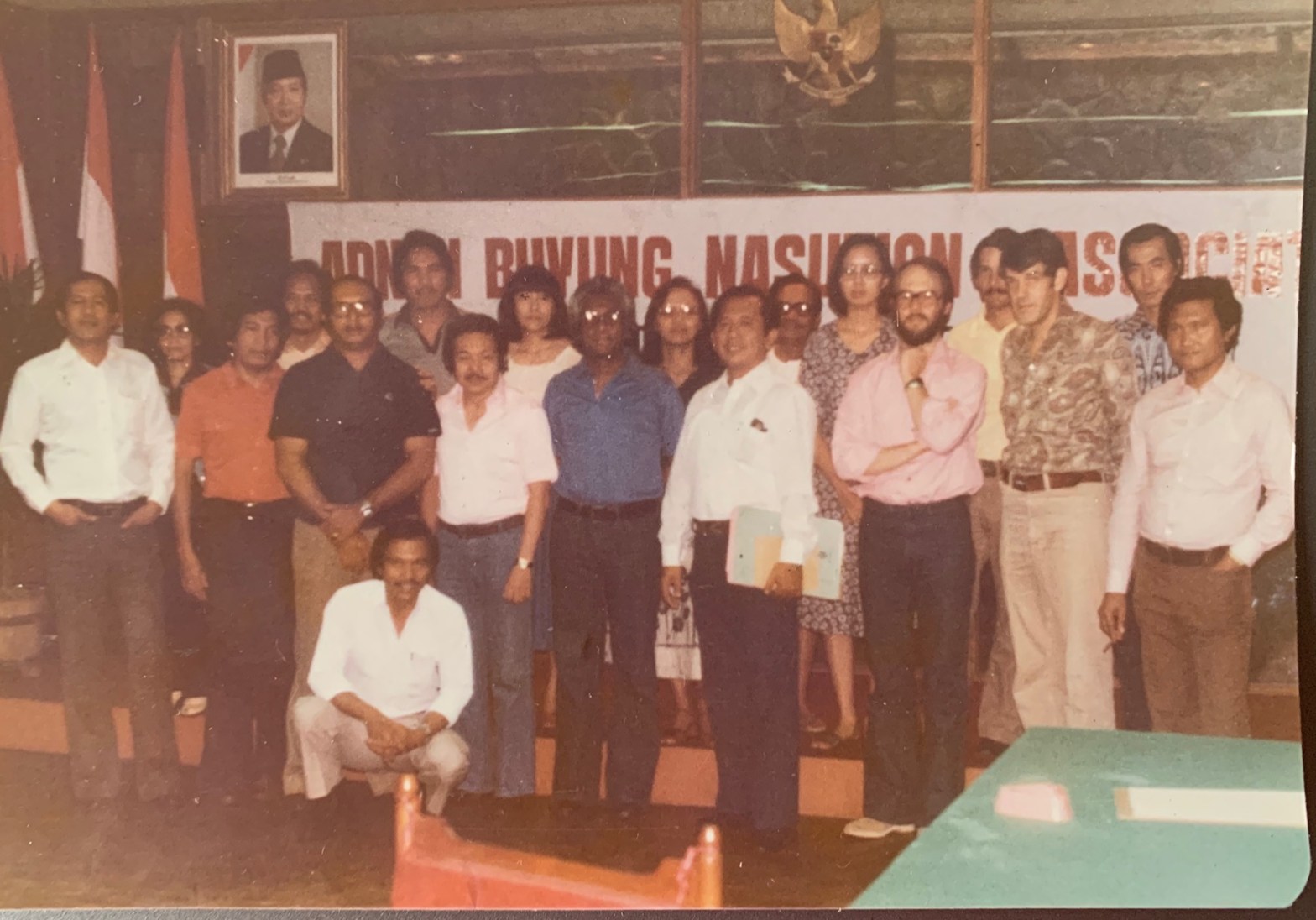
I think it was part fate and part passion that I ended up in Indonesia. It is quite a long story which I started writing for my grandchildren to read one day, but thought some of you who read these blogs might also be interested.
As a child I loved reading adventure stories like Treasure Island and Gulliver’s travels (although of course I did not appreciate the latter was a satire on the pettiness of human nature and an attack on the conservative UK Whig party of that era). In my teens I moved to novels set in the East and consumed books by Rudyard Kipling, like Plain Tales from the Hills, Rikki Tiki Tavi, The Jungle Book, Kim and his poem Gunga Din, Somerset Maugham (the Casuarina Tree and Borneo stories) and Joseph Conrad’s Lord Jim and The Malay Archipelago.
I can’t remember exactly how it happened but, at the time I left Sydney Church of England Grammar school (known as “Shore”) in 1967, one of my school friends, Vaughan Lehman and I decided to hitch hike to Darwin and fly to then Portuguese Timor and travel through the Indonesian islands ending up in Bali and Java. Hitchhiking was then a safe way of getting around in Sydney and certainly in the Australian outback as this was way before the 2001 murder of backpacker, Peter Falconio in the Northern Territory (his girlfriend Joanne Lees luckily escaped). What I remember most about the hitchhiking in the Northern Territory was being dropped in the middle of the night in the middle of nowhere as the person dropping us had turned off to go to the homestead of a cattle station which could have been 50km from the highway. At that time one could wait many hours before a car or truck would pass and, of course, not every vehicle would stop for two young men in the middle of the night. I think the longest we waited was around 6 hours but some talk of days of waiting.
We flew from Darwin to Bali. Kuta in Bali was a very different place in those days with only small losmen (small B&B houses) providing a place to sleep with fruit for breakfast. I can remember it cost around 35-50 cents per night and we could afford to have a small lunch and sometimes dinner for around 50 cents thereby living on around $1 per day. We travelled through to the ancient city of Djokjakarta (Yogyakarta) in Central Java which has a unique status in Indonesia of being the sole Sultanate in the country and was once the capital of Java. Djokja, as it is often called, is famous for its many ancient cultural traditions such as dance and music as well as for its batik painting. I can remember Vaughan and I purchased some cloth batik paintings by a well known artist, Bambang Oetoro. I believe he has passed away but found that he moved to Australia in 1972 to teach and paint before returning to Indonesia some years later. The paintings I purchased hung in our home in Sydney until around 2000 when we downsized and am not sure where the paintings are now.
By now I was smitten with Indonesia and so, at the end of my first year of university in 1968, I worked as a bricklayer’s labourer for 1 1/2 months and then used the money to again head to Indonesia by myself and decided this time to go via Portuguese Timor and then on to Indonesia, Singapore and Malaysia before heading back to Sydney. I again hitchhiked both ways from Sydney to Darwin. There were a couple of memorable moments on that trip.
Somewhere out in the Northern Territory on my way to Darwin, I was waiting for my next lift when I noticed a large road train start to slow down and stop by me. As most of you would know these road trains are prime movers pulling two or more full sized trailers so are double or more the length of a typical semi trailer. The driver leant over and wound down the window on the passenger’s side and said “Mate, can you drive?” I responded that I could drive a car but not something like a road train. He was not discouraged and asked me to hop in and he would explain how to drive the road train. I need to explain a few things. Firstly, his road train was empty having dropped his load of cattle off somewhere and he was returning to Darwin to get another load. Drivers in those days were paid per trip and so the faster you could turnaround the more money you could make. Secondly, the road is dead straight for hours on end. I don’t know how many gears his prime mover had but I am sure it was more than 10. Anyway he worked his way through the gears until we were traveling at a decent speed. He then asked me to crawl over and sit between his legs, put my right foot on the accelerator beside his and to hold onto the steering wheel. He then slowly pulled himself up behind me until I was the only one with my foot on the accelerator and with hands on the steering wheel. He moved into the passenger’s seat, told me to take over and promptly feel asleep. I don’t know how long I drove for but it was certainly a few hours. I figure his thinking was that I could not do much damage as the area beside the road was almost as flat as the road and if I had headed off onto that he would have immediately woken up and taken back control. There was also little traffic but I can tell you I kept the speed down and concentrated very hard on keeping the road train heading straight.
Another memorable experience from that trip was that the flight in those years from Darwin to Bacau in Portuguese Timor was by a small Indonesian airline called Zamrud which flew old DC3s. On the short flight from Darwin I can remember looking out of the window and seeing smoke and flames coming out of the port engine. I called the cabin attendant who looked as worried as me and he disappeared for a moment coming back with the pilot. The pilot looked out the window at the smoke and flames and then looked at me, shrugged his shoulders and returned to the cockpit.
In those years the route I was taking was very much on the “hippy trail” to Europe. We landed in Bacau, Timor’s second largest town, before catching a bus to the capital of Dili which was some 140km away on winding and poor roads. On arrival in Dili the authorities encouraged we backpackers to sleep in a large open air shed on the beach. The idea I am sure was so that we hippies did not contaminate the locals. The shed was essentially a large concrete slab with a roof and no sides, except where the toilets and showers were located. There would have been about 40 of us travelling to and from Australia and we all slept on that slab. I learnt that the Portuguese authorities were very short of blood supplies as apparently the Timorese were superstitious about giving blood; so much so that we backpackers were offered $30 for a pint of blood. This was an enormous sum to me and I immediately took up the offer as it provided me for funds for about 30 days as explained above.
In Bali I had one memorable but very lucky experience. A Dutch backpacker who was staying in the same losmen decided to climb Mt Batur with me. This is an active volcano which erupts with minor to moderate intensity every few years. I would have been climbing it around February, 1969 unaware, as I am now from research for this blog, that there had been minor eruptions in 1968 and again in 1970. The climb starts near Kintamani and takes a couple of hours of moderate intensity to reach the summit of 1717 meters. As we entered the lava fields my Dutch colleague and I separated as we choose separate paths. I choose the wrong one and ended up in box canyon which meant I either retraced my footsteps some 15 minutes back to the path the Dutchman had taken or I climbed the wall at the end of the canyon. I decided on the latter as I could see that the wall was only around 20 meters high and I could see a flat area at the top. I guess I had climbed about 10 meters, being careful to keep at least 3 of my arms and legs secure, when both my footholds collapsed and I was left dangling by my arms. There was no point in calling out for help and I knew I needed to keep calm. The strangest memory I have of that moment is that a fly landed on my face and I knew I could not swat it away as my two arms were the only thing stopping me from falling. I managed to kick some new footholds and knew I could not descend without a significant risk of falling or risk going higher, so I slowly manoeuvred myself across the face of the cliff to the left hand side of the canyon which was only 5 meters or so away. Needless to say when I rejoined my Dutch colleague at the top I did not admit I had taken the wrong path! This taught me a valuable lesson as to how one’s life can very easily be lost and the need to carefully calculate risk.
I stayed a week or two in Bali before moving on to Java as my next destination was Jakarta where Dr Ken Houston, a friend of my father, was the resident doctor for the Australian Embassy staff and Australians living in Jakarta. I cannot believe that I did it, but I decided to try my hand at hitchhiking across Java to Jakarta and found it extremely easy to get lifts as young foreign travellers at that time were most unusual in Java as compared to Bali. I got picked up by a wide range of trucks and cars. Usually I was dropped off in towns but I vividly remember I was dropped off late one night between villages. It was raining and not knowing where I was and how far it was to the next village I wandered along the road until I came to a small very basic house. Everyone was asleep but I knocked on the door and woke up the family. My Indonesian was not very good in those days and I made the sign of sleep by tilting my head onto my two hands. They kindly provided me with a corner of a shed to sleep and at first light I was out on the road seeking another lift. The generosity of Indonesians who have little in the way of material possessions is something that is a common theme I have experienced time and time again.
My time in Jakarta was a complete contrast with air conditioning, clean food and a comfy bed to sleep in. I decided to take a boat from Jakarta to Singapore as this was the cheapest way to travel and particularly if one took a deck ticket which I did. The deck ticket meant we had to stay on the deck for the couple of days it took to reach Singapore as we stopped at a number of places en route such as Tanjung Pinang, the capital of Indonesia’s Riau islands. It was pretty crowded on deck and there were no facilities for washing meaning that by the time we arrived in Singapore we must all have been quite smelly. There were, of course, a number of backpackers on the boat, and our main concern was whether we would be allowed into Singapore as we had all heard its then Prime Minister, Lee Kuan Yew, was very opposed to “hippies” who could be identified in men if they had long hair. At that time in Australia almost every young man had longish hair. When I got off the boat and was queuing for the immigration official to stamp our passports and allow us in, I noticed that the immigration had given a pair of scissors to one young man with long hair who was not far ahead of me in the queue. He asked the young man to get one of his colleagues to cut his hair. This involved back and forth for a few minutes as the official kept asking for more to be chopped off. Although my hair was far shorter than the young man ahead of me, I too suffered the indignity of having someone in the queue chop a few centimetres off.
After Singapore I headed north to Pinang and then took a ferry across to Medan in Sumatra where I started heading South on my long way back to Australia. I had two scary experiences in Sumatra. Both were on the bus trip back to Jakarta. At that time the roads in Sumatra were very bad and a normal bus would not be able to get through. This was solved by modifying trucks so that the back where normally they would be carrying rocks or sand or some such thing would be converted with several rows of hard wooden benches with an awning over the top to protect passengers from the elements. The idea was the bus never stopped, other than to pick up fuel and for comfort stops, and drivers would be changed about once every 12 to 18 hours at one of those stops. Late one night we were traveling through the jungle and came to a bridge. Most of the bridges were very basic wooden structures and the drivers took it very carefully as they crossed. This bridge consisted of long parallel wooden planks running the length of the bridge and on which our wheels were intended to stay. Under these long planks there were multiple horizontal cross planks. We were part way over the bridge when our front wheels went off one of the parallel planks and the truck crashed through the horizontal planks and the front of the truck started dropping down. Everyone was brought wide awake by the cracking sound and it was then I heard voices screaming two words which I did not then understand but have been etched for ever in my mind ” cepat turun” meaning “get out fast”. There was, of course, chaos as it was every man or woman for him or herself. Our exit was hampered due to the multiple rows of bench seats and only one exit. But we all did get out safely. The driver and his assistant instructed everyone to start walking to the next village as they had no idea if they could get the truck up from its wedged position. As we straggled to the next village I could hear the sounds of the jungle and imagined I heard the roar of tigers which then existed in that part of Sumatra. I don’t know how long it took them but after several hours the truck reappeared and we all got back in. Indonesians are ingenious at solving problems like this with very limited tools and I learnt what they did to get the truck back up. I believe they put their wheel jack on a horizontal plank near where the truck had fallen through and jacked that up so that they could then put more planks in to hold the truck at that level and then moved the jack closer to where the front wheels had fallen through. Over time they managed to get the front wheels up to being level with the surface of the bridge and somehow managed to then get the truck onto the parallel planks so they could drive off the bridge.
The route criss-crossed Sumatra, starting in Medan, Sumatra’s largest city on the East Coast and meandered across to Padang, another large city before heading South East to Palembang, the second largest city. By the time we arrived in Palembang after a couple of days of non stop travel all the passengers who had started in Medan were exhausted. We were told we had a hour or two to stretch our legs before the final push to the ferry taking us across the Sunda Straights and on to Jakarta. An English backpacker and I decided to walk down the main street and were about a kilometre from the truck. At that time, as mentioned, there were few westerners travelling in Sumatra and swarms of children followed us down the street and the braver ones occasionally ran up to touch the fair skin on our arms. This got pretty annoying. We were wearing our back packs and if you have had the experience of sitting in an aisle seat on a plane when a passenger wearing a back pack turns to talk to the person behind them, you will know how you get wacked in the head by the backpack. At some point my fellow English companion swung around to chase away a couple of annoying children and, in the process knocked over, a couple who started crying. We helped them up but did not see the impact this had had on adults nearby. They were furious and started throwing small stones at us. We tried to get away as quickly as we could but the stones kept coming and, although we were at this stage not hurt, a head shot might have done us serious damage. We saw a horse and cart “taxi” some 25 meters away and started running as fast as we could for it. But the stones kept coming. We jumped onto the back of the cart and the horse, which must have been hit by some of the stones, just took off with the driver and us hanging on for dear life. The driver made a circuitous route back to our truck where not long later we continued our trip to Jakarta. Other than that my return trip back to Sydney was uneventful.
While I was studying law at the University of Sydney in the early 1970s I made a decision that, once I finished, I wanted to combine my law degree with a post graduate specialisation in customary (adat) Indonesian law. In my final year I wrote to a number of Indonesian universities enquiring about a Master’s degree focused on adat law. As I wrote in English at a time when relatively few spoke the language let alone wrote it, I should not have been surprised that I did not receive any replies. I then found out that there was an English academic, Professor Mervyn Jaspan at the University of Hull who was the world’s leading anthropologist on customary law in South East Asia and particularly Indonesia. I wrote to him in late 1974 to enquire about doing a doctorate under his supervision into adat law in Indonesia. To my delight he accepted me, and Ginny and I were all set to move to Hull in the English summer of 1975 when I received the sad news that Professor Jaspan had committed suicide. I do not know what happened, but he left to the university all of his substantial research in what is known as the “Professor M A Jaspan Collections”.
This obviously led to a change of plans and I looked at doing a doctorate in Asian history at the University of Kent but finally decided on doing a Masters of Law at the University of London. As you will see this proved to be a very lucky decision. One great strength of this degree is that it is inter collegiate, meaning that I could study different areas of law at the different colleges that make up the University of London. I had the pleasure of studying company law at the London School of Economics (LSE) under Bill Wedderburn who was the most brilliant law lecturer I ever experienced. He made the dry cases of company law come to life. Not long after I finished my degree he became a life peer in the House of Lords. I also studied Trade Practices and Intellectual Law under excellent lecturers at University College and LSE. But it was the fourth course of Traditional Chinese Law at the School of Oriental and African Studies (SOAS) under a new young lecturer Dr Chen which changed my life.
SOAS would have to be the most eccentric academic institution in England, if not the world. I found the specialisations of its academics eccentric and often bizarre. There was, for example, one lecturer who specialised in something like the music of the central Sahara. This was a time way before documentaries appeared on TV and, before or after my Chinese law lectures, I was able to enjoy many of the anthropology documentaries which were shown in the main lecture hall. In my Chinese law class there were about 15 people hailing from a range of countries, including Malaysia, Canada, Hong Kong, Australia and the United States. We were all studying for our Master of Law degree but had different majors. Mine was corporate law, but others specialised in public international law, intellectual property and in admiralty (or maritime) law for which University College was world famous. Just as Professor Wedderburn was a giant in company law so Professor Francis Cadwallader (known as “Cad”) was the same for admiralty law. I became friendly with Neil Naliboff, an American who was a couple of years older than me and who had a good law degree from Boalt Hall at Berkeley. He was majoring in admiralty law. Like me, he was married but, unlike me, he had two young children; a son named Tenlay and a daughter named Samantha. Neil was Jewish but, like me, had become fascinated with Buddhism and a Tibetan yogi had given them the name for their son.
We chatted often about Asia and I told him many stories about Indonesia. At the end of our time at the University of London, Neil told me that Sharon and he were heading to China to work on their admiralty law and I told Neil that Ginny and I were heading back to Sydney where I would resume my corporate law practice at Clayton Utz, one of Sydney’s leading law firms. We agreed to keep in touch.
During my time in London I was entitled to a research pass at the British Library which is, not just the largest library in terms of number of items catalogued in London, but the world. I was able to find out one of my Scottish forbears had established a trading company in Jakarta (then called Batavia) in the early 1800s, post the British taking control from the Dutch. This reinforced my sense that my destiny lay in some way in Indonesia or at least South East Asia.
I returned to Sydney and, in my spare time, I participated in LawAsia, an organisation that had been established for lawyers in Asia Pacific interested in the practice of law in the region. At that time there were few Australian lawyers who were members. In June 1978 I noticed that a famous Indonesian lawyer would be speaking at a function to be held one evening at the NSW Law Society’s rooms. It was a cold and wet winter evening and I think only half a dozen lawyers turned up to hear the Indonesian lawyer’s presentation. As so few of us were there, each of us were able to chat for some time with the Indonesian lawyer.
On returning home that evening Ginny handed me my mail for the day and I noticed, in amongst the window envelopes with bills, was an envelope hand addressed to me. I opened the envelope and found a letter from Neil. He told me what they had been doing since we last met and that he was working as a lawyer in Indonesia, the country I had always talked about to him about, and that he was working with a famous Indonesian lawyer, Adnan Buyung Nasution. This was the very Indonesian lawyer who I had met earlier that evening! His letter ended by saying that if I ever wanted to come and work in Indonesia to let him know. At this time I had just been offered a partnership at Clayton Utz and, as attractive as this was, I knew in my heart that I should take up Neil’s offer if Ginny was happy to do so. Fortunately she was, and the rest as they say is history as within a few months were were on our way to Jakarta. Many of my lawyer friends thought I was insane to turn down the partnership offer, but I knew if Indonesia turned out to be a disaster I would certainly be able to find another job as a lawyer in Sydney. And I also knew, if I turned down the Indonesian opportunity, I may have regretted it for the rest of my life.
I had an absolutely wonderful time in Jakarta and a number of my other blogs cover some of my experiences. I was the first Australian lawyer to practise law in Indonesia; my friend Zeke Solomon from Allens had earlier than me worked on a number of World Bank or internationally funded projects in Indonesia but had not lived there and Alan Cameron (currently Chair of the NSW Law Reform Commission) had also spent time in Indonesia before me working for an international not for profit organisation. At the time I arrived there were only 5 foreign lawyers in Indonesia – Frank Morgan, Tony Granucci and Daryl Johnson who worked for Mochtar, Karuwin and Komar (known as MKK) and Neil Naliboff and me who worked for Adan Buyung Nasution and Associates (known as ABNA). At that time MKK and ABNA were the only two firms with foreign lawyers. The reason behind there only being these two firms with foreign lawyers is very interesting. Although he had retired from practice by the time I arrived in Indonesia, the “Mochtar” in the MKK firm name comes from Mochtar Kusumaatmadja who was a prominent lawyer; not just in Indonesia but globally in his efforts to have the archipelagic theory accepted into the generally recognised public international law of the sea. From 1974 to 1978 he was Minister of Justice and used his influence to get work permits for foreign lawyers to work in MKK but, as a sign of fairness, allowed ABNA to also have permits. Buyung Nasution was a famous human rights lawyer and to an extent was seen as an opponent of the President Suharto regime. If one had a commercial argument with the Government there was little point in going to MKK so we picked up a lot of that work. In addition, MKK had such a large client base that they often were too busy or had conflicts and passed on some fantastic clients to Neil and me.
There is a very sad end to this story of my friendship with Neil. After about 4 years in Jakarta, Ginny and I returned to Sydney leaving Sharon and Neil in Jakarta. I think it must have been in 1982 that Neil contracted a severe case of pancreatitis. Doctors were unable to treat him in Jakarta and he was moved to a hospital in Singapore where I saw him for the last time. He was so weak that his watch, which depended on him moving his arm to charge the spring, had stopped. Again the doctors in Singapore were unable to restore Neil to full health so his parents arranged for him to be medevaced to their home in California. After several months in hospital Neil was well enough to return to his parent’s home and Sharon and he went out to celebrate. On their way home, a drunk driver crossed centre of road crashing into Neil and Sharon’s car and killing them both. It was so needless and unfair after all he and his family had been through. Their children were adopted by Neil’s brother and brought up with their children. I am pleased to say in the last couple of years I managed to track down Tenlay – how many Tenlay Naliboff’s could there be in the world – and have shared with him photos of his family’s time in Jakarta.
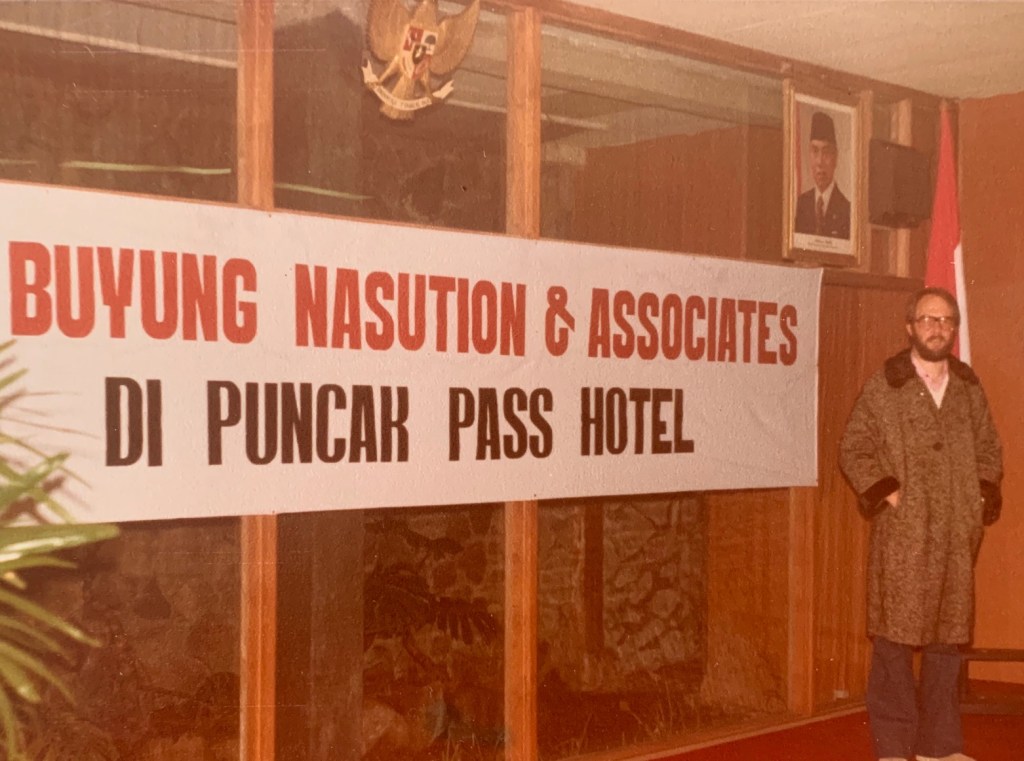

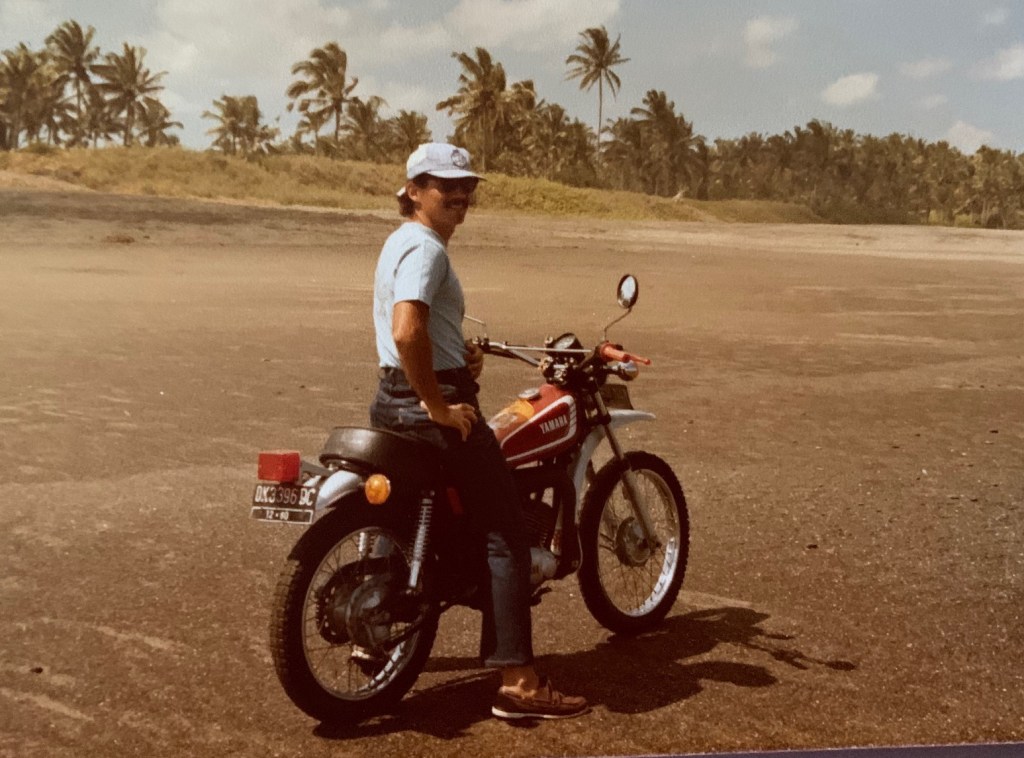
In returning to Sydney I was not returning without a job as Freehill, Hollingdale and Page (Freehills), one of Sydney’s most progressive law firms, saw the future that Asia offered to Australia and was keen to bring on board lawyers with practical Asian experience. The timing of my return was perfect in creating an opportunity for me to work with Freehill’s large Australian corporates which were beginning their first forays into South East Asia.
So that is the long and winding road of how I ended up in Jakarta in 1978.
Interesting quotes from some of the leading businessmen and women covered in my Indian life story books*
* “Added Value- The life stories of Indian business leaders” – Roli Books 2010
“Profiles in Enterprise – Inspiring stories of Indian business leaders”- Roli Books 2015
Note: the below quotes are extracted from the above books. Sadly some of the people I interviewed have passed away and, where I know this to be the case, I have indicated this. Some of the others have changed their roles but I have left them as what they were when I interviewed them. The quotes are in no particular order.
Subhash Chandra
Founder and Chairman
Essel Group/Zee TV“
“My brother rang me and said ‘Subhash, I am here with two of our brothers watching Zee [their TV channel] and am alarmed to see there have only been 3 ads on the station this evening’. I said that was the ‘good news” and did he want to hear the ‘bad news”. Of course he said he did and I told him all 3 ads were free. I think I heard my brother drop the phone!”
AVS Raju
Founder and Chairman
Nagarjuna Construction Company Ltd
“You may have all the education in the world but what’s more important is common sense which, despite its name, is not that common. Recently I was invited as the chief guest to a meeting of auditors. I think they must have regretted inviting me because I told them that, I did not know much about the auditing profession. All one needs is common sense to understand how a company is doing.”
Deepak Puri
Founder, Chairman and Managing Director
Moser Baer India Limited
“The government at that time wanted the Indian entrepreneur to go and box in a boxing ring with his arms tied behind his back and win the bout. An Indian businessman in those times had to find a way to win a boxing bout without using his arms.”
GM Rao
Founder and Chairman
GMR Group
“I have decided to give more importance, not only to ‘corporate’ but also to ‘family’ governance. Without family governance, the circle is incomplete.”
Arun Bharat Ram
Chairman
SRF Limited
“Back in the ‘30s the leading Indian dancer was Uday Shankar. Believe it or not my grandfather used to invite Uday and his whole troupe of 30 or 40 dancers and musicians to come and stay at his big house. And they used to stay, not just for a night or two, but for months in a year.”
Shahnaz Husain
Founder and Chairman
Shahnaz Husain Group
“Everyone has a God they worship.
I had mine – my father – I worshipped him.
He taught me to have total faith in my capabilities.
He always said you can make your own destiny.
Your life will be exactly the way you will it to be.”
(dedication by Shahnaz Husain to her father in her book on health)
Kiran Mazumdar Shaw
Chairman and Managing Director
Biocon Ltd
“When I think back on those days, it was foolish courage. When I look at how amateurishly I started the company, I don’t think I would have been successful today. I think I just had the luxury of a time when India was very primitive and there was the ‘licence raj’ so there wasn’t any real pressure on anyone to perform in a big way.”
Subash Menon
Founder Chairman, Managing Director and CEO
Subex
“When I am asked to speak to students about success, I tell them that in order to be successful one has to have strongly held convictions. I tell them what my convictions are, and they are not rocket science:
- Whatever happens, happens for good
- There are two sides to every coin
- All crises pass”
Dr Anand Deshpande
Founder and CEO
Persistent Systems
“…. I told him [Secretary Mr. N. Vittal] nothing had happened for 4 months other than being told there was no space [at the Pune Software Technology Park for Persistent Systems]. I told him I already had 2 foreign companies ready to give me work but was stuck twiddling my thumbs. He clearly felt bad about the situation because two days later I received a call from the Head of the Software Technology Park in Pune. He told me ‘Secretary Mr. Vittal has told me to vacate my office and give it to you.’”
Uday Kotak
Founder and Executive Vice Chairman
Kotak Mahindra
“Dad, I don’t want to join the complicated family business. I love commerce; I love trading; I love everything which is being done, but I find it difficult to manage the family complexity. I would rather take professional employment at Hindustan Lever. He said ‘Uday, what if I gave you an opportunity – on the family platform – for an independent business? What is interesting to you?’ So I said ‘financial consultancy’. Actually I didn’t know anything about it but he said, “I will try and convince the family to give you 300 sq ft of office space in Fountain and you can do what you want’.”
Habil Khorakiwala
Chairman
Wockhardt
“Leadership is like traveling on a road at night with a visibility of 100 meters.”
Professor Monkombu Sambasivam (M.S.) Swaminathan
“For me, it was blindingly clear that the most important thing for India after WWII was going to be food.”
Arun Firodia
Chairman
Kinetic Group of Companies
“When we are doing a business we should make profit but at the same time we must also use the knowledge and insights that we have gained to make a difference in the lives of others. We should focus on other things besides making money. Today, money doesn’t excite me.”
Kishore Biyani
Founder and CEO
Future Group
I ask him if he knows which part of his character is most responsible for his success in business. “That’s easy“ he says “Rebellion. It’s a very positive force. In fact, I remember the first ad I made when I started the business. I created the character of a black sheep of the family and he was successful in life. The ad was for trousers.”
BN Kalyani
Chairman & Managing Director
Bharat Forge Limited
“I can also remember as a small boy I had a mindset for mechanical things. I enjoyed doing such things as tightening nuts and bolts. Even when I was around eight or nine years old I could dissemble and reassemble my bicycle and repair it. I did this very often with many things.”
Y K Hamied
Chairman and Managing Director
Cipla
Yusuf handed me a speech he gave in 2007 in Lord Todd’s honour and asked me to read the first paragraph out. It read ‘Lord Alexander Todd was my mentor, philosopher and guide. No person has played a more significant role in directing my life or helping to shape my destiny.’
Captain R Gopinath
Founder Air Deccan/Deputy Chairman
Kingfisher
“I saw the senselessness of war – war bruises everyone, both the victor and the vanquished.”
CK Ranganathan
Founder and CEO
CavinKare
“I used to play chess with my brothers and they would beat me in 7 to 8 moves. I was the kid who was always struggling, did not speak English and was not brainy. If I managed to pass in school, it was just barely. I was shy and had a terrible inferiority complex.”
Harsh Mariwala
Chairman and Managing Director
Marico Limited
“Every person is born with certain strengths. I recommend that a young person determines what his or her strengths are and then leverage those strengths rather than merely aspire to be ‘something’.”
Narayana Murthy
Founder
Infosys
“I strongly believe that people get into trouble when they become victims of money. As long as you are the master of your money, as long as you can live without a luxury there should not be a problem. Many of those who violate laws and behave unethically do so because they are victims.”
Raghav Bahl
Founder and Chairman
Network18
“Even if you’re doing something marginally right or wrong, be honest. Even if you have to take a decision which you know to be walking the edge between the right and wrong, don’t try to fool yourself that you’re doing the right thing. Remember that your credibility and your honesty is all you will have as you go forward. That’s your biggest wealth. I’m not saying you’ve always got to be morally right, but you’ve got to be honest – honest with your colleagues, partners, vendors and consumers.”
Vijaypat Singhania
Chairman Emeritus
Retired Chairman and CEO
Raymond Limited
“When the body is so tired that it feels no pain, when the mind is so exhausted it feels no anguish, something beyond the mind and body makes you endure the journey you have decided to embark upon. This incomprehensible, intangible something is what “Gita”, the Hindu book of scriptures & philosophy, calls “Atman” – the Self. I call it the spirit of man. We all possess it deep within us. It need only be ignited to experience our true potential.”
Rahul Bajaj
Chairman, Bajaj Auto and Head
Bajaj Group
“It is not just India but everywhere in the world there is an issue with succession. 95% of the Bajaj family wealth is tied up in the equity of the Bajaj Companies of which 80% is Bajaj Auto. If the Bajaj Auto share price goes to the dogs then our wealth goes to the dogs and our reputation goes to the dogs. During the socialist times in India, a brother or a son was put in charge of a company even if he was not competent as there were other professionals who were managing the company, the opportunities were limited and there was a shortage of supply in the economy. Given these situations, any one could have managed the company. Nowadays, with globalisation, many MNCs have come into India and if a son is not as good or better than somebody else, you better not give him charge of the company because then nobody benefits, not even you and your son.”
The late Dr DB Gupta
Founder and Chairman
Lupin
“Be sincere, honest and forthright, express yourself clearly as to what you want and, whilst luck certainly plays a part in one’s life, don’t forget that “God helps those who help themselves.”
The late Capt Krishnan Nair
Founder and Chairman
The Leela Group
“I was arrested many times and put into lock up, kicked and beaten. When we students were in the lock up we would all recite out loud the words of the Gitanjali by Rabindranath Tagore. I can remember them to this day:
Where the mind is without fear and the head is held high;
Where knowledge is free;
Where the world has not been broken up
Into fragments by narrow domestic walls;
Where words come out from the depth of truth;
Where tireless striving stretches its arms towards perfection;
Where the clear stream of reason
Has not lost its way into the dreary desert sand of dead habit;
Where the mind is led forward by thee into ever-widening thought and action
Into that heaven of freedom, my Father, let my country awake.”
The late Dr Anji Reddy
Founder and Chairman
Dr. Reddy’s Laboratories
“One day, I was just walking past the lab and the thought suddenly struck me: I had to build my own Pfizer one day. The feeling was so powerful that, from that moment on, I looked at chemistry from the point of view of a businessman.”
Ranji Dua
Founder and Senior Partner
Dua Associates
“As I suspect at all other leading law firms at that time, when I was with Jimmy Dadachandji, not only didn’t I have a room, I didn’t even have a desk, I didn’t even have a chair! I used to sit and work on files or find an empty seat.”
Shashi Kiran Shetty
Founder and Chairman
Allcargo Global Logistics Limited
“In one sense I was delighted to be on own at last; at the ripe old age of 29. But it was very tough as I had no financial support. It was a ‘hand to mouth’ existence. I often had to avoid calls from creditors while I chased debtors to pay. To give you an idea of how little spare money I had, you should know I built up running accounts at the local restaurant just so I could eat!”
GVK Reddy
Founder and Chairman
GVK Group
“I am told that one day, when I was a child, my parents went to a fortune teller. The fortune teller apparently told them about me up to the age of 14; and stopped after that saying: ‘I don’t want to say anything more about this child as he will be totally useless.’”
Deepak Parekh
Chairman
HDFC bank
“I was a crummy, absolutely crummy, student. I had to take a lot of help from my colleagues and my mother had to teach me. I can remember on one occasion I had failed, but I managed to score just enough marks to have my failure condoned. At best, I got borderline marks.”
Arunachalam Vellayan
Chairman
Murugappa Group
“I have until 2018 when I turn 65. So I look forward to the next few years as I still enjoy doing business. I believe that the group is hugely privileged because we are in a position today where the entry barriers are very strong because of our size. We have chosen to focus on seven areas of business where we seek to be dominant: fertilizers, sugar, tube, cycles, abrasives, financial services and insurance.”
Anand Burman
Chairman
Dabur India
“It is our philosophy – and that philosophy started off way back – when we have somebody to invest with us, we will always leave something on the table for our partner. There is no fun if I try to take all the “cream” for myself. You will be unhappy and, if you are unhappy, you will make damn sure that I am also unhappy.”
Adi Godrej
Chairman
Godrej Group
“I see that the younger generation in India, whether in my family or elsewhere, has tremendous ideas. They are entrepreneurial and passionate. I believe we will see them do a much better job than my generation.”
Ajay Bijli
Chairman
PVR Cinemas
“We were the first to invest in a Dolby sound system. But it was not just a question of an English language movie with a great sound system because there were other differences too, such as a clean place to watch the movie, a staff wearing clean uniforms, and the overall experience was colourful.”
Ajay Primal
Chairman
Piramal
“Our use of the Nicholas name is an interesting illustration of our values. When we acquired Nicholas in 1988 we agreed that in 1990 we would cease using the name. But they saw that in those two years our new investment in the business and the growing of the business had enhanced the reputation and value of the Nicholas name; not only in India but internationally.”
The late Bhavarlal H Jain
Founder and Chairman
Jain
“In business, even if you are an average person, if you are honest, if you are willing to work hard and if you are sincere towards your objective, you will succeed.”
BK Jhawar
Chairman Emeritus
Usha Martin
“Charity only destroys dignity and independence. We did not want to give them ‘fish’, but to teach them how to ‘fish’- and also to teach them how to ‘market the fish'”.
The late BM Khaitan
Chairman
Williamson Magor
“I would not be giving you the correct impression if I were to claim that I was all the time on the “up”. I have had “down” periods too, but even in the worst of times, I never changed my value systems of kindness, honesty, and integrity – I would not allow anything to affect that. Even more so in the tough periods you have to rely on your honesty and integrity.”
Ela Bhatt
Founder
Self Employed Women’s Association of India (SEWA)
“But also if your mind is still working and you see what is happening in the world, you immediately want to know more about it and find alternatives and answers. I mean, who retires? Only those who have jobs and are working for someone else, they retire. But, for me, everything I do is a continuation of my lifetime’s work.”
Harshavardhan Neotia
Chairman
Ambuja Realty
“My family has been successful in recent times. … And thus there is indeed an obligation or expectation for me to succeed too, but it is not something that bothers me too much. All I can do is my best and if that is not good enough, so be it.”
Keshub Mahindra
Emeritus Chairman
Mahindra and Mahindra
“My father and uncle had a sort of vision, a dream; they were not interested in really doing anything which did not add to value creation of India’s economic role. They were not interested in a “quick buck” and they were not interested in retail. So they concentrated on basic industries, which they thought would supplement India’s effort and that is the history of this company.”
Naveen Jindal
Chairman
Jindal Steel and Power
“The national flag is the most solemn symbol of our country, and when our citizens gather around the flag it is absolutely non controversial and allows them to rise above their religious affiliations, their political affiliations and, above all to demonstrate that they are proud to be Indian.”
Professor Balachandran
Founder & Dean
Great Lakes Institute of Management
“I would create a movement with youngsters of my own age and go on the social media and do what the two guys in Egypt did, create a wave and then eliminate the damn cancer of the corruption which we have somehow got in this country. Youngsters between thirty and forty years would have to take charge of the administration and governance of the country. I agree that this is revolutionary because the evolutionary way in India is just not realistic.”
Ramesh Chauhan
Chairman and Managing Director
Bisleri International
“It is nice to read these theories in books but, you know, when it comes to it, I like people. I enjoy spending time with people and am in the fortunate position, I do not want or need anything from anybody. That makes life easy. If somebody wants something from me, I tell them, “Whatever you want to say, please say it simply; otherwise forget it.”
Ronnie Screwvala
Founder
UTV Group
“The investment by Disney was a necessary part of UTV’s growth because the media business has always been a very undercapitalised business and we needed more financial muscle to expand on an international scale. Also, the media business is risky and, whilst we were confident we would succeed seven out of ten times, realistically we would fail three times. Not because we had made bad decisions or had not delivered, but because that is the nature of the industry.”
Radhe Shyam Agarwal
Founder and Chairman
Emami
“The West does not know the meaning of friendship. Friendship is a matter of what we call ‘sambandh’ in Hindi, which means equal relations – equal bondage to each other. There is usually no equal bondage in the West.”
Sanjay Lalbhai
Chairman and Managing Director
Arvind
“I think that in family businesses, ownership and management have to be segregated. You may inherit wealth or shares or a controlling interest in a company, but you do not, per se, just go and manage a business unless you are capable. All our businesses are professionally managed.”
Sanjay Nayak
CEO and Managing Director
Tejas Networks
“I believe we have to think differently. It will be foolish for us to try to replicate the factory model of China. In India we have the capabilities to design even a complex product in electronics, but the rest of the supporting ecosystem is missing. We have to leverage our large domestic market to get economies of scale, and we need access to low-cost capital and finance.”
Sanjiv Goenka
Chairman
RPG-Sanjiv Goenka Group
“I think Marwaris have a very good sense of commerce. We instinctively understand business as most of us grow up in a business family environment where it is talked about from an early age. You adapt to it much easier than to anything else.”
Shobhana Bhartia
Chairperson and Editorial Director
HT Media
“To my father, the thought that the paper should be benchmarked against others is something that he would never have considered. For him, the Hindustan Times was still the media vehicle that was used for the Independence struggle.”
Subroto Bagchi
Chairman
Mindtree Inc
“I think that the next seven years will be the defining years for Mindtree. We are making the transition from being a culture-led company to expertise led, but culture backed company, and that is an interesting and fascinating journey because it is not the journey of a company; it is the journey of people. In my view when people go to a destination, they take the company with them.”
Sunita Narain
Director General
Centre for Science and Environment
“I think that the biggest victory we have had is the one in Delhi on compressed natural gas (CNG). We pushed very hard from the 1990s saying that the pollution levels in Delhi had reached such high levels that we needed to do something about it to prevent it affecting our health.”
Venu Srinivasan
Chairman
TVS Group
“It is quite amazing to note how my grandfather planted the seed and his elder sons acted as his lieutenants and built a solid foundation. Then every brother who came along after them added something to it. What is amazing is that each of my grandfather’s five sons did exactly what your book is about – they ‘added value’. As you would know from your studies of Indian joint families this is quite extraordinary, as usually there are one or two members who are not interested, who ‘coast’ or cause the joint family to lose value.”
* “Added Value- The life stories of Indian business leaders” – Roli Books 2010
“Profiles in Enterprise – Inspiring stories of Indian business leaders”- Roli Books 2015
My time as a monk in Myanmar

I became interested in Buddhism when I was in secondary school at Shore in Sydney during the 1960’s. It was a Church of England school so understandably we were taught the principles of the Christian faith. However, I can remember asking the school chaplain in my mid teens if we could learn a little about other religions and I am pleased to say, not long after this, we were given an introduction to the world’s other major religions. Through this, I became interested in Buddhism and have tried to follow its principles over the decades since I left school.
In the late 80s and early 90s I had the opportunity to visit Myanmar many times and realised there was an opportunity for me to spend time in a Yangon monastery and to be ordained as a monk. Buddhism is unusual in that to become a monk does not require one to undertake years of study but instead that you firstly agree to follow the eight precepts all Buddhists follow – often called “the Noble Eightfold Path” which include right speech (e.g. not lying, not gossiping, avoid abusing others), right action (e.g. not killing living creatures, not stealing and avoiding sexual misconduct) and right livelihood (e.g. avoiding unsavoury businesses like prostitution which cause or could cause harm to others). Secondly, monks are expected to follow a further 227 rules and failure to comply with any of them could lead to their expulsion from the monk-hood.
There were two main reasons why I embarked on this adventure. The first was to experience life as a monk in a developing country which, at that time, had not been touched by western materialism. In neighbouring Thailand it was a common sight to see monks wearing designer sunglasses, using modern mobile phones and wearing expensive watches. This was not the case in Myanmar. The second reason was to observe how Buddhism worked in practice. There was a third unexpected benefit in that my son, Nick who was then 13, was able to join me.
I should also point out that my experience of monkhood was extremely short as I was only in the monastery for 3 days. With Buddhism, one can become a monk for just a day. In Myanmar it is frowned upon if one does it too much but there was an elderly monk in my monastery who told me he had been ordained dozens of times.
Let me explain what Nick and I experienced. On Saturday 8th January, 1995 at 5.30AM we arrived at Mahasi Sasana Yeiktha (“Mahasi”) together with the two Burmese Buddhists who were my proposers; namely U Aung Gyi (and his wife, Daw Yin Yin Kyi) and U Than Shwe (and his wife, Daw Khin Win). They both worked for the Ministry of Industry and I had been working closely with them on a project over a long period time. They had been able to arrange for all the necessary permissions. For a Buddhist to propose someone to become a monk is considered to earn that person merit for his next life. Normally a parent would do it for his or her child, so it was an unusual experience for these officials to do this for an adult and, even more unusual at that time, to propose a foreigner.
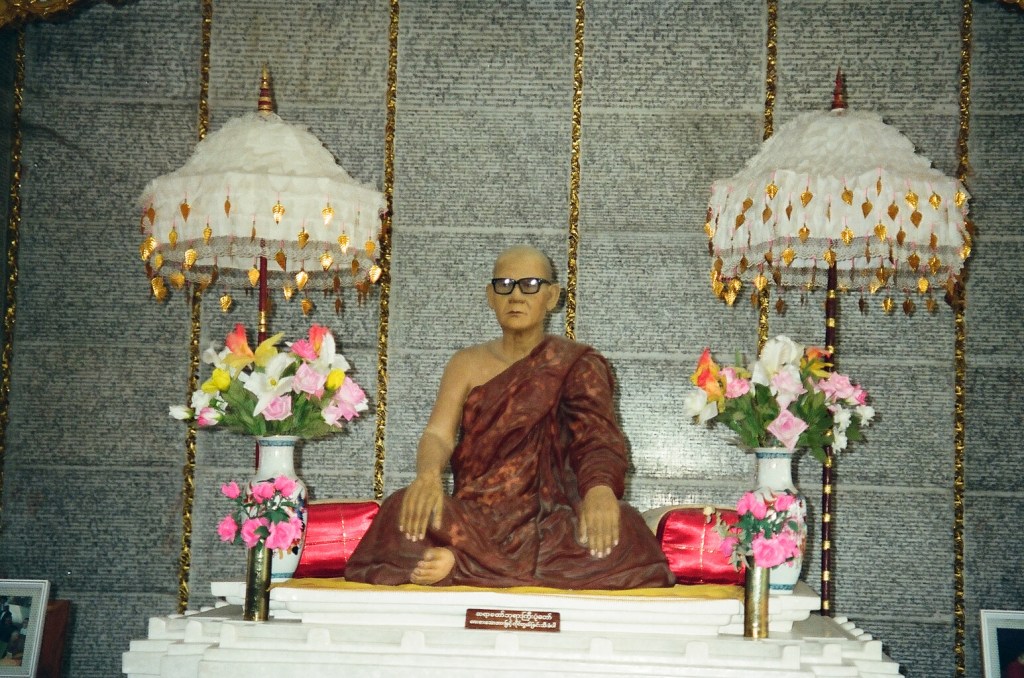
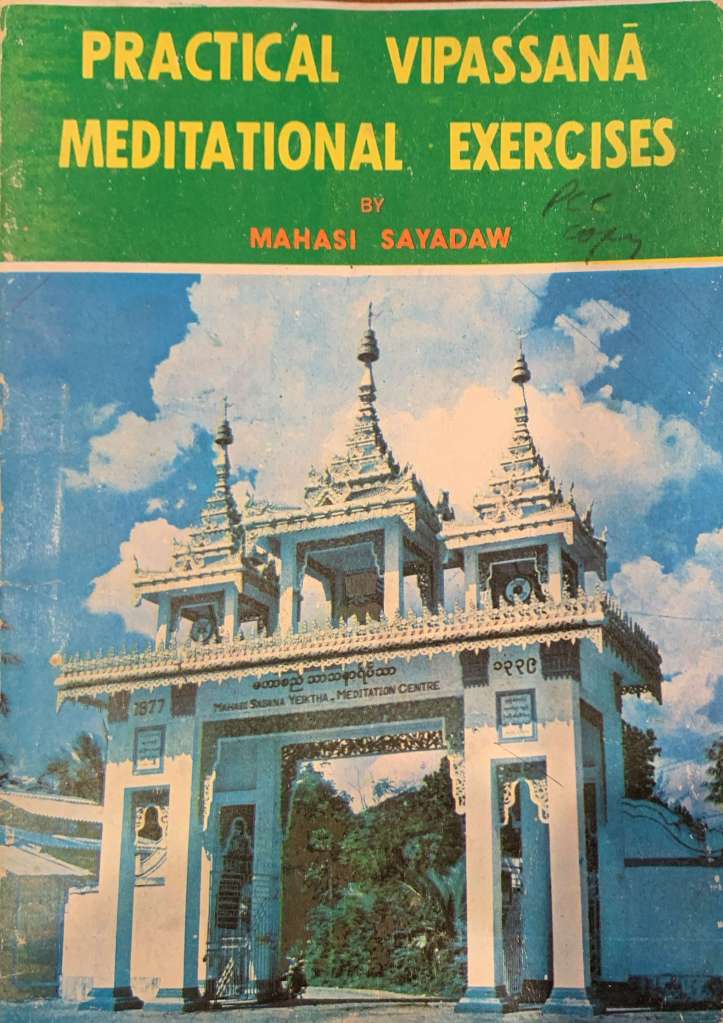
I have called Mahasi a monastery but it is, strictly speaking, a meditation center specialising in Vipassana meditation but which also functions as a monastery. It was founded in 1947 by the Venerable Mahasi Sayadaw – “sayadaw” means “monk” – who was born in 1904, became a novice monk at the age of 6 and a monk at the age of 12. He spent much of his life teaching Vipassana meditation; eventually at the center which took his name after he died in 1982 – see photo. Monks and others from all over the world who are interested in meditation, come here to study Vipassana meditation.
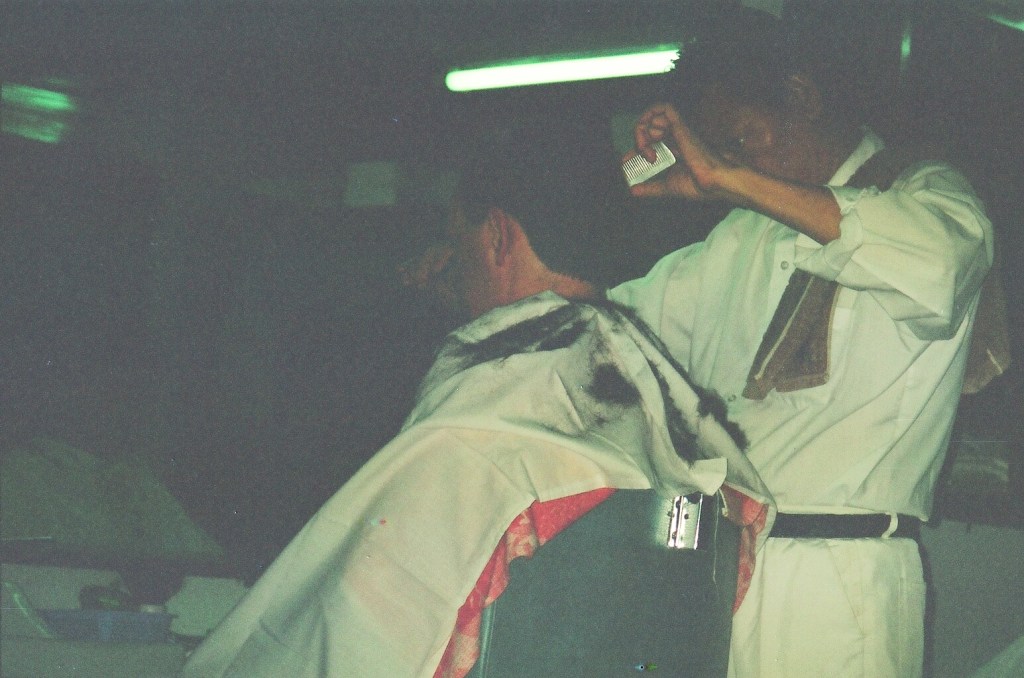
As soon as we arrived, we were taken to a wooden cottage where the monk who was to perform my ordination poured water over my head which fell onto my shirt and longyi (a Burmese sarong). Someone then shaved off my hair using a German cut throat razor which I had purchased (along with a second) as a donation – see photo. I had been advised they usually used Chinese made cut throats and that my new razors were very much appreciated. My sponsors held a white cloth into which my hair fell. Following this, I was sent to a bathroom to bathe in cold water and then return to the room wearing my longyi and wet shirt.
At 6.30AM I went to meet my teacher who was a senior monk and who gave me my monk name of “Nanavara”, which I understand is a Pali word; Pali being the traditional language of Buddha (who, as I am sure you know, was Siddhartha Gautama, a minor Indian royal prince, before he abandoned that life, founded the religion and became Buddha). I have tried to find what the name means without success, but believe it has some honourable meaning like “truth”. I found this meeting with my teacher excruciatingly painful as I had to squat for at least 45 minutes without stretching – see photo. My teacher conducted a ceremony in which I had to repeat Pali words he recited and at the end of which I was a novice monk and dressed in monk’s robes.
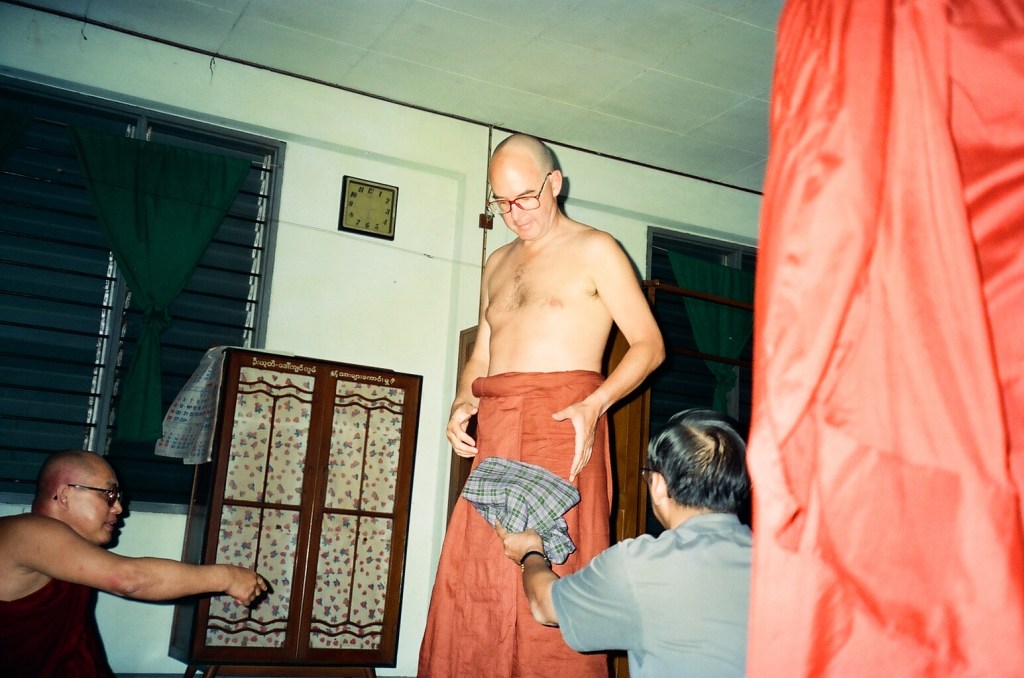
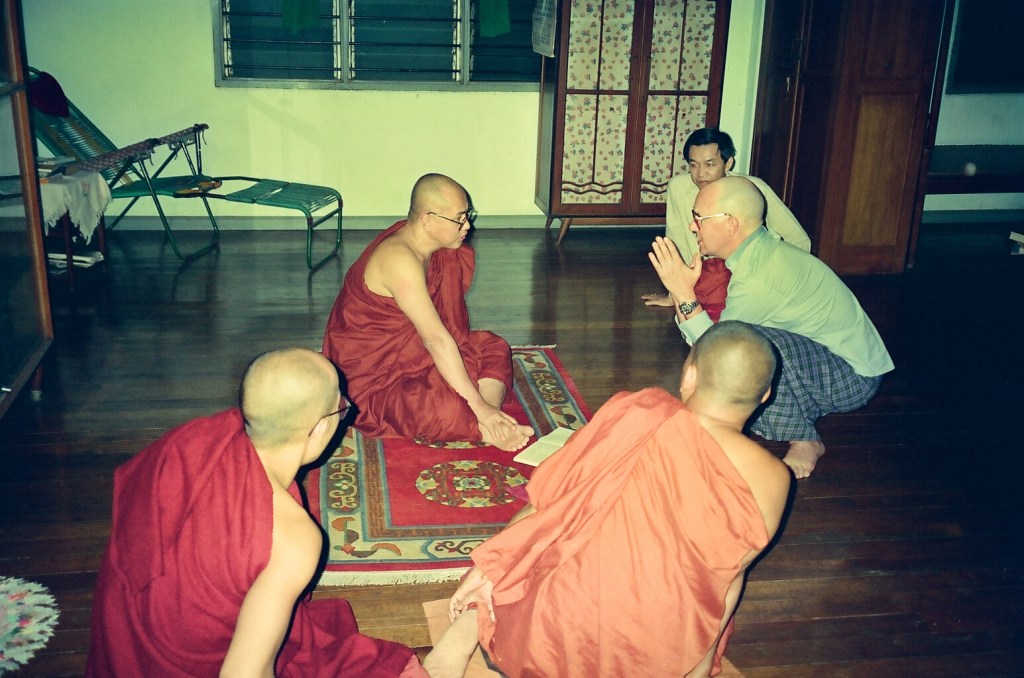
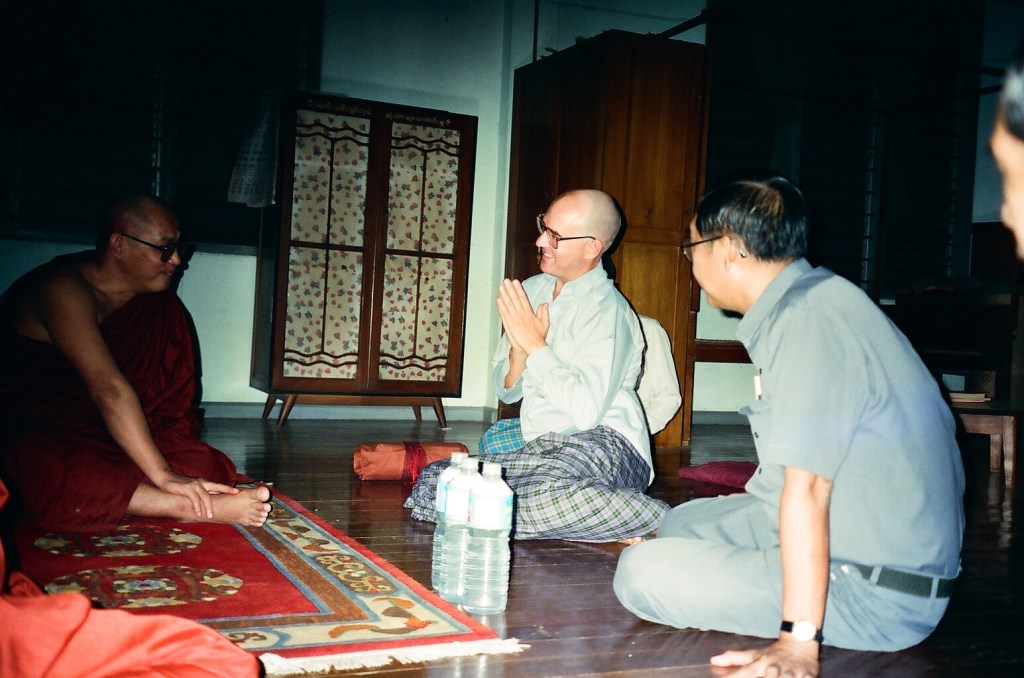
At 7.30 I was taken to my “cell” where my proposers and Nick were waiting. My proposers had kindly bought several bottles of water, toothpaste and toothbrush, toilet paper and books on meditation. The monks had kindly given Nick the cell beside mine. When I say “cell” that is what they called them but, in fact it was a small very clean room with a bed, a wooden chair, a bamboo mat and a window. Nick’s was identical to mine.
At 8AM Nick and my proposers left. Nick was to have stayed with me but he suddenly felt ill and the best place for him to be cared for was at a small hotel owned by Burmese friends. Nick’s handwritten notes of that day record, almost with surprise, that he had “my own personal room”. Fortunately by the next day he had largely recovered.
The balance of the day was spent following the timetable set out in the daily schedule –see below. You will see monks are only allocated 4 hours sleep a night. Whilst this seems extremely short, I think it may be enough given that most of the other 20 hours is spent meditating.
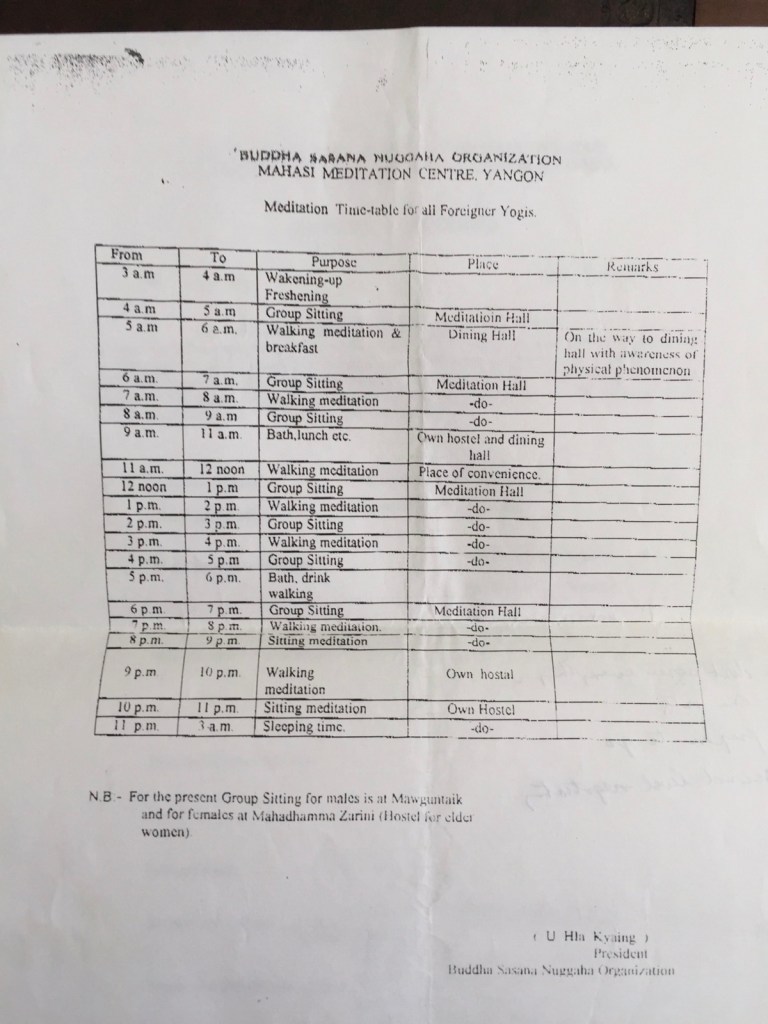
You will see the second meal of the day takes place in the time slot of 9 to 11AM. Monks, nuns, novices and visitors line up in order of their ranking (see further below) in two long lines (one for monks and one for nuns) and slowly walk to their separate dining rooms – see photos.
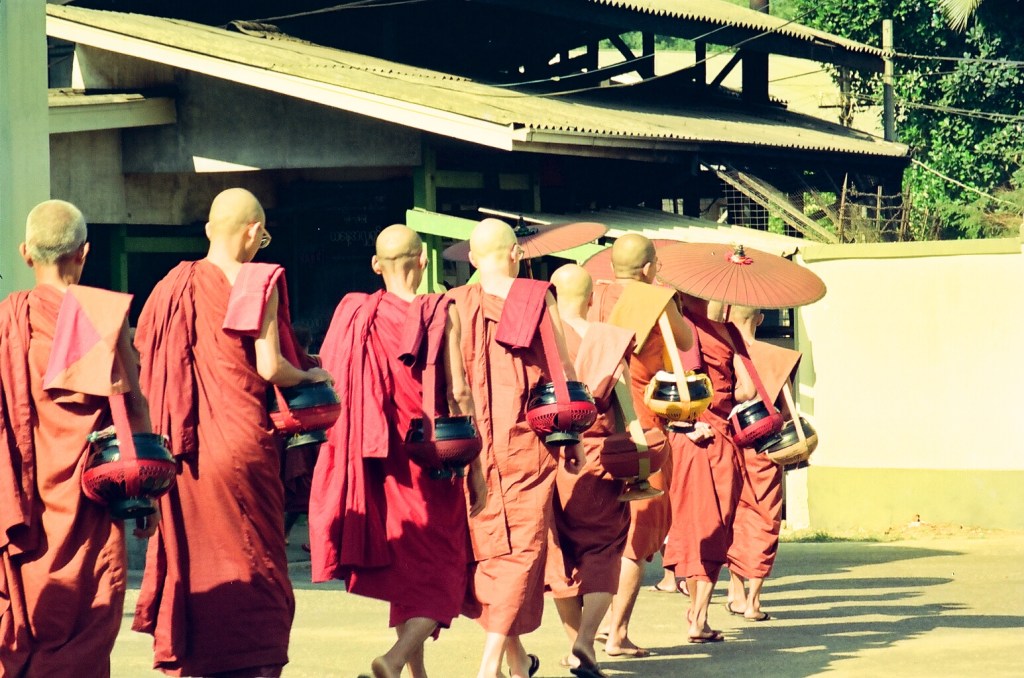
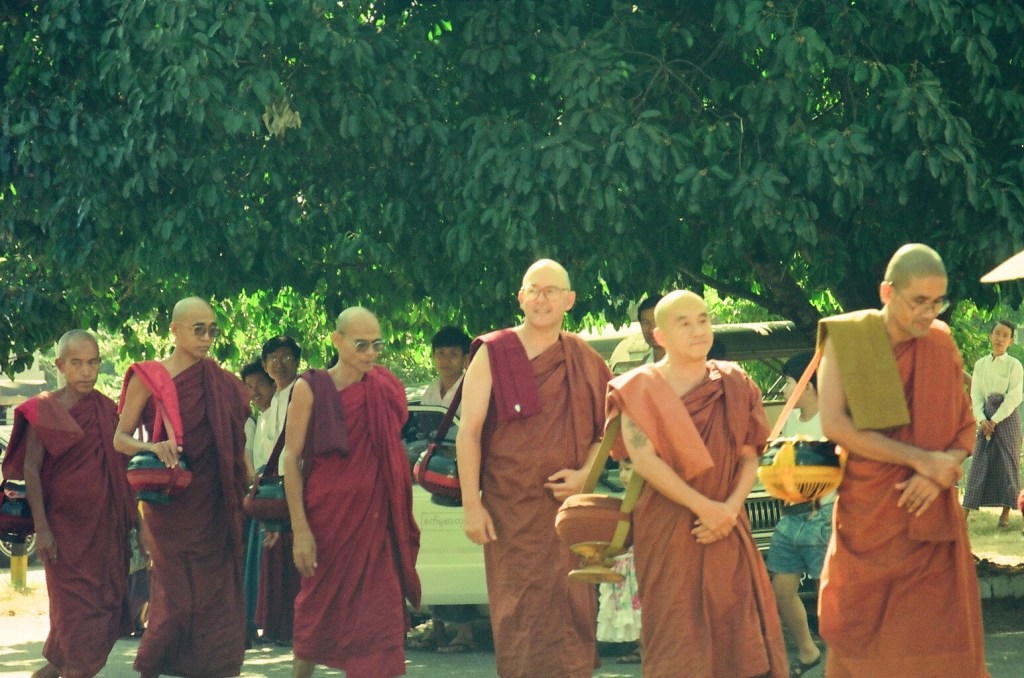
I was seated with an Indian monk, a Malaysian monk called “Buddhawangsa” and a Thai monk – see photo.
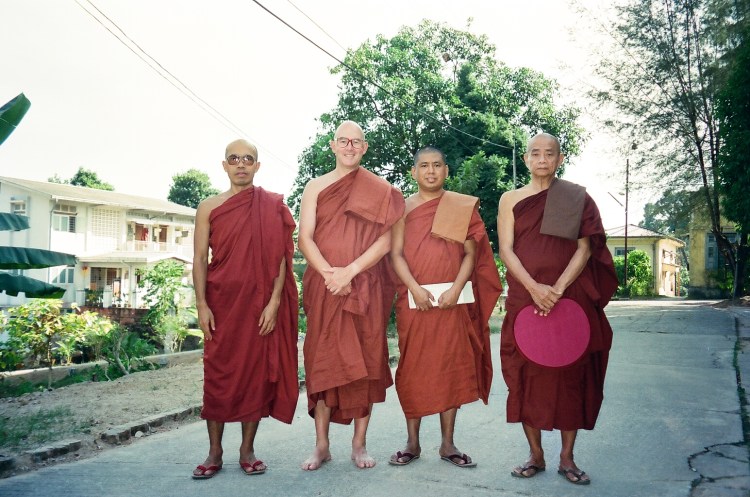
There were two surprises for me at the meal.
Firstly, I expected to be walking the streets around Mahasi to receive food from the residents which I would place in my “alm’s bowl”. In the west we often call these wooden bowls, “begging bowls”, but nothing could be further from the truth. A monk can only take what he is offered; he cannot ask for anything. Food could be sitting on a table right in front of the monk but, unless and until, he is offered the food he must leave it there. As Mahasi had over 500 monks, nuns and novices we would have caused the residents living within walking distance of Mahasi to be severely affected. These residents would feel compelled to offer whatever food they had, even if it meant them doing without. The solution was for Mahasi to have a massive kitchen where donors provided food and/or money. At the time I was staying at Mahasi, the meals for each day were donated by a different family, usually in memory of a departed family member.
Secondly, I was very curious as to what we would be eating in our two meals a day. From completion of the second meal there would be no further meal until around 5.30AM the following morning, although of course one could drink water. So as I watched food being placed on my plate I noticed that some of it looked very like chicken and tasted very like chicken. I knew Chinese vegetarian food can be made to look and taste like meat, but I was sure this was chicken I was eating. I quietly asked one of the monks at my table who spoke English what we were eating. He replied “chicken”. Remembering one of basic precepts of Buddhism is not to kill living beings this came to me as somewhat of a shock. I asked him how we could eat chicken when it involved the killing of an animal. He had no difficulty in answering this question by saying “Oh, provided we do not kill the chicken, it is ok.” I started to realise that the Eightfold Noble Path I mentioned above was likely to be interpreted quite differently by different groups of Buddhists. For example, Right Action, is interpreted by some Buddhists as meaning one should not drink alcohol at all and, by others, that it is ok to drink alcohol as long as it is not to excess.
As you will have seen from the photos of the lines going in for a meals, we each carried our alm’s bowls. Servers put food on each table and we took what we wanted and placed it in our alm’s bowls and ate with our hands – see photo. The meal usually consisted of boiled rice, a meat dish of chicken or pork, a vegetable dish, a soup, bananas or melon, cake and tea or coffee. I must say the food was excellent.

Following lunch I joined in the program for the rest of the day but I went to bed at 9PM as Nick and I had only had 4 hours sleep in the last 24 as we had flown from the Maldives to Yangon via Singapore. There was a simple thin mattress on the bed which was nevertheless comfortable. I was told to sleep in my sarong and to use the robe we cover our upper body as either a blanket or sheet. Other than my toiletries and the books on meditation I had been given, the only possessions I “owned” were my sarong, robe, alm’s bowl, sandals, a fan and one other item my proposers forgot to give me until after the ordination ceremony. This was a small piece of cloth like a small sarong which was just wide enough to tie around my waist and just long enough to cover my genitals. I was told monks should wear this when washing so they do not get tempted to masturbate! I am pretty sure one of the 227 extra precepts I mention a monk must follow includes a prohibition of masturbating.
I was allowed to “sleep in” to 4.30AM when I washed my face, cleaned my teeth and was taken down to the room of the warden who is responsible for foreign monks. He tried to teach me how to wear the monk’s robes. I was proficient at the sarong but the robe needed constant readjusting for the whole time I was at Mahasi. There were, in fact, a couple of different ways of wearing the robe for different ceremonies and functions. There was also a string belt we wore around our waist and on which hung a key to the padlock with which we locked our cells. I was quite surprised that we all had to lock our cells each day, given the basic precept of not stealing and that we had little in our rooms. It was explained to me they were not worried about monks stealing, but about visitors and thieves in the neighbourhood.
At 5.15 AM I left the warden and was instructed to do walking meditation until it was time to line up for breakfast. It is a strange sensation to see hundreds of monks and nuns walking slowly by themselves in the pre-dawn. Some looked to me like the “grim reaper” as they pulled the robe up to almost completely cover their heads.
I should mention one other important fact about Mahasi. It is a silent monastery and one is only permitted to talk to other monks or nuns in the slot set aside for bathing before lunch and in the early evening. There was no talking at meals. And perhaps you will be interested to know, monks do not “wolf” down their meals, but instead to chew each mouthful slowly and deliberately. For someone who has always eaten quickly, this was quite a challenge.
After breakfast I went back to my cell to prepare for the ordination ceremony which was to commence at 8AM. There were two questions which I had to answer at the ceremony and which I found rather strange. I was to be asked “Are you a human being?” The reason for this question was apparently at some stage a “naga” (dragon) pretended to be a man. The other question was “Are you a free man?” The reason for this is that, in early years of Buddhism in India, I was told slaves were known to escape from their masters and become monks. This seems strange to me because slavery is one of those prohibited professions and I would have thought Buddhist monks would give refuge to runaway slaves.
I was then taken to the ordination room where I could see Nick, my proposers and a number of officials from the Ministry of Industry, as well as other guests. I was the only person that morning to be ordained as a monk. The senior monk took me through the questions, a couple of which I have mentioned above. A prayer in Pali was then read out. I was then asked to wait while the monks witnessing the ceremony decide whether or not to accept me into the monkhood – see photo.
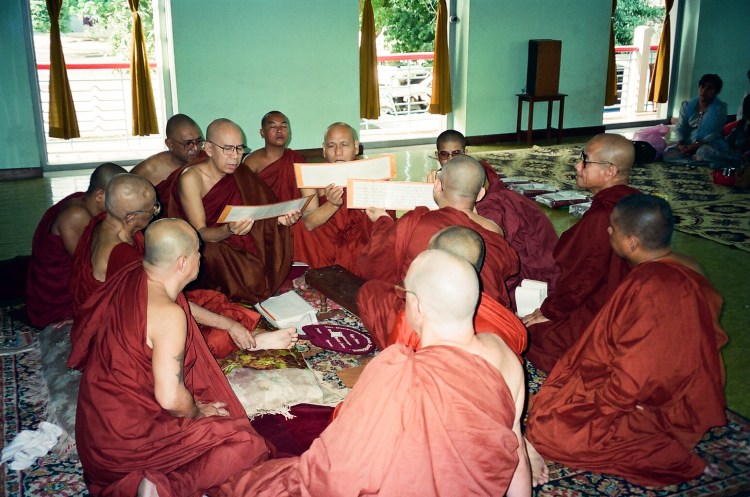
I must have passed as I was then called to sit in front of the senior monk who explains some of the key rules with which I must comply or risk automatically being “disrobed” (i.e. thrown out of the monkhood). Amongst these are sexual intercourse (even with an animal I am told!) and killing living things (curious in the context of my meal). With the completion of these explanations I became a monk. I had been seated facing the senior monk and his assistants. Upon the change in my status I was instructed to sit beside the other monks and face the guests – see photo. There followed a 30 minute sermon in Burmese.
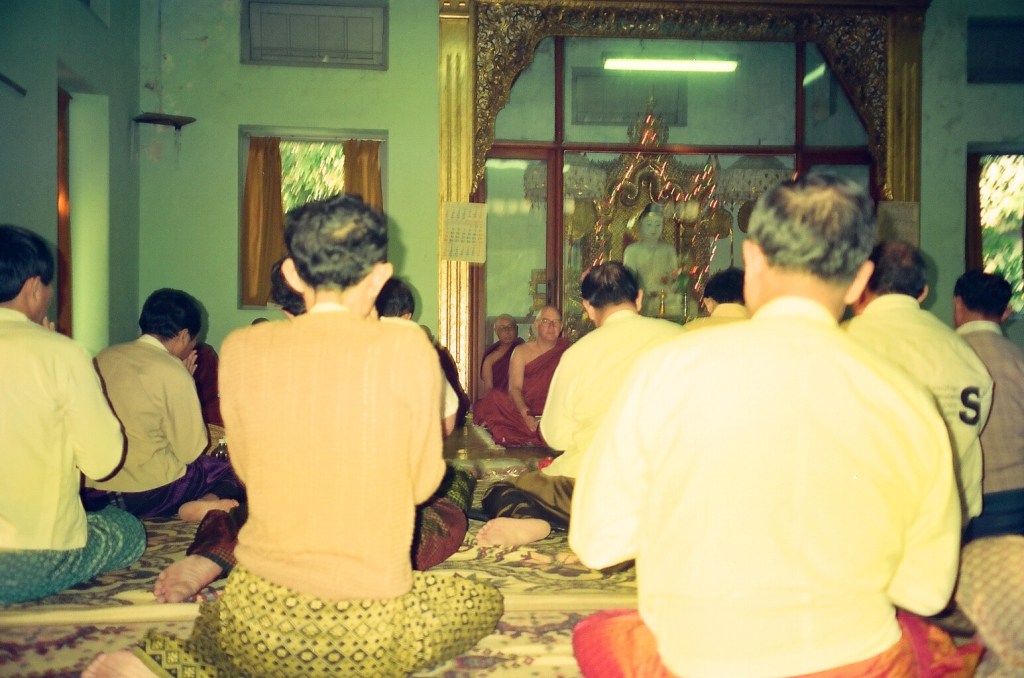
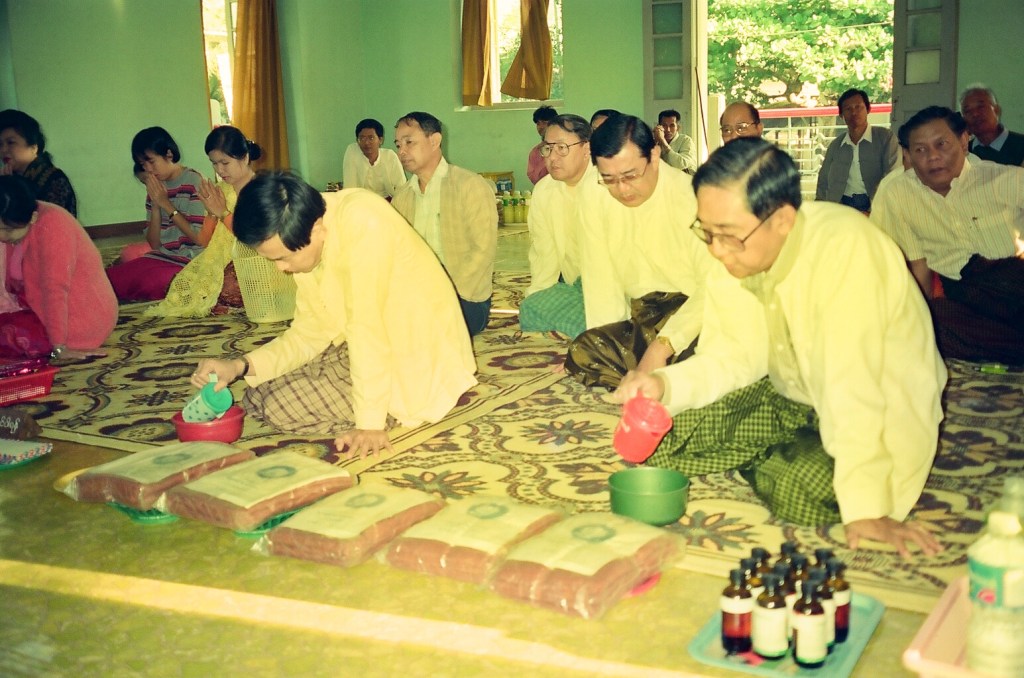
Following this, my proposers poured water drop by drop into a bowl –see photo. As they were doing this, one of the monks recited a prayer in Pali reciting the good deeds of the proposers, including their sponsoring me for ordination. I was told the water is a symbol of the good deeds and when it is poured into the ground, news of the good deeds will spread through the earth.
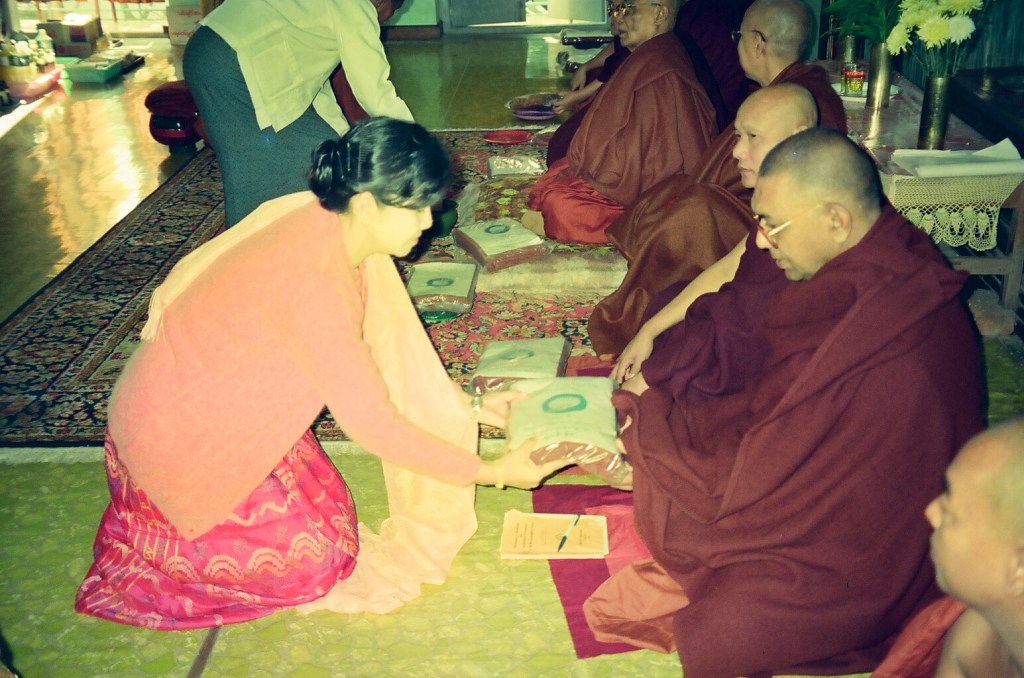
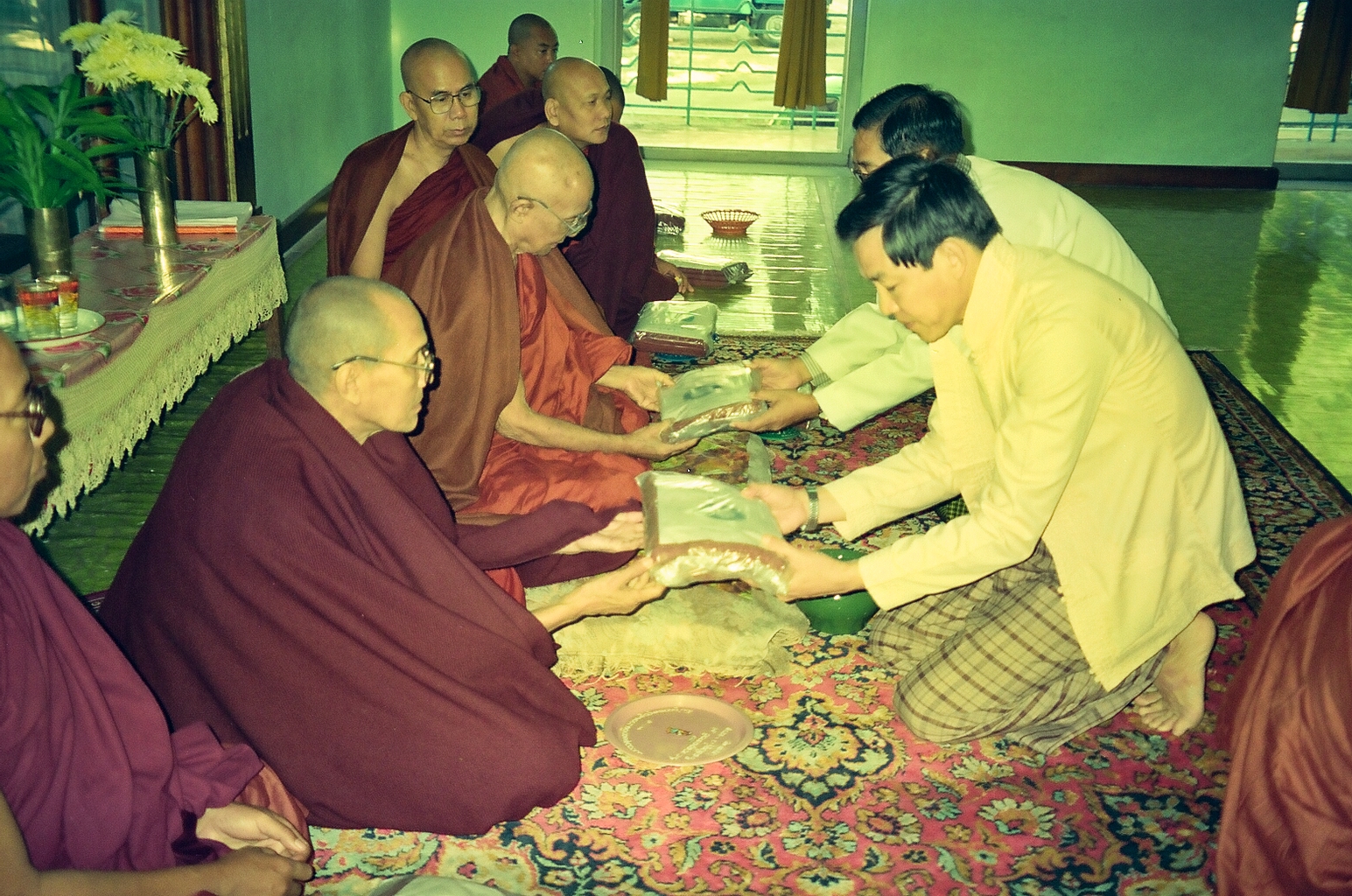
The ceremony ended with my proposers and other guests making gifts to each of the monks at the ceremony (including me) – see photos. The gifts were mainly robes, food and toiletries. These gifts were put in a basket and a lay person was selected to accompany the monk and carry the gifts back to the monk’s cell. This led to a strange experience for Nick and me. As soon as Nick and I saw each other we started to give each other a hug but were stopped by a senior monk. He explained that, for as long as I was a monk, Nick was not allowed to touch me and, on approaching me, he was required to kneel on the ground in front of me and bow three time with his head touching the ground. Sad to say, Nick has not continued this practice post our time in Mahasi!
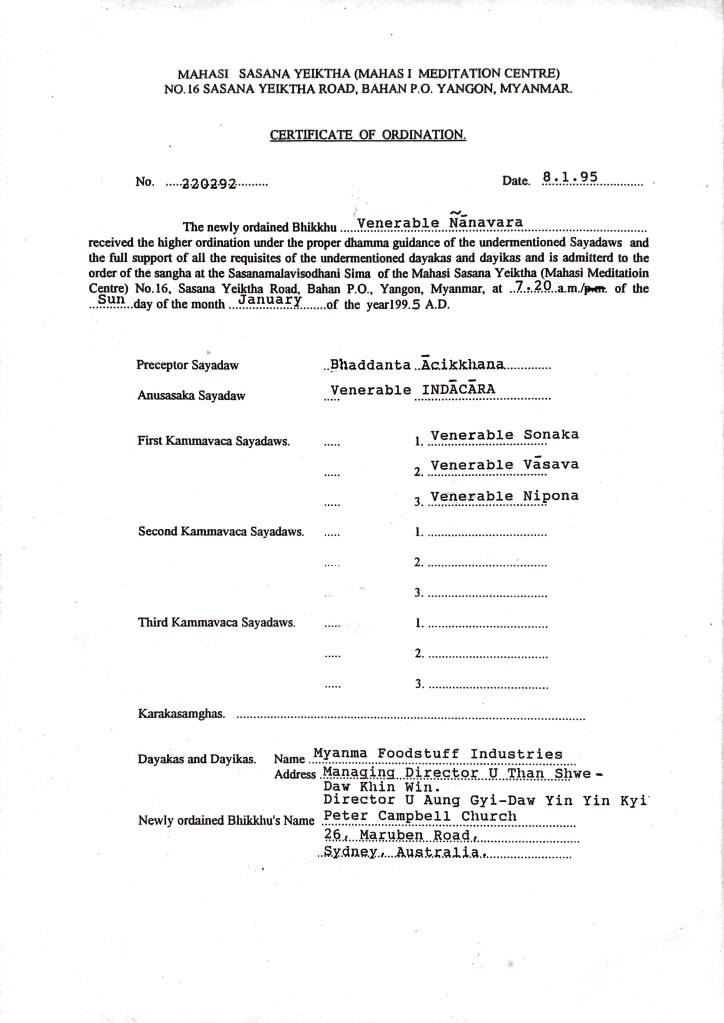
I was given a certificate – see photo – which sets out the details of my ordination. I was very surprised to learn that monks are accorded seniority based on the exact time they were ordained, rather than seniority based on merit. I am not sure how they do it, but I was told that somehow incompetent senior monks are usually appointed to roles where they cannot do damage. However, of course, this all depends on having competent monks at the top making decisions.
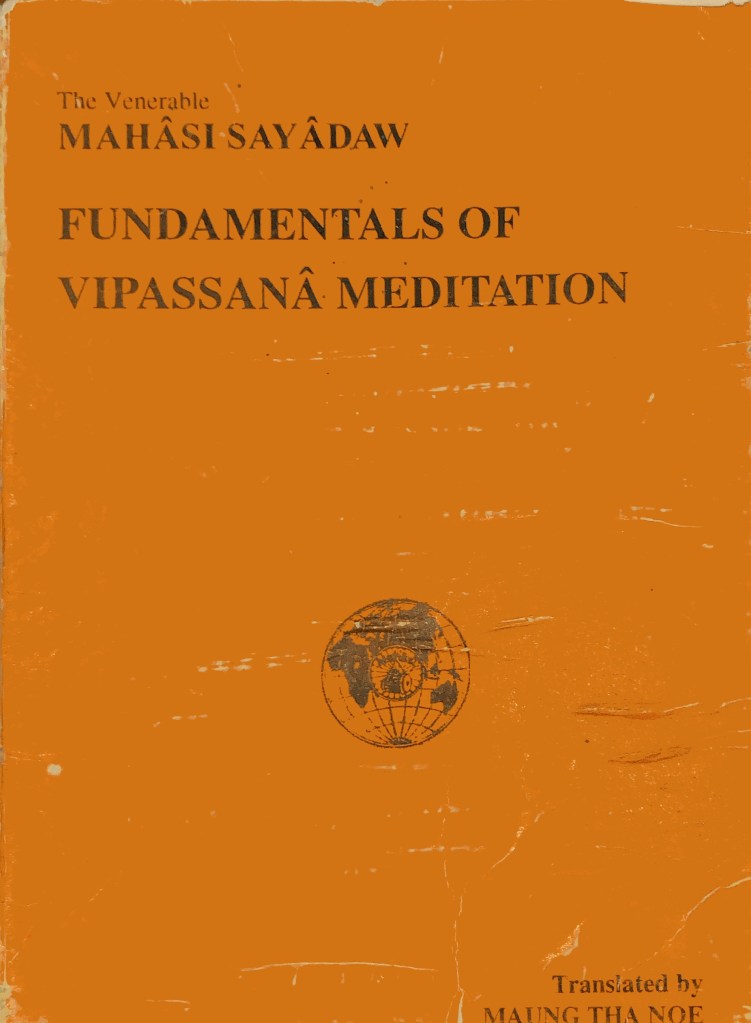
Shortly after the ceremony I was taken to meet the monk who would be responsible for teaching me meditation. This teaching is based on what Mahasi Sayadaw learnt – see photos of the covers of two of his books. As my instructor could not speak English he played a 10 minute tape in English spoken by Mahasi Sayadaw. In fact I found reading Mahasi’s books and watching the other monks to be more helpful. Whilst Mahasi operated primarily on silence we were allowed to talk to each other in the 5-6PM slot each day. My time with my instructor was over in time for me to join the line for lunch at 10AM.
As I have mentioned already one is expected at lunch to eat very slowly and not to talk. When I quietly asked a monk on my table what I should be doing, I got glares from one of the senior monks who had their own table at the front of the room. The custom was, as soon as you finished, you stood up and left the dining hall, although I tended to wait for the other monks on my table.
Nick, my proposers and several of the officials from the Ministry of Industry had stayed for lunch and after it was over we gathered together for photos – see photos– before they all left. Nick was still not feeling 100% and we decided it was better he stayed another night at the Best Inn where I knew he would well taken care of.
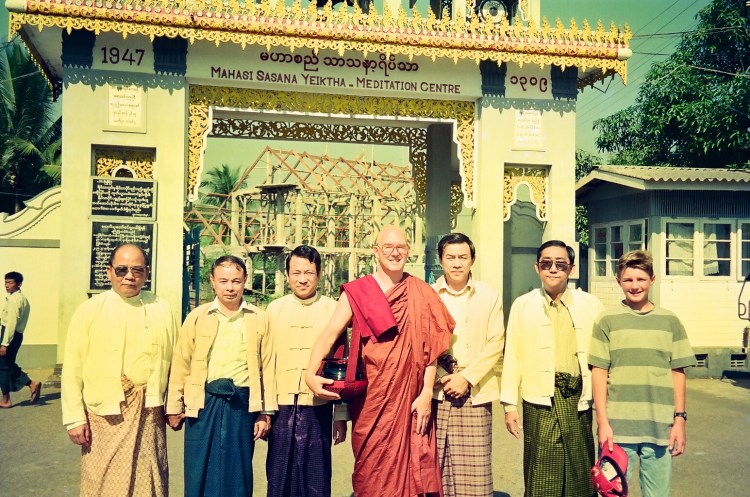
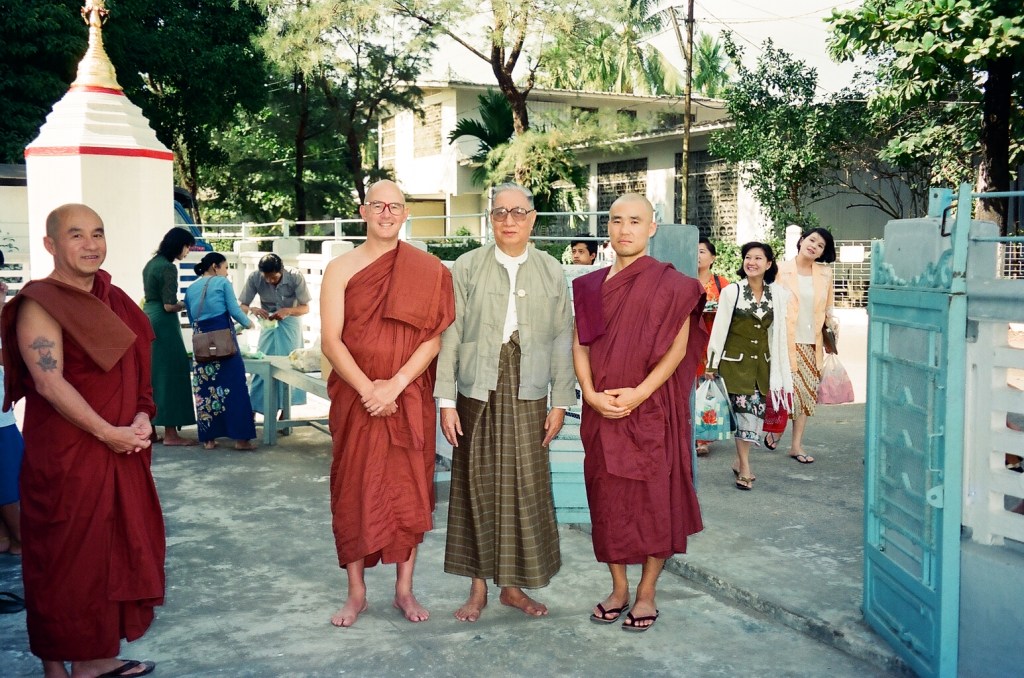
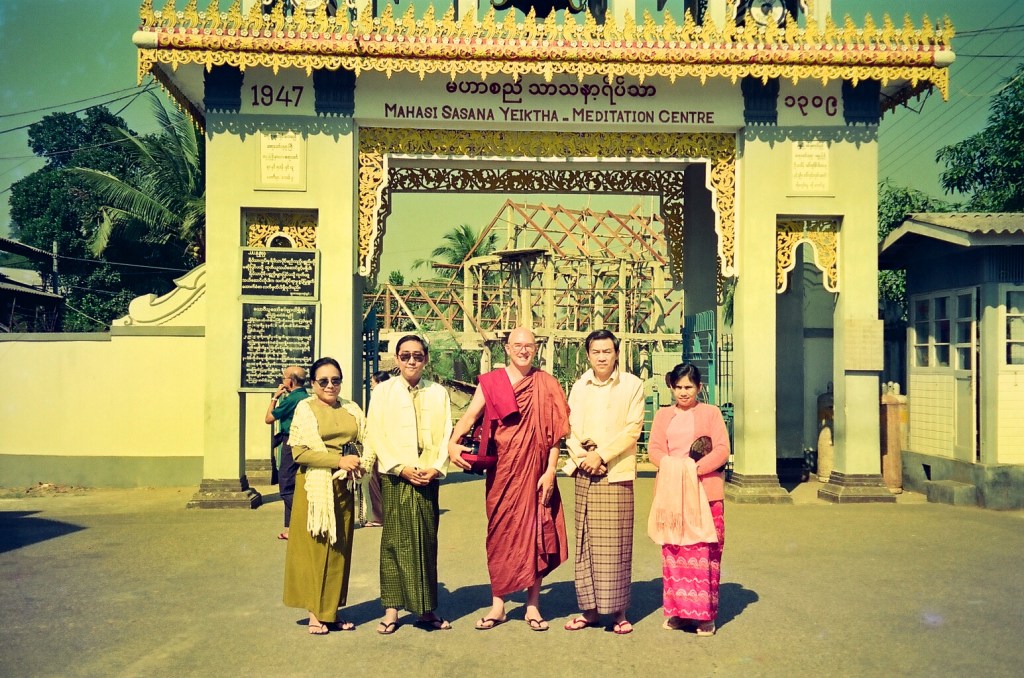
I then had a second meeting with my instructor when he suggested I speak as little as possible while I was at Mahasi and to concentrate on meditation. I was then advised to join the walking and sitting one hour meditations which alternate each hour between 12 noon and 4PM.
I found sitting meditation extremely difficult, even though foreign monks were allowed to use a cushion. Sitting for one hour without moving was a new experience for me. I had read in my meditation guide that, if you ignored an itchy nose or on some other part of the body, the itch would eventually disappear. I found this to be true and have used this technique many times since. But I am afraid my limbs were just not accustomed to being in the crossed leg position and, try as I might, I had to move every ten minutes or so.
I enjoyed walking meditation. The aim was to walk as slowly as one can and to concentrate on all the individual movements of walking, such as the heel of one foot touching the ground with the weight slowly moving through to the ball of that foot. At the same time as your weight comes onto the ball of your front foot, the heel of your trailing foot comes off the ground and your weight then moves to the ball of that foot before your back foot comes off the ground as it then moves past the other leg and the heel of that foot then touches the ground. We did our walking meditation on a 25 meter long covered verandah where the floor was covered with cool marble tiles. It was fascinating. I would walk as slowly as I could and noticed that, when I had nearly completed walking both ways, some of the other monks had barely moved a quarter of one way!
Following these four hours of meditation each of the four foreign monks and the foreign meditators were interviewed by the instructor to see how we were going with their meditation. We waited in line and a bell was rung to indicate it was the next person’s time. As I had just started, my interview was over very quickly!
I was then in the 5-6PM slot for bathing, drinking and walking and decided I wanted to ring Nick to see how he was feeling. There was only one public phone at Mahasi but there was a problem as monks are not meant to touch or be involved with money so I had to ask a lay woman who was nearby if she could make the call for me which she kindly did and, once Nick was on the phone, she passed it to me. Fortunately Nick was feeling much better and had agreed with U Aung Gyi that he would bring him to Mahasi the following day at 9AM.
Not long after making the call, U Aung Gyi popped in to visit me in my cell for a few minutes to check I was ok. He was a senior official and I felt quite uncomfortable that he insisted sitting on the floor rather than the chair or bed.
Just before I started the 6PM meditation I had a chance to have a chat to the Malaysian monk, Buddhawangsa, who spoke English. He told me that there was a Japanese yoga teacher staying at Mahasi who wanted to be ordained. However, his proposers lacked the funds to pay for the cost of the ordination, so I offered to arrange for Nick to donate the missing balance. This was accepted and led to him becoming a novice the next day and that he would be ordained on Tuesday before I left Mahasi.
I participated in the sitting and walking meditation from 6 to 9PM and then returned to my cell to read one of my books on meditation but fell asleep after an hour.
At around 3AM I heard monks getting up and doing the sitting meditation from 4 to 5AM but did not rise myself until 4.30AM to be in time to do some walking meditation before breakfast.
I then participated in the sitting and walking meditation up to 9AM when I met with U Aung Gyi and his wife who had kindly dropped Nick at Mahasi. This was the time for washing and lunch.
Following lunch, I participated in the meditation program through to 9PM when Nick and I retired to our cells. Nick, of course, did not have to participate in the meditation program and spent most of the day wandering Mahasi and occasionally popped in to see how I was going. U Aung Gyi and his wife were extremely kind and popped in again during the 5 to 6PM break to give Nick some sandwiches as they knew a teenage boy would be hungry and there was no need for him to follow the rules for Buddhist monks who only eat twice a day with the second meal completed by midday.
On Tuesday morning I decided to participate more or less in the full program and got up at 3.30AM so I could participate in the sitting and walking meditation before breakfast. I woke Nick shortly before 5AM so he could have a quick wash before joining the line for breakfast. Being now a monk I had moved up the line from the day before, whereas I think Nick as a new arrival and being neither a monk or novice was at the end. After breakfast, I participated in the walking and sitting meditation up to 9AM, whereas Nick went back to bed! It was on my way back from meditation I met U Aung Gyi and his wife who wanted to discuss the arrangements for my disrobing and leaving Mahasi. We agreed 5PM.
I then washed and got ready for lunch. We had to wear our robes a different way for lunch as a wedding had taken place that morning at Mahasi and the couple had donated the funds for our lunch that day. This new method of wearing our robe involved the robe being wound tightly around one arm. Mine kept falling apart.
After lunch Nick and I returned to our cells and we set about donating everything I had received to the other foreign monks – see photo.
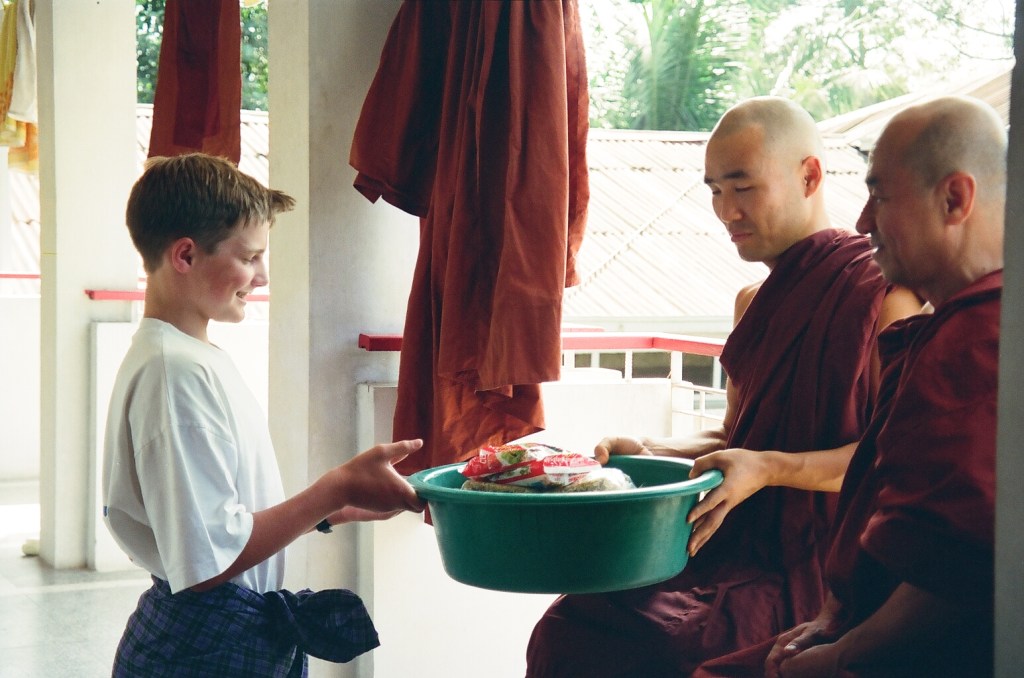
As I had made the donation which enabled the Japanese monk be ordained I was invited to participate in his ordination ceremony. I was told this was a great honour for a 3 day old monk and I really appreciated the gesture.
As I knew I would be leaving later that day and would be participating in the ordination ceremony for the Japanese monk, Nick and I spent the next couple of hours talking to monks in the building where our cells were located and who had also decided not to participate in the meditation program for a few hours. Clearly one was not expected to participate in every meditation session, but I am sure if one was seen not to be participating enough, you would be asked to leave. This gave me a chance to discuss a number of Buddhist concepts with these monks such as a re-birth. I found I was not alone in believing that this need not be interpreted literally. I compared the Christian concept of “heaven and hell” with the Buddhist concept of “rebirth”. Both encourage one to lead a good life with the former sending a non believer who has not led a good life to “hell” whereas a Buddhist who fails to lead a good life is likely to be reborn as a lesser human or other living being.
At 2.30PM Buddhawangsa and I met with the senior monk who was to conduct the ceremony for the Japanese man. We had to recite a Pali prayer before we entered the ordination room. I was told that at the point one is ordained it is considered one is pure.
The ceremony for the Japanese monk was not remarkable as it was identical to mine except that this time, along with the other monks conducted the ceremony, I received the gifts from the proposers which, immediately after, I redistributed to Buddhawangsa. There is however, one particular memory of the ceremony. I was sitting beside Buddhawangsa and noticed a number of ants heading towards us. My instinct was to brush them away which I am sure would have caused a few casualties. Just as I was about to do this, Buddhawangsa bent over and gently blew them away from us.
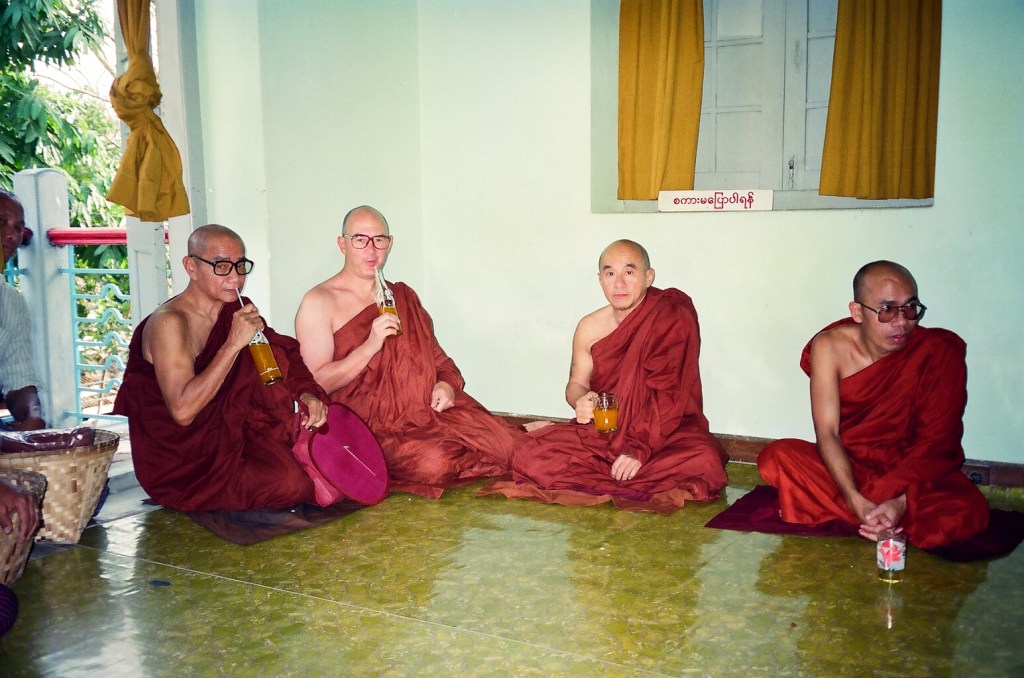
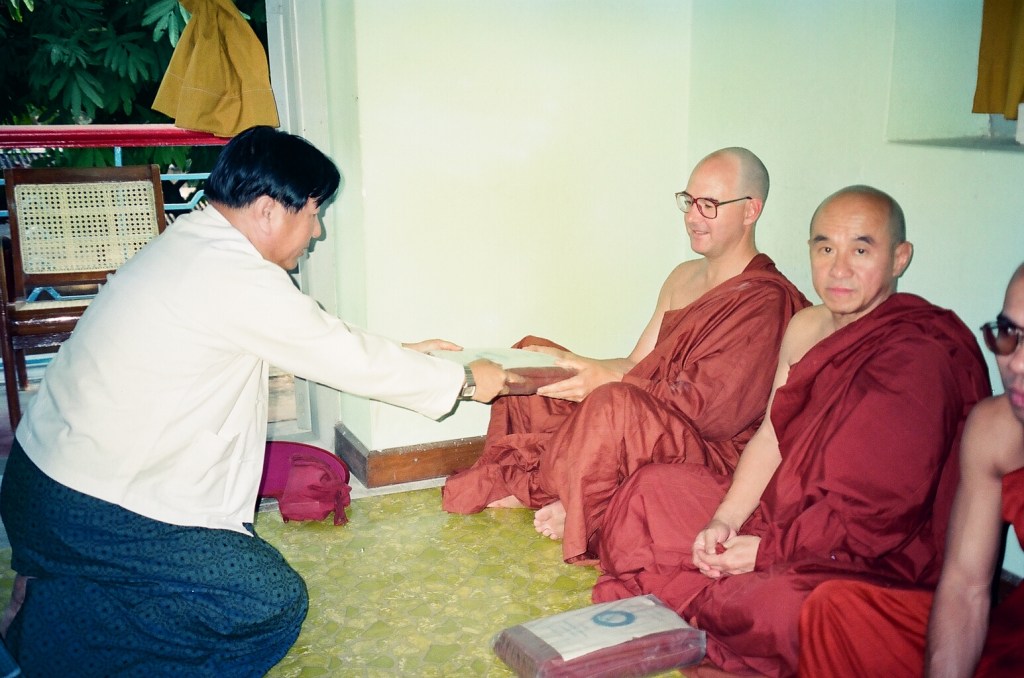
A short time after the ordination, U Aung Gyi, Nick and I met the lay chairman of Mahasi and Nick handed over our donation – see photo. The donation was to be split into two parts. One part was a contribution to a building program whereas the other was to help create a fund where the interest on the principal would be enough to feed all those at Mahasi. I was told it cost $1 per day for food for each of the 500 monks and nuns. It was fascinating for me to see when I returned to Mahasi about 15 years later with Nick’s close friend, Mitchell Brown that they had created a wall where the names of all donors were listed. It took us some time but eventually we found our donation – see photo.
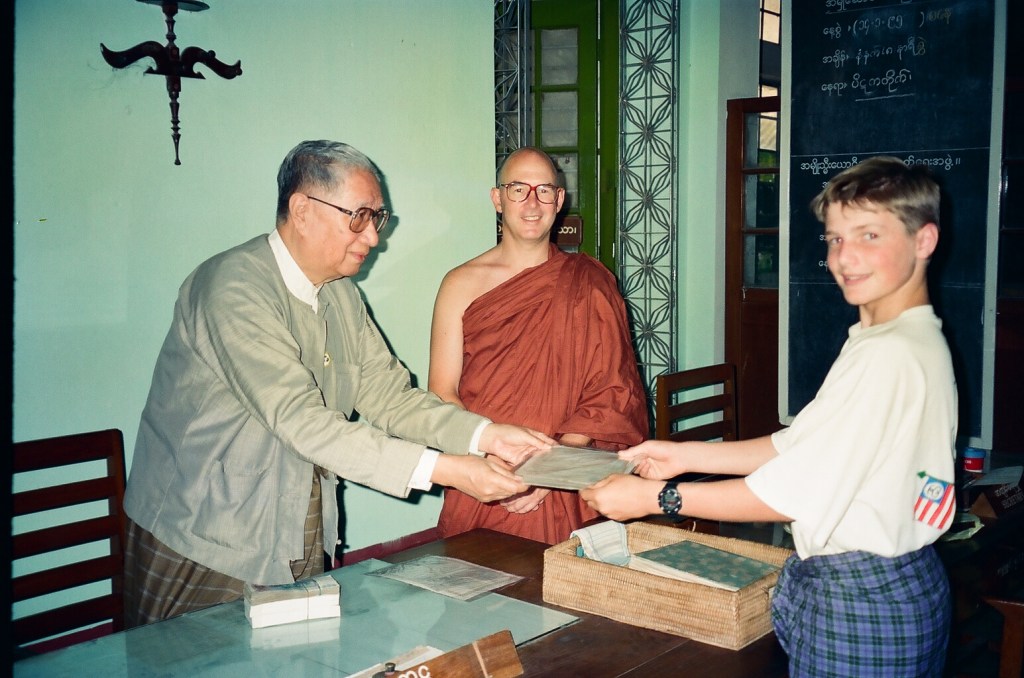

We then headed off to meet the monk who had been my instructor for the disrobing ceremony. This took about 15 minutes and involved me having to tell him I no longer wanted to be a monk and he had to say that he had heard me. At the halfway point, my monk robes were removed but, before they were, I had to put a longyi on under my monk sarong so that I would not be naked when the monk sarong was removed.
I was back to being a normal man and Nick could finally give me that hug. It was a wonderful and unique experience to share with Nick and one which I know we will forever remember.
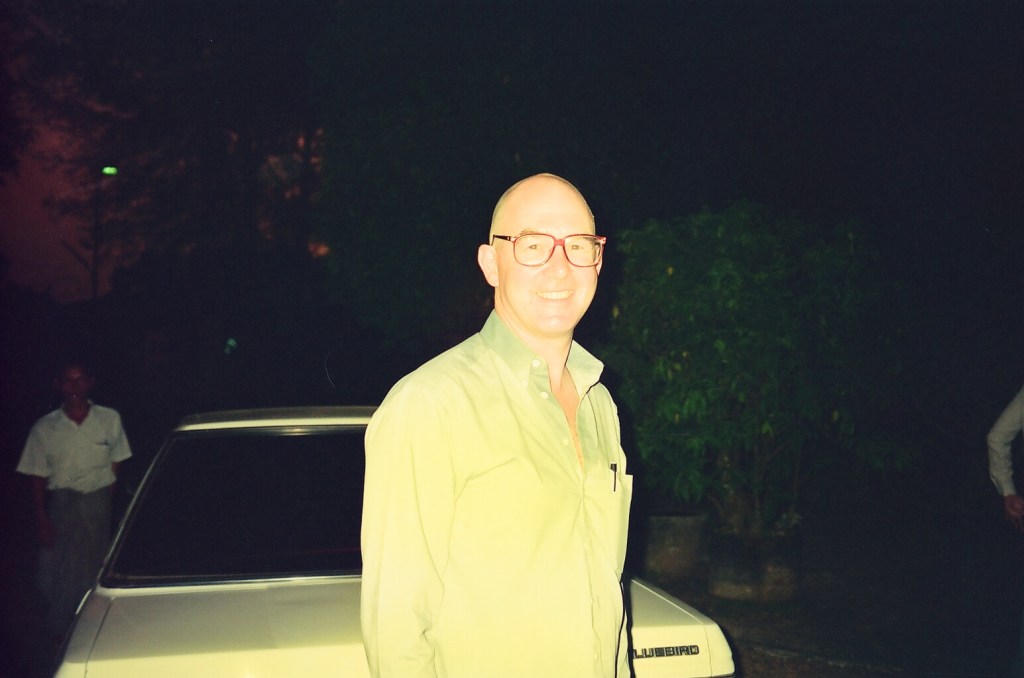
Professor MS Swaminathan -a giant in Indian agriculture
I have been very fortunate to meet many inspirational men and women during my life and Professor MS Swaminathan would be right up there; not just in terms of inspiration but also his contribution to India and the world over his long life.
He was born in 1925 and thus when I interviewed him in 2007 in New Delhi he was 82. I am pleased to say that Prof. Swaminathan is still with us today in mid 2020.
Like many of those who have achieved greatness in pursuing a passion rather than chasing dollars or fame, he seemed to me calm and content and certainly did not have that A+ personality or ego we often associate with successful business people.
One of the first lessons in life, he learnt from his father when he was a small boy. His father was a prominent doctor and had a deep social conscience. The shocking disease of elephantiasis was common in his village and it seemed that almost every third person had it.
His father decided to see what he could do to eradicate the disease. He knew it was carried by mosquitoes, but there was no chemical in those days to kill mosquito larvae, but he knew that they bred in still water. He instructed villagers to get rid of any still water they did not need and to poor crude oil on top of the water if they needed to keep it. The villagers trusted Swaminathan’s father and followed his instructions. Within a year the mosquitoes were gone and the incidence of the disease decreased significantly. The lesson young Swaminathan learnt was the power of ordinary people to get seemingly impossible tasks done.
His father died when he was only eleven and his father’s brother, as was the custom, took on the role and responsibility of caring for Swaminathan’s family. These were tough times. However, Swaminathan excelled in his education and was able to commence his university studies when he was only 15.
He chose to study zoology but, by the time he completed his bachelor’s degree, he knew agriculture was to be his passion. Part of the reason was that, while he was studying, the Great Bengal Famine of 1943 was in full and devastating swing, killing over 3 million Bengalis. [Compare this to the concerns we currently have about the death rate from Covid-19.] We now know the reason for the Great Bengal Famine was not the weather but a disgraceful policy of the British Government. Churchill, who was Prime Minister at the time, deliberately ordered the diversion of food from starving Indian civilians to well-supplied British soldiers and even to top up European stockpiles. Swaminathan told me, “For me it was blindingly clear that the most important thing for India after WW2 was going to be food.”
After completing a second bachelor’s degree in agriculture, a few years later he earned a PhD from Cambridge University for his work on the breeding and genetics of potatoes, so that they would be resistant to a disease that destroyed many crops during WW2. This experience taught him, not only the importance of potatoes as a basic food stuff for Europe, but led him to turn his mind to what he should do in India to secure its food sufficiency.
His research into developing a dwarf wheat variety which was resistant to disease took more than a decade but, by the mid 60’s, Swaminathan had perfected the seed and the crops gave farmers up to a 300 percent increase in their crops. This huge success created a problem which is worth understanding. From the times of the British raj, the British exported everything India could produce so that the storage facilities were all at the ports and India became dependent of food imports. New storage facilities had to be built where the wheat was grown. India’s tough and dictatorial Prime Minister, Indira Gandhi told him “We must safeguard food security for national sovereignty; otherwise I will have to surrender my foreign policy if I need to feed my people with imported food. I think she felt President Lyndon Johnson behaved patronisingly in providing India with wheat.” And I imagine in all their minds was what happened during the Great Bengal Famine.
Swaminathan impressed all who worked with him and, after the Gandhi Government fell, he was appointed Minister of Agriculture by Prime Minister Morarji Desai. Not long later Desai’s government collapsed and Gandhi returned to power. She invited him in 1980 to be Deputy Chairman of the Planing Commission. This was not a role he wanted as it took him away from agriculture.
Swaminathan then told me a story of an event in his life which I have always remembered. Not long after to took the role he was invited to become President of the International Rice Institute in Manila. This appointment was the most prestigious and important for any agricultural scientist to aspire to. You only need to consider the importance of rice as a food crop to most of the world’s population.
Swaminathan went to meet PM Gandhi who was a formidable woman to ask her permission for him to accept the appointment and resign his role as Deputy Chairman of the Planning Commission, which itself was an extremely important institution. He went through all of the pros of him taking the Presidency. When he had finished the Prime Minister said to him, “No you cannot go” and then, after a pause, “you are indispensable.”
This took him aback and, as he told me, he has never been good at thinking on his feet. Somehow he said the following words leapt from his mouth “Prime Minister, since you say I am indispensable, then I must leave.” She looked perplexed at Swaminathan and asked him “What did I say? Did I hurt you?” His reply to her was brilliant. He said “You said I am indispensable and I feel I must go. I must go when I am wanted not when I am not wanted.” He could see Indira Gandhi repeat these words over to her self a few times – “you must go when you are wanted not when you are not wanted.” He was very concerned as to how she was going to react as she was known to have a fearsome temper. Suddenly she stood up and said, “You have my blessings.”
During his time in Manila, Swaminathan personally received many international awards and grants for his earlier research and these funds enabled him to establish the MS Swaminathan Research Foundation in 1989 following his six year term at the International Rice Institute. This is where he has spent most of his time his since and particularly focused on the environment. Because of his decades of work on the environment he has become known as the “father of the green revolution” and has been recognised around the world for his work. I think he has been awarded over 50 honorary doctorates.
As Professor Swaminathan walked me to the door of his Delhi apartment he told me everyone should have a mission in life. “When I was young I used to read many philosophical books, like Swami Vivekananda, in particular. Some 100 years ago he said, ‘This life is short, its vanity is transient; one day you may be here and another day you may be gone'”. For those of you have read my blog on the life of Shahnaz Husain you may remember Shahnaz’s father told her the same thing. As I am closing in on my 70th birthday these words resonate with me more than they probably did 20 years ago.
As Professor Swaminathan shook my hand and bid me farewell, as he was closing his front door he said to me, “Remember Mr Church, he alone lives who lives for others.” Powerful words to end my meeting and certainly a cause for reflection about my own life.
Ela Bhatt – a remarkable woman

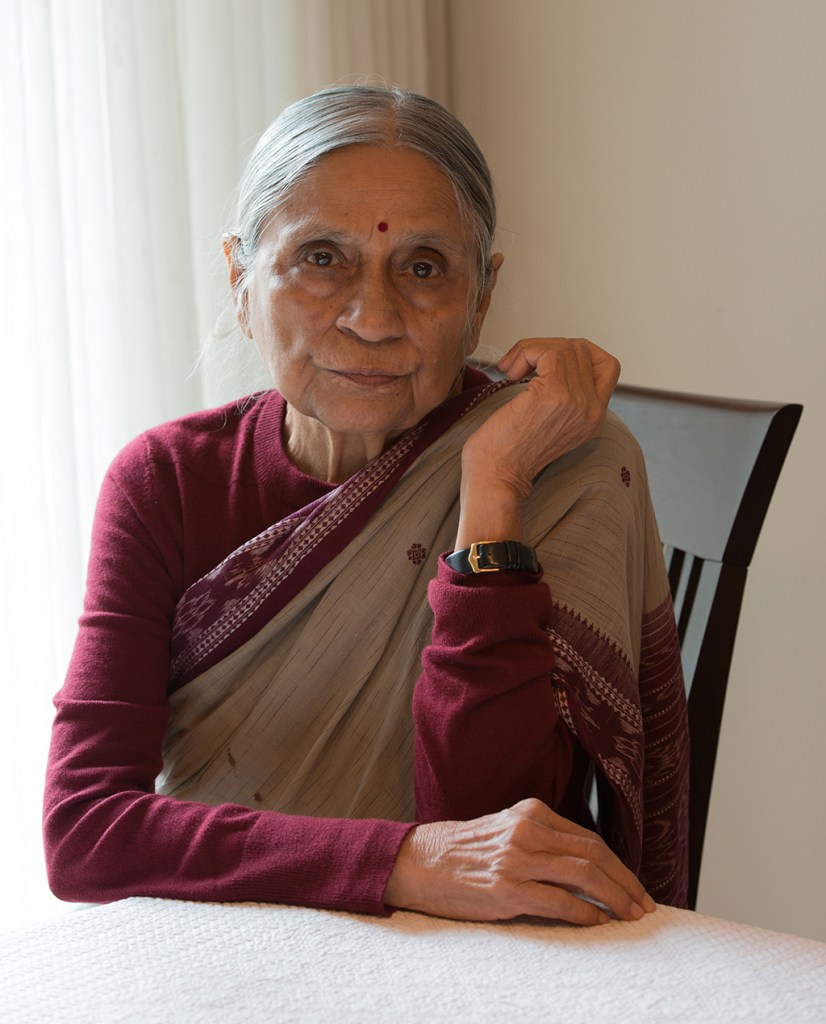
Ela Bhat is indeed a remarkable woman. She was born in Ahmedabad, Gujarat into a life of wealth and social standing in Ahmedabad in 1933. Her parents were Nagar Brahmins. As most of you may know the highest caste in the Hindu religion is that of Brahmin and it is from this caste that Hindu priests are drawn. All Brahmins believe in the importance of education over wealth and it was into this world Elara was brought up.
Her father was a successful lawyer who, in due course, was appointed “to the bench” as a judge whereas her mother’s father was a doctor. Her mother’s side of the family were staunch nationalists and many of whom spent time in jail as a result of their fight for independence from Britain.
Her mother had to stop her education in 6th class of primary school but was determined, once she had had her three children, to complete her education. At night Ela’s father coached her mother and over a decade she completed, not only her secondary education, but graduated from university and became active in the women’s movement in India.
Ela graduated from school at the young age of 15 and went to university to study law. It was here her world got turned “upside down”. She fell deeply in love with Ramesh who was two years ahead of her at law school. He too was a Brahmin but came from difficult family circumstances, as he lost his mother when he was five and his father was very poor and it fell to Ramesh to support the family. To Ela he was, as she told me, “brilliant and handsome.”
Ela was desperate to marry Ramesh but her father told her “we did not educate you for this…. Have you seen poverty? How are you going to spend your life in poverty? You know getting married is not an ordinary thing: it is not just romance.” To prove her parents wrong she left home and spent a year living in a village of landless labourers and cut off contact with Ramesh. As Ela recounted to me “Of course I could survive for this short period because of my caste and my education as I was not actually poor.” I was surprised to learn that, because she was a Brahmin, these poor landless labourers who largely accepted their ‘lot’ in life would often give her extra food with the excuse or belief that, if they did, they would receive good luck.
On her return from the village her parents finally accepted Ramesh and they were married in 1956. But her life style was changed; from living in a large house she moved to a rented room.
Not long before she got married she started working for the Textile Labour Association (TLA) which was one of the most powerful unions in India with close links to the ruling Congress Party. She worked there until 1981 when, as Ela puts it, “they threw me out”. Ela became a skilled labour lawyer protecting the rights of textile employees. But change was happening and during the late 1960’s mills all over India started to close down. Ela was asked to go to the homes of these now unemployed workers and find out how they were surviving. The answer was “women”. It was the women who were managing the home, earning money and feeding the family. They sold fruit and vegetables in the streets, stitched in their homes at piece-rates for middlemen, worked as labourers and many other roles, including collecting refuse. Ela realised these women were not protected by labour legislation and, in fact, accounted for a huge workforce nationwide.
Ela set about organising a union for these women and, after a long battle with bureaucracy, achieved the registration of the Self-Employed Women’s Association (SEWA) in 1971. She cleverly called these women “self employed” rather than “unemployed”. The next challenge was how to help these women financially. Many middlemen preyed on their situations charging huge rents for their use of equipment like sewing machines and carts. Indira Gandhi, the Prime Minister at that time, was pushing the banks to lend to small borrowers but, firstly the banks did not know how to reach these people, and secondly they did not see them as reliable borrowers. Chandaben, one of Ela’s close colleagues asked why they could not establish their own bank. Ela, as a good Brahmin, had avoided being involved with money and responded to her “But we are so poor” to which Chandaben replied “But we are so many”. Years later this became the title to Ela’s biography.
It took three years of hard work for the SEWA bank to be registered. One of the issues was that almost all of the women were illiterate and the banking regulator would not accept thumb print impressions. However, Ela came up with the alternative of using a photograph of the woman with her name underneath and which was accepted by the banking regulator and is now widespread in its use by other banks. From the bank’s second year of operation it has always paid a dividend.
Ela continued as a fierce advocate for the rights of her women members until she retired as Chairwoman at SEWA’s Annual General Meeting at the age of 65 in 1998. Her last day was not as she or anyone would have predicted. The elections of the new committee proceeded smoothly and at the end of the meeting Ela had no role. “To be honest, I had hoped someone would stand up and say a few good things about me; but there was nothing. After the meeting I came downstairs to my office and sat in the chair for the last time, but everything inside of me felt empty. I picked up my bag and left the office and got into my rickshaw. But there was a lump in my heart. I knew perfectly well that my SEWA colleagues were stunned and did not believe I would really retire and that they did not have the words to say anything at this time. I knew all of this but still I felt bad.”
But as we all know sometimes ‘one door closes and another opens’ and in many cases most unexpectedly. This was to be the case with Ela. As she told me “I could not cry. Then I came near my house where there is a music school on the left in the road. So I saw that and asked my driver to stop the rickshaw. I went in and upstairs into the school….There was a lesson in progress and I just sat there and waited for it to finish. The teacher came over and asked if I wanted to join a class. I told him I would and so he asked me to sing a few things to find out my level. The following week I joined the music school.”
The point of this story, she says, is that she always told her husband that she wanted to learn music and that he always gave her the standard boring answer of “Ela, there is a time for everything, there is a time for everything.” She suddenly realised that the time for music had come. She had not prepared for music to play a role in her post SEWA life but it has. “Music has become my passion; if I had not spent all those years at SEWA, I am sure they would have been spent on music.”
There is surely a message in Ela’s life for all of us. Just because your “day job” ends, it does not mean that beyond that there is not something else just as satisfying to take its place. Ela found hers at 65 and, as I turn 70 this year, I wonder if something new lies ahead for me?
What a way to fly
During our time in Jakarta we used to return to Sydney for “home leave” each Christmas to spend time with family. Those Australian readers of my age would remember how back in the 70’s and 80’s, our trade unions were quite militant and the union representing the baggage handlers at the airports worked out, if they threatened to go on or actually went on strike over the Christmas holiday period, their employers would quickly cave in to their demands.
I think it must have been early in December 1979 that we heard that the baggage handlers were threatening to go on strike close to Christmas Day. Ginny and I decided that it was not worth Ginny taking the risk and so she took a flight in mid December with the idea I would follow on an overnight flight on Saturday 22 December.
Early in the week before my flight I was conducting a round of interviews to try and identify an enterprising young lawyer to join our law firm. Many of the interviews went ahead exactly as one would expect anywhere in the world, but there were some standout differences. I am not sure how many of you have heard of this but in India it was, at that time, quite common for applicants to fill their cv’s with all sorts of irrelevant information including, for example, that they had failed to get a particular degree at university. That very week I had my first and only experience of this in Indonesia. A young man handed his cv to me at the start of our meeting and there it was for all to see “BA (failed)”. In some cases I suspect this is included to show that the person had the requisite marks to get into university but, in sadder cases, it might mean they could not afford to continue their studies due to some family mishap. In the same week another young man came into the interview with an enormous suitcase. He sat down and handed over his cv and, as he took me through it, he would open his suitcase and hand over a framed degree or certificate as evidence that he really did have the qualification mentioned in his cv. However, he did not just have his law degree diploma in his suitcase but he had many framed certificates for even attending one day seminars. It was no wonder the suitcase was bulging.
So you can imagine what a “breath of fresh air” it was when a young woman candidate met with me and was extremely professional in her interaction. As I have mentioned in another of my blog posts, meetings usually start with a general chat. I learnt that her husband worked for Garuda and I told her that I was planning to take a Garuda flight to Sydney that Saturday but was concerned about a possible baggage handlers’ strike. We then spent time discussing her cv and what she was interested in doing with her career, with me explaining the role we had in mind. As she was leaving, she said to me “Look, if you are worried about your flight, please don’t hesitate to give me a call at home.”
As it got closer to the end of the week, the more concerned I became about the baggage handlers’ strike. I woke up on Saturday morning to hear they had indeed gone on strike. I thought “nothing ventured, nothing gained” and immediately gave the young lawyer a call. She said she would call me back in a couple of hours. Sure enough, just before noon she called me. She told me, “Please go out to the airport four hours before your scheduled flight. On arrival you should find out where the check in will be for GA897A.” This was actually not my flight number but I did not question her advice. I thanked her profusely and headed to the airport around 4pm as the scheduled flight was not until 8pm. In those days Halim airport did not have any electronic flight information and, usually an hour or so before the flight, a wooden board with the flight number on it would be slotted into the sign board above the relevant check in rows. I decided I need to find out where the check in would be so I could start queuing and approached the Garuda Information Counter. In my best Indonesian I asked them where the check in would be for GA897A. “Oh” they said, “you must be Bapak [Mr] Peter Church”. I was curious as I was traveling economy and, as this was so out of the ordinary, I asked “How did you know it was me?” The reply shocked me “Because Bapak Peter you are the only passenger on GA897A”. They asked if I was ready to board as we could leave immediately.
In those days there were no “air bridge” connections to planes and one had to walk out on the tarmac and climb up the stairs into the plane. As I was walking towards the plane I realised it was not one of Garuda’s smaller planes but a huge DC 10. When I got to the top of the stairs, there to greet me were, not just a couple of cabin crew, but all the cabin crew plus the pilot and co pilot. They clearly all thought it was going to be an unusual flight.
There were two standout memories from the flight. Some of you may remember in those days on overnight flights they used to feed you first and then put on the movie. The senior stewardess asked me if I would like to have my meal with the movie which never happened. Not only that, but all the cabin crew watched the movie and ate their meal with me. Rather than sit in first class we sat in a line in the first row of economy and watched the first class screen which was much bigger than the economy class one. The other memory which has stayed with me is post dinner going for a walk around an empty DC10. I imagined this must be what it would be like on Airforce One.
The flight went via Melbourne where I had to disembark to present my little yellow health book to the health officials for clearance and could then re board the aircraft before joining passengers. These little yellow health books still exist but one usually one has present them to show vaccinations from diseases like cholera and yellow fever before entering countries where those diseases are rife. Perhaps in a post Covid-19 world we will need to use these books more frequently?
There are two questions that I suspect some of you may have. Firstly, yes the young lawyer got the job and was a valuable member of the firm for many years. And secondly, why was I the only person on the flight? I found out that the husband of the young lawyer was a flight scheduler for Garuda. He took a chance that the strike would break while we were en route to Australia and that he would have a full flight back to Bali and Jakarta. And indeed that is exactly what happened. More than a decade later, when I would tell this story to Garuda executives, they would frequently respond “So you are the guy who got this flight?” Indeed I was -what a way to fly!
“Get my God damn aircraft back”
This is the story of another lesson I learnt early in my time working as a lawyer in Jakarta in the late 1970’s. Like the pirate story just published, it shows how legal proceedings are not the way to resolve disputes unless it absolutely cannot be avoided. This general principle is even more true if the dispute is tied up with significant cultural or religious issues.
At this time the Indonesian Government did not have enough aircraft to fly its pilgrims to and from Mecca. The solution adopted by the Government was to lease aircraft from the international market. And so, for this particular year, they leased several aircraft from an American businessman whose name is permanently etched into my memory bank but who I will call “Fred Smith”. I was sitting in my office early one morning when the operator put through a call to me from Fred Smith. With a very strong New York accent, Fred proceeded to tell me that the Indonesian Government had impounded two of his aircraft in Jakarta and had refused to pay him the balance of what he was due under the lease agreement. He ended his call telling me in no uncertain terms, “Get my God damn aircraft back”.
Of course I told him we needed to review the lease agreement. In those years there were no faxes or email, so he couriered the agreement to me. A week later I had the agreement and painstakingly read the document and found the clause I had hoped was there. The clause in essence stated that the Indonesian Government took the aircraft “as is where is”. This means that the lessor made no warranties as to the fitness of the aircraft and it was up to the lessee, being the Government, to do all its due diligence before taking possession of the aircraft. I suspect the Government did no checking at all.
The system of getting their pilgrims to and from their haj was meant to work like clockwork. As you would know all Muslims, if they can afford it, are expected to complete one haj in their lives. In a country of over 200 million that means many tens of thousands each year embarked on the haj. Some of them would have even sold the small padi they owned to fund their one and only haj. At that time the pilgrims came from all over Indonesia to wait at Halim, the then main airport in Jakarta, to take their flights. They did not just arrive a few hours before their expected departure time but some arrived a week before and just camped out in and around the airport.
No sooner had they starting using Fred Smith’s aircraft they started to break down all over the route. Some broke down in Sri Lanka, a transit stop en route to Mecca, some broke down in Saudi Arabia itself and some broke down in Jakarta. This posed a huge political problem for the Government. Some of these pilgrims had saved all their lives for this trip and, if it appeared to them, that they risked not making the haj due to no aircraft being available to take them, there could well be riots and attacks on Government officials. Not just this, but with thousands of pilgrims arriving each day in Jakarta overcrowding at the airport posed serious public safety and health issues.
Armed with a copy of the agreement, my good friend (and now one of Indonesia’s best known lawyers) Nono Makarim and I went to meet Mr. Risakota (whose name is also etched in my memory). Mr Risakota was the then Director General of Civil Aviation and the official who had impounded the aircraft. Often an Indonesian’s family name tells you where in the vast archipelago they originally came from. Mr Risakota’s name indicates he most likely came from the island group called the Moluccas (or Maluku in Indonesian) in the far east of Indonesia. Ambon, its capital, is some four hours’ flight from Jakarta which gives you a sense of how vast the archipelago is. Now to an Indonesian, the name not only tells where he or she came from, but it also gives a hint as to their likely personality characteristics. At this time all I knew was that, as a generalisation, the Javanese were very indirect and thus difficult to read as to what they really meant when they told you something. On the other hand I had a general understanding that those from the far east of Indonesia were more direct.
Just before we went into the meeting with Mr. Risakota, Nono turned to me and said “As it is a western client, why dont you lead the discussion from our side?” Nono was ten years my senior and had just returned from the US with a Doctorate of Law from Harvard University so I thought this was an exceedingly generous offer from him. And so, into the meeting we filed. The meeting proceeded in the normal fashion where you chat about general things for some time largely to see if there are any personal or family links or interests between those involved. After about ten minutes Mr Risakota said in English “How can I help you two gentlemen?” I told him we acted for Mr Fred Smith and he was most concerned that his aircraft had been impounded. I then said I would like to draw his attention to the clause in the lease agreement which stated the Indonesian Government took the aircraft “as is, where is” and what that meant in law. Mr Risakota listened patiently and when I finished my pitch he calmly and directly looked me in the eye and said, “Mr Church, this is not a question of law but a question of power and the aircraft will remain impounded.” Everything I had learnt at law school in Australia and England about the “rule of law” was utterly useless in this situation. Our meeting was clearly at an end. Mr Risakota thanked us for coming and we left. As we left the building I turned to Nono and said something to the effect “You knew exactly what would happen, didn’t you and that is why you asked me to lead the meeting?” Nono smiled and we both then laughed. Mr Risakota was clearly in a very difficult situation and would have been under extreme pressure as it was probably his department which failed to do due diligence.
As with my pirate story with the oil rig, the only thing we could do was to negotiate a fee with the Government for the release of the aircraft which claimed (with justification I have to admit) that the aircraft were “dogs”. Fred Smith came to Indonesia to conduct the negotiations and, unknown to us, he did something rather stupid in that he arranged for a couple of his pilots to fly in separately with the idea that they would “steal” back his aircraft and fly them out of Indonesia. We later learnt that the Indonesians already suspected he might try to do this, so they sabotaged the aircraft by taking out parts of the engine which they thought would stop the aircraft from flying. Fred Smith’s pilots never did “steal” back the aircraft as a deal was done with the Government. But on regaining possession of the aircraft they found the Indonesians had removed the “inboard igniters” which I am told would not stop the aircraft becoming airborne but would, not long after that, set the wings on fire and the plane would crash.
Another valuable lesson learnt – you also need to do due diligence on one’s potential clients.
Indonesian pirates
From 1978 until 1981 I practised law in Jakarta. It was an incredibly exciting time to be there as the first wave of major multinational corporations were exploring the opportunities Indonesia offered since it opened up to foreign investment during the 1970’s. There were at that time only five foreign lawyers in a country of over 200 million. As a young lawyer then in my late 20’s, I had the opportunity to personally manage the legal issues of these major clients for whom, back in Australia, I could only dream of acting. There, such clients were few and far between and would be handled by senior partners and I would, at best, have been given segments of the legal work.
And the range of work we did was enormous and, in many cases, my Australian experience ill-equipped me for the assignment. My blog today is about one such experience. As you may know Indonesia has (or at least had) large reserves of oil and gas and much of it is to be found offshore the Indonesian portion of the island of Borneo called Kalimantan. The other parts of that island are divided between Sarawak and Sabah being part of Malaysia and the Sultanate of Brunei. Kalimantan is rich in resources, not just oil and gas, but minerals too. I suspect it is not true (“fake news” if you like) but some Indonesians told me back then that the name Kalimantan comes from the Indonesian words of “kali” meaning “river”, “mas” meaning “gold” and “intan” meaning “diamonds” . Whether true or not, Kalimantan is indeed blessed with abundant resources of gas, timber, gold, coal and other minerals. But it is sparsely populated and much of the island is covered in thick jungle with very few roads. Rivers and the sea are the roads in Kalimantan.
Our client owned an oil or gas exploration rig which was working off the eastern coast of Kalimantan. With its work completed the owner hired a tug from Singapore to tow the rig back to Singapore. The tug boat captain was towing the rig close to the coast when suddenly he spied a speed boat racing towards him. The speed boat pulled alongside the rig and a number of men jumped onto the rig and cut the tow rope. The tug boat captain immediately turned the boat around and approached the rig only to find the men on board were carrying rifles and made it very clear if he sought to tie up to the rig they would shoot him and his sailors. The tug boat captain made the decision he was not being paid danger money to deal with pirates so sailed full steam ahead back to Singapore. Our client was there waiting to inspect his rig and was, needless to say, rather angry to hear what had happened. He contacted our law firm and instructed us to get the rig back for him.
I assumed this was a pretty simple case for Indonesians to sort out amongst themselves and thought the first thing we had to do was to find out where the rig was being held. I arranged for one of our young lawyers to take on this task. He arrived back a week later to say he had found the rig located at the mouth of a river four hours by speedboat north of Samarinda, the capital of East Kalimantan. Samarinda itself is a two hour flight north from Jakarta, which is on the island of Java.
With this information I decided the next thing to do would be to seek assistance from the government of East Kalimantan province, rather than even thinking about commencing legal proceedings. There is an expression in Indonesia of “hukum rimba” meaning the “law of the jungle” and, back then (and perhaps even now), the conventional view was that the “law of the jungle” started just beyond the outskirts of Jakarta. Some would argue the expression even covers Jakarta. But one thing all Indonesian lawyers know is that litigation is an extremely unpredictable weapon and to be avoided at all costs. To seek assistance from the East Kalimantan Government, we sent a senior lawyer plus the young lawyer who knew where the rig was. They flew to Samarinda and met with the Governor. He expressed great concern at what had happened and immediately issued a document ordering the people holding the rig to return possession to our two lawyers. With the document, like the young lawyer had done a week or so earlier, the lawyers hired a speed boat to head north up the coast to where the rig was being held. On arrival they went and met the local policeman and gave him the document. I am told he read the document and said something along the following lines to our two lawyers “I can see this is a valid order, but you must understand I am the only policeman for miles around and I live here with these people who have stolen the rig and there is nothing I can do to help you.” That is, he had not only to maintain harmony in the village but he did not have the practical power to force them to hand the rig over. Our lawyers gave up and came back to Jakarta.
With the unpredictability of lengthy legal proceedings, and absent any real assistance from the Government of East Kalimantan, our client was sadly left with no option but to go himself and negotiate for the release of the rig because, without proper maintenance in the tropics, the equipment on the rig would quickly become worthless or inoperable. We lawyers had failed him. This experience was a shock to me as all my legal training had been of the importance of the rule of law and here was a clear case of its unimportance in the jungles of Kalimantan.
Shahnaz Husain
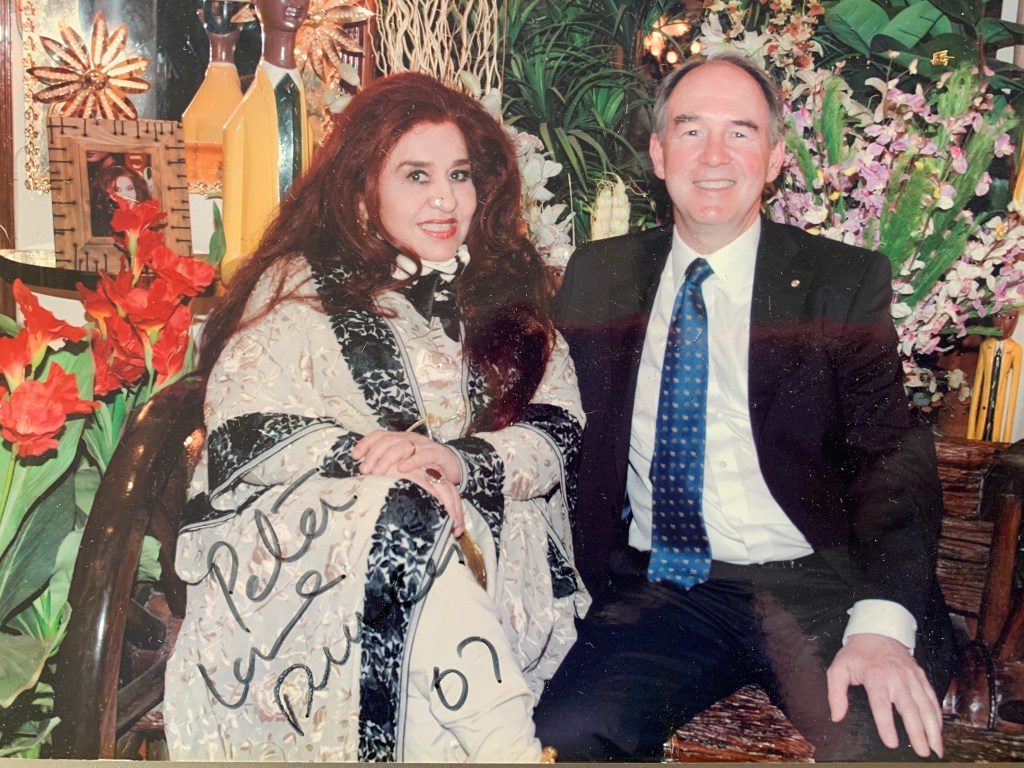
Shahnaz Husain is an extremely colourful and interesting woman who has built a very successful natural beauty business where many of the products are based on ancient Ayurvedic recipes. It is a far cry from the world into which she was born in 1941. Her father was a prominent lawyer and judge and came from a family of lawyers, whereas her mother’s family was related to the Nizam royal family of Hyderabad. Her father was educated at Cambridge in England and was, as was common at that time, a staunch Anglophile. On the other hand her mother had been brought up in a very conservative Muslim household. In fact she wore a veil to her wedding and continued to wear it, much to the disappointment of her father, until one day when they were traveling in her grandfather’s private white train carriage – he was at that time the Governor of Nagpur – her father grabbed her veil and threw it out the window, so that when she alighted from the train she was without “purdah” and never wore a veil again.
Like my story on VP Singhania, Shahnaz was never allowed to go to parties and it was expected she would have little or no contact with boys until she was married. What usually happened, Shahnaz told me, was that her mother and her would go to the party before it had started, hand over their present and return home.
Despite the conservative attitude of her mother, her father was desperate to ensure his daughters received a first rate education. She remembers “… he often used to give me stanzas of Keats and Shakespeare to learn or ask me to compose my own poems. My job was to stand behind him when he was shaving in the morning and recite what I had learnt or written…I have such memories of those times and I know there was a very special and close bond between us. Why he then did what he did has always puzzled me.”
Of course I wanted to know what he did, and I suspect you might too. Her father agreed to marry her off at the age of 15, then the minimum age for a girl to marry. She believes her father regretted his decision until his death. Her husband to be was 10 years older than her and spied Shahnaz arriving and leaving school when he was dropping off one of his young sisters. Apparently her father put up the argument to the father of her husband to be that Shahnaz was too young and he wanted her to be educated to university level. The response was that post marriage Shahnaz could get all the degrees she wanted. And, of course, the final decision was made by Shahnaz’s mother who was worried that, if Shahnaz went to university in England, she would never come back.
Within a year Shahnaz was not only married but had a daughter. Not long after giving birth, her husband was posted to Tehran to head up India’s trade relationships with Iran. Shahnaz decided that, as she had not finished high school and was now living in a foreign country, for her to become a doctor or lawyer as her father intended was just not possible. She decided on the beauty business. She was in the fortunate position to be able to fly to famous beauty destinations together with her daughter and complete beauty courses at schools like Helena Rubenstein in London, Schwartzkopf in Germany and Lean in Denmark. Shahnaz used her knowledge to open beauty schools in Tehran and started to write about beauty in magazines. The business grew quickly and after several years there, Shahnaz and her husband were offered Iranian citizenship. She wrote to her father to tell him what she thought was exciting news. His reply was not as expected. It was full of anger and disappointment, including as Shahnaz told me, words to the effect “… looking at your letter I am suspicious that my blood does not flow in your veins because, if it did, you would never desert your country. We are not a family of deserters, but a family of loyalists.” And he went on to state that if Shahnaz had any respect for her parents she would immediately return home to India. This she did.
Once back in Delhi she started to build a beauty business using all she had learnt from her time in Iran. Needless to say, it has been very successful. Before I end this short extract on the life of Shahnaz I would like to share one story she told me and which has remained with me. Some years after Shahnaz became a well known figure in India, she was chatting with her father and telling him about her recent successes and he asked her whether she had planned for the future. Shahnaz told him that she was young and had many years to plan for that. Her father asked a servant to bring a torch. He switched it on and shone the light in her face and said “Do you see how bright the light is?” Of course she did. He then suddenly switched it off and said “Who knows when there could be a mechanical failure, Shahnaz? Start planning now!”
My abandoned book on the Prime Ministers of South East Asia
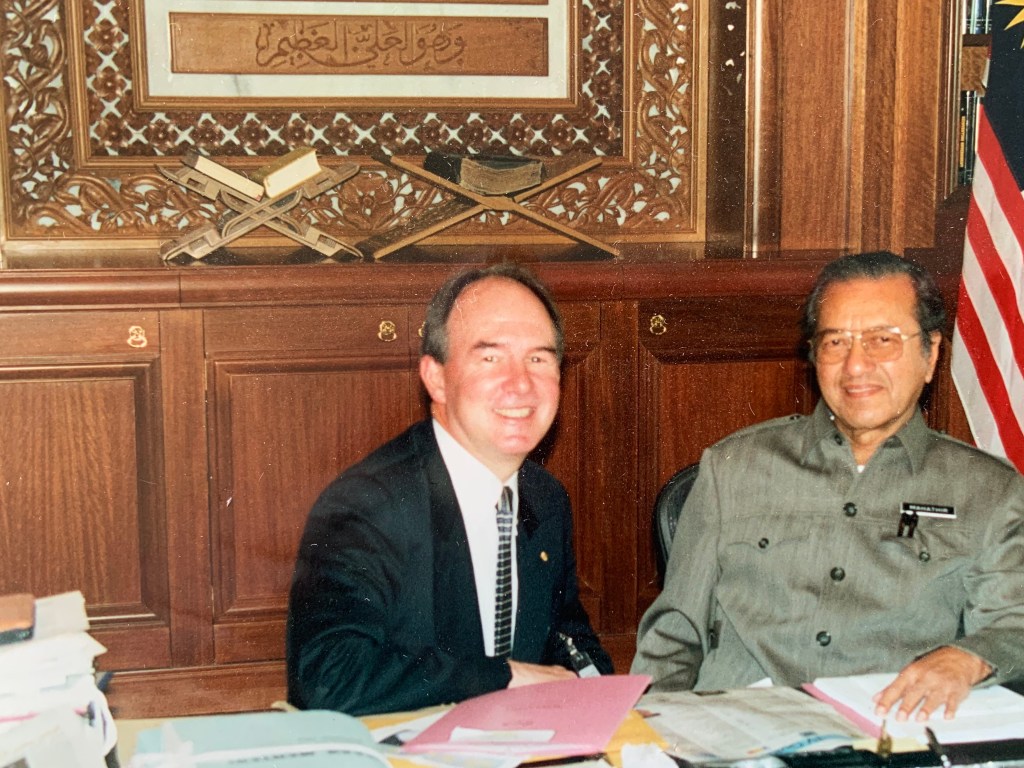
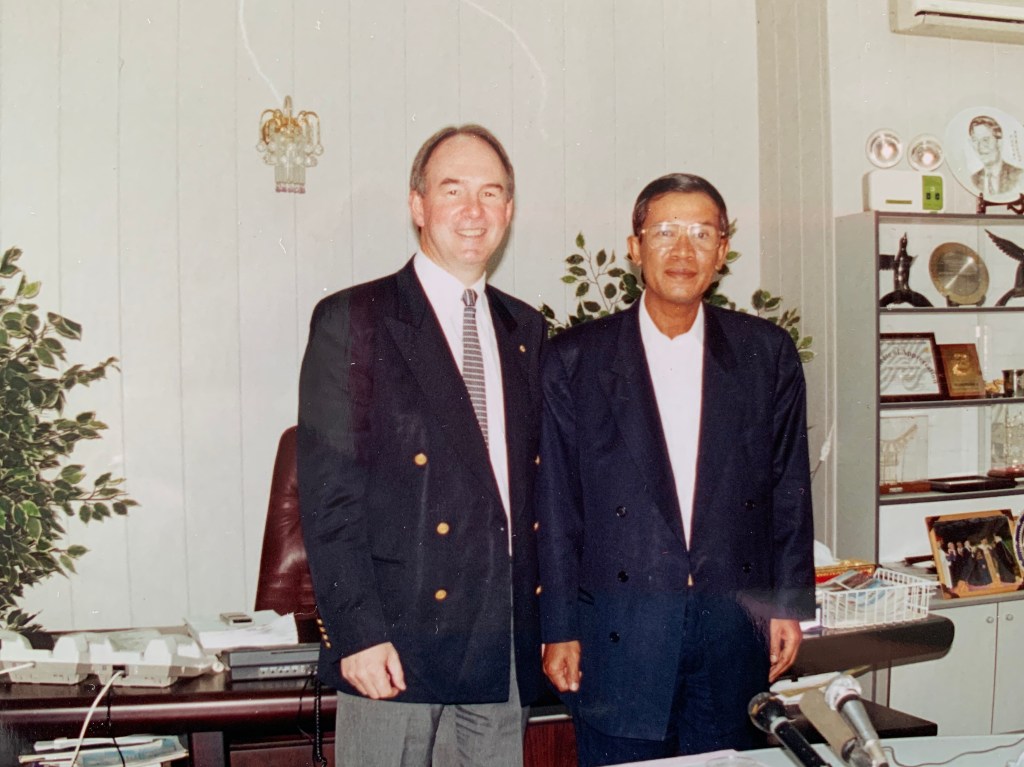
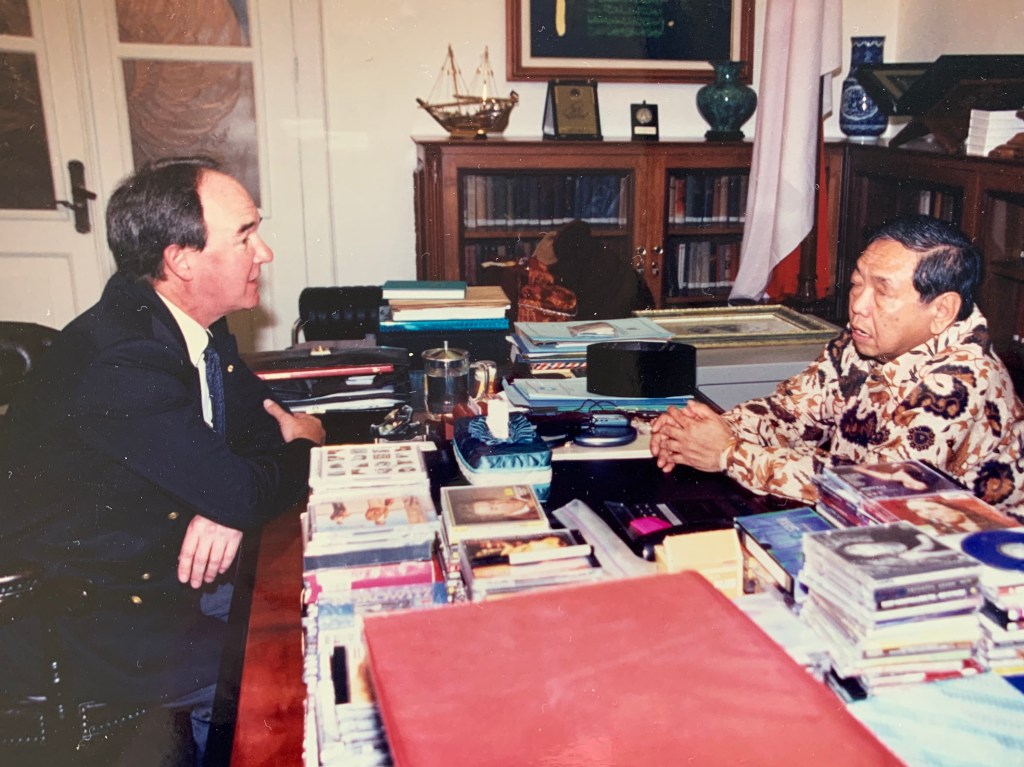
Using this time of self-isolation at home I thought I would spend some time writing up some of the inspirational and interesting stories told to me by fascinating characters I have met over my decades in Asia. Some of these stories are covered in my three life story books on South East Asia and India and some have been told to me by elderly Myanmar citizens for my Myanmar Oral History Podcast.
About 20 years ago I thought it would be a good idea to do a book on the life stories of the then Presidents and Prime Ministers of South East Asia. Combining such an endeavour with my “day job” meant I moved much slower than professional writers. This proved to be a big downside as several of the people I interviewed lost their role as leader before I completed the book and I decided to abandon the project as I figured not many people would be interested in reading a book on immediate past Presidents and Prime Ministers. There is only one leader who was a leader in 2000 and is still a leader now and that is Prime Minister Hun Sen of Cambodia. However there is, of course, Tun Mahathir bin Mohamad of Malaysia who lost his Prime Ministership in 2003 but surprisingly came back to lead the country again from 2018 until a few months ago.
Most of my story today will be about Prime Minister Hun Sen but I thought you might find one part of my meeting with Mahathir of interest. Anyone who can come back as Prime Minister at the age of 93 – he was born in 1925 – has to be exceptional. Through media coverage, many of you would have heard him speak in the last couple of years and would not only have been impressed with his mind, but also his physical well-being. When I interviewed him for my aborted book project, he would have been a mere 75. Much of my interview was taken up in going through his many achievements over those years and I knew well that he is someone who makes every minute of every day count. He is the sort of person who on a short 30-minute flight within Malaysia can write articles or sections of the many books he has written. He is also a gifted orator. I have been present in an auditorium full of young students and, within minutes, he has them all “eating out of his hand” and prepared to do whatever he asks of them. My meeting took place in the Prime Minister’s office in Putrajaya, the administrative capital of Malaysia just outside Kuala Lumpur. It is an enormous office (bigger than any other I have seen) and I would say the width of his desk is at least 2 1/2 meters so I could not see anything on his side of the desk. At the end of my meeting I asked the Prime Minister if he would mind if I had a photo with him to which he kindly agreed. I went around to his side of the desk and, for some reason, the Prime Minister decided to stay seated so I decided to kneel on the floor so I would be about the same height as him which you can see in the attached photo. After the photo was taken, I could not help but look down at the papers he had in front of him and noted to my surprise he had the newspaper or some other guide open as to what was on TV that evening. I burst out laughing and said, “Mr Prime Minister, I am pleased to see that you are not all work and no play.” I am pleased to say he too laughed.
I also had the pleasure of interviewing President Abdurrahman Wahid of Indonesia. As some of you would know he was almost blind and was known to the world by his nick name “Gus Dur” which derives from “bagus” meaning “good” and an abbreviation of his family name. I met him several times before he became President and I always found him to be a humble and kind man. I have attached a photo of my meeting with him and, if you look closely, you will see many music CD covers as he used to listen to music a lot between meetings and rely more on oral briefings as his eyesight was so poor.
This leads me to my story of my meeting with Prime Minister Hun Sen. There are many stories which flow from the meeting but there is only space in this short note for one. Often, but not always, there will be a pre meeting with the Prime Minister’s or President’s staff at which they will cover things they feel you should know. This one was different to any other I have had. The first thing they told me was to be aware the Prime Minister had quite a temper and there could be no telling whether I would be with him for 5 minutes or 2 hours so to be prepared for anything. The second thing they told me was under no circumstances to ask him about his glass eye.
And so, into the meeting I went – see photo. It started off being in Khmer, the national language. This meant we had a translator translating my questions and his answers. Understandably this really slows things down and makes the whole conversation quite stilted. I knew a few things about Hun Sen, including that he loved playing golf and that he spoke quite reasonable English. I turned the conversation to golf, and he became quite animated and pulled out his membership cards of a golf club in Paris and one in Phnom Penh. Not surprisingly the local club gave him an extremely high handicap (meaning he would be difficult to beat in Phnom Penh – and who wants to beat a Prime Minister anyway) whereas the Paris one gave him a much lower handicap. He thought the French were most unfair.
As the conversation was going well, I asked him if we could switch to English to which he agreed. We chatted on happily for another half an hour or so and I had pretty much everything I needed and decided to take a big risk and asked him “What is the story about your glass eye?” I could feel his Khmer advisers literally tense up and I prepared for the meeting to come to a very abrupt end. However, he must have been in an extremely good mood for he responded immediately “Let me tell you what happened.”
Hun Sen was part of the murderous Khmer Rouge army but fled to Vietnam along with some of his men in 1977 when he could see how the Khmer Rouge leaders were starting to turn on each other and he knew he was at risk of being killed himself. He realised that only the Vietnamese had the strategic interest and power to defeat the Khmer Rouge which they ultimately did on 7 January 1979. That same day Hun Sen was appointed Foreign Minister by the Kampuchean People’s Revolutionary Council which took control. The rest, as they say is history, and he has been de facto head of the Cambodia since 1985.
But back to 16 April 1975, the night before the Khmer Rouge captured Phnom Penh and forced all of its inhabitants to leave their homes and possessions and walk into the countryside where they would spend the next four years working and dying as peasants. Hun Sen was, at this time, a Corporal in charge of a section of some seven men. His battalion was based less than ten kilometres outside Phnom Penh and his orders that evening were to take his men and attack a Nationalist Army camp just outside Phnom Penh. This involved them swimming across a river and then attacking the camp which he was told was two kilometres away. However, when they got to the river, they could see the army camp was less than a kilometre on the other side. He said “We were using very old French maps and clearly the river had changed its course since the map was made. I radioed back to headquarters and asked what we should do as I said if we swam across the river we would surely be spotted by the enemy’s scouts. HQ’s response was clear that we should continue as planned. This was the army and we had no choice. As I guessed would happen, when we were mid-way across the river we were indeed spotted and the enemy open fired. Some of my men were injured by the gun fire but we all made it across. As I was climbing up the river bank a shell hit a coconut tree near me and some shrapnel ricocheted into my eye. I can remember grabbing the field radio and telling HQ we had injuries and to send urgent assistance. The next thing I knew was that I woke up in an army field hospital where they were taking out my injured eye without anaesthetic and putting in a marble as its replacement.” At this point I looked him in the eye and said “Well, whoever did the operation that night, Prime Minister, has done an excellent job on your eye as I can’t tell which is the artificial one.” He laughed and pointed to his artificial eye and said, “Oh no, that was long ago and this is a Japanese eye!” It was the perfect point to end the meeting.
Vijaypat P Singhania
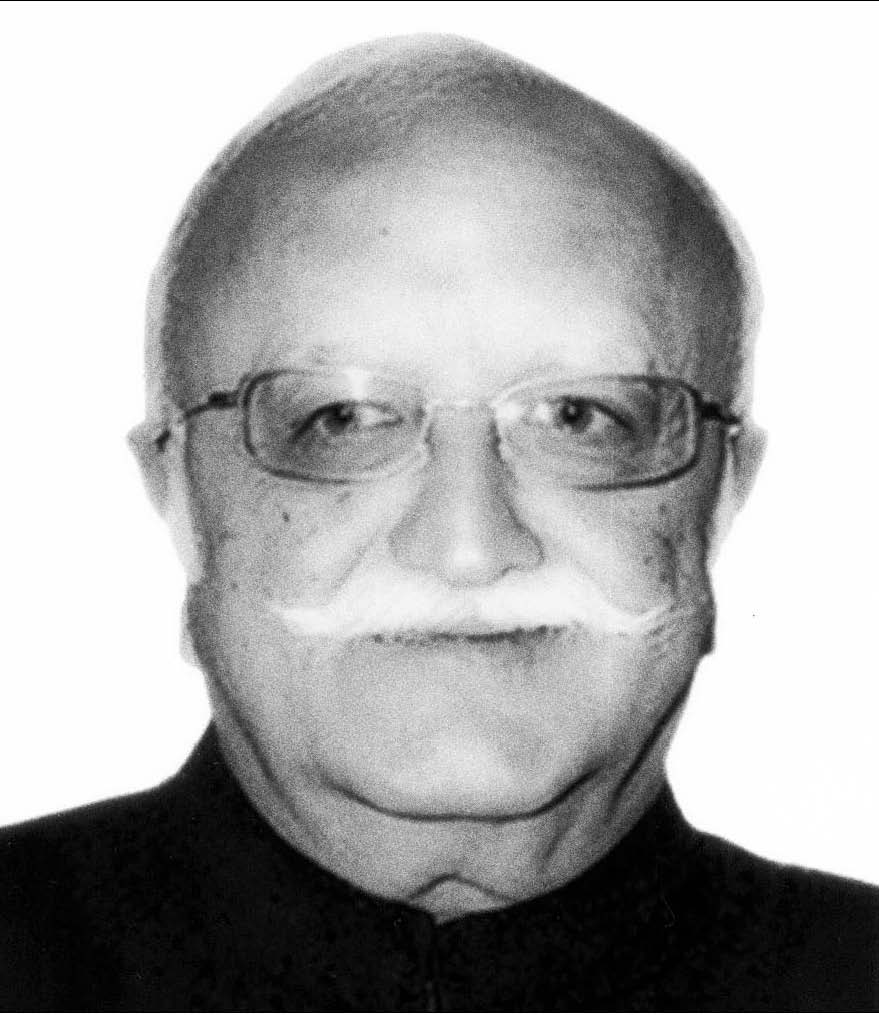
Using this time of self-isolation at home I thought I would spend some time writing up some of the inspirational and interesting stories told to me by fascinating characters I have met over my decades in Asia. Some of these stories are covered in my three life story books on South East Asia and India and some have been told to me by elderly Myanmar citizens for my Myanmar Oral History Podcast.
The last two stories in these posts have been about individuals who started life with little. I thought you might be interested to read a story about someone who started life with the opposite. It is the story of Vijaypat P Singhania (known to most as “VPS”) and who is a Facebook friend. But before I delve into his life, I would like to provide some historical and social context for those of you unfamiliar with India. The Singhania’s origins are in the village of Singhana in Rajasthan; an area famous for its fierce inhabitants and most of whom have lived hand to mouth in its unforgiving land for centuries. There are two main ethnic groups in Rajasthan are the Marwaris and the Merwaris. The Marwaris are made up of an equal mix of the warrior caste Kshatriyas and merchant traders. Many Marwaris over the centuries left the barren lands of Rajasthan for the cities and have excelled in business. VPS’ Raymond Group is one such example.
By the time VPS was born in 1938 the family had been extremely wealthy for generations. The wealth came predominantly from textiles. They made a fortune during both World Wars producing, not only military uniforms for the British, but a wide range of other equipment and food such as tents and cashew nuts. VPS’ uncle was knighted by the British Government for his services during WW2.
And so, VPS was born into a life, not only of wealth, but prestige given that the wealth had become “old”. But he was not a happy child. His mother died when he was four and, not long after, his father remarried to a woman who VPS describes as the classic “wicked stepmother”. Apparently, she used to beat him and his brother several times a day and frequently moved VPS and his brother between schools. VPS told me “we never visited friends outside of school and they never visited us. A watchman used to take us to school and bring us home.” To think of going to a movie or a restaurant was out of the question. VPS lived in what is known as a “joint family” where it is common for parents, sons and their families to all live together. After he came home from school he and his cousins would wash and then sit together with guardian teachers and tutors to do their homework and for more lessons. These teachers taught the children to refer to their cousins as “brothers”, reinforcing the Hindu joint family concept.
When he was only 12 his father arranged for him to marry a young girl from Calcutta who reminded his father of VPS’ mother. VPS was never told of this by his father although his cousins teased him about it. The first he formally knew of the marriage was when the two-week marriage ceremony started in 1956. He tragically told me he never managed to have a relaxed and friendly chat with his father right up to the time he passed away. Sadly, VPS’ formal and reserved upbringing has carried through to his relationship with his own children and he emotionally told me “the first time I knew what the four-letter word ‘love’ meant was when I saw my first granddaughter.”
But back to what he did with his life post childhood. His father made him study commerce and economics as it was expected he would go into the family business to which he felt most unsuited as his passion lay more in the area of maths and science. Unhappily he joined the family business. Around this time, he developed what he says became an addiction or obsession with flying and which eventually took priority over everything else. He told me “In flying maybe I was seeking to escape the reality of a broken home… I know when I was in the sky that I found temporary solace that allowed me to reconcile myself to the life I led on the ground.” Over the years he learned to fly every commercial aircraft available in India, flew a microlight from London to New Delhi and had the world record for the highest hot air balloon ascent. But one story from that era stands out for me. He wanted to fly a Boeing 737, but Indian Airlines would not let him train on its simulator. That was no problem for VPS as he travelled to Miami and trained there, gaining a US licence to fly 737s with a Captain’s rating. On his return to India he asked the Director General of Aviation to recognise his US licence and allow him to fly in India. The Director General refused. This was a big mistake! VPS was able to point out that, if India did not recognise US licences, then the US would not recognise Indian licences, thereby meaning Indian Airlines could not fly to the US. The DG backed down.
I am sure you will find it difficult to believe what I am about to tell you. The years went by and, in due course, VPS became a very hard working and successful Chairman of Raymond. That makes sense. But, at the same time, VPS became a commercial pilot for a number of Indian airlines. Given who he was, the airlines would give him early morning flights out of and back to Mumbai, where a car would meet him and take him to the office. He admits he fell asleep at more than one Board meeting he was chairing. He kept this up until 1998 when under Indian regulations he could not fly commercially over the age of 60.
When I last had lunch with VPS in Mumbai a few years ago, on parting I said I hoped he would be able to reconcile with his family. I am sure this is what he, above all, wishes for too.
Captain GR Gopinath
Using this time of self-isolation at home I thought I would spend some time writing up some of the inspirational and interesting stories told to me by fascinating characters I have met over my decades in Asia. Some of these stories are covered in my three life story books on South East Asia and India and some have been told to me by elderly Myanmar citizens for my Myanmar Oral History Podcast.
Continuing with theme of those with a military background is the life story of Captain GR Gopinath (known as ‘Gopi’ to most). Like many Indian life stories Gopi’s starts in the early 1950s in a small village called Gorur about four hours west of Bangalore. There were eight children in the family and his father was both a schoolteacher and a farmer. Each morning he would go to the fields at daylight, until it was time to catch the bus to school. He would return home around 5.30 and, after dinner, he would spend time teaching each of his children. He never once complained of his “boring” and monotonous life and explained to Gopi that he was comforted by a view of Bertrand Russell that a large part of education must be to teach people to accept boredom, because that is the reality for most lives.
But not for Gopi. One day while he was still in primary school the headmaster came into the class and announced there was a scholarship for a military boarding school and asking if anyone was interested. Gopi’s hand shot up and he found he was the only one interested. He says there is a poem in his local language of Kannada which inspired him. It roughly translates that there is life beyond the village temple and its neighbouring woods, and one should “go for it”. There was a catch that the exam was in English and, at that time, Gopi only spoke the local language. He naturally failed. It was here that fate played its hand. The headmaster pointed out to the military authorities that, if they wanted bright young Indians in the military, to only test in English would cut out a huge number of potential candidates. They allowed him to take the test in Kannada which he passed. Very few people in his village ever left and so the whole village came to see him off. His father accompanied him on the first eighteen-hour bus and train trip to Bijapur and Gopi remembers his father sitting next to him reading passages from the trial and death of Socrates and talking to him about Gandhi.
Of the students who attended the military school only three made it into the National Defence Academy, India’s equivalent of West Point or Sandhurst. Gopi graduated as an officer and promptly found himself in the 1971 war with Bangladesh and Pakistan. He hated the senselessness of war and exited the military after eight years and returned to his village without any plan for his life. His parents were extremely embarrassed. Virtually no one in the village had the opportunity to leave and here was Gopi as a young Captain with a stellar career ahead of him quitting. And worse than that he had no plan as to what he was going to do next.
There are many fascinating stories of what Gopi did do next, but I would like to conclude with the one that started his business career. Gopi eventually decided after hanging around the village for months he wanted to be a farmer. His father and uncles begrudgingly provided him some remote family land the Government had given them and had never been farmed. Gopi moved there with a tent, a Doberman dog and a Dalit boy (the lowest Indian Hindu caste) who worked in the family home. He decided to go into silkworm farming and for that to grow mulberry trees to feed silkworms. However, he had no money. He worked hard improving the land but was going nowhere. One day the local bank manager came to see this eccentric man who everyone was talking about. He was impressed with what Gopi wanted to do and helped him prepare a loan application which was approved, subject to him providing collateral which he did not have. So, everything ground to a halt. But one day he says Manje Gowda, an old man with a neighbouring piece of land, came to see him. He told Gopi he had heard stories that Gopi needed collateral and offered his own title deeds as security. Manje said the reason he was prepared to do this was because Gopi’s hard work, frugal lifestyle and use of ecological techniques were wonderful examples for his children and he could tell he could trust Gopi to honour his obligations. Within a few years of receiving the loan, Gopi became the largest silkworm producer in the State and won the prestigious Rolex Award for Enterprise based on his ecological farming. Now, he could really “go for it” and which Gopi has certainly done over the years as a serial entrepreneur.
 Peter Church blog